Women In Pharma Quality Control: Challenges And Opportunities
Women lead pharma QC on the ground but rarely at the top. Here's an honest look at the barriers, the breakthroughs, and what must change.


Every time a patient swallows a tablet or receives an injection, there is an invisible layer of protection working behind the scenes and that layer is Quality Control.
Pharma Quality Control, commonly known as QC, is the department responsible for testing raw materials, monitoring manufacturing processes, and ensuring that every product leaving a facility is safe, effective, and meets regulatory standards.
It is one of the most critical functions in the entire pharmaceutical industry. And increasingly, it is a space where women are not just present, they are leading.
Women have steadily carved a powerful presence in pharmaceutical Quality Control over the past few decades. From laboratory analysts to QC managers and regulatory compliance heads, their contributions have shaped the safety standards of medicines that reach millions of people worldwide.
Yet despite this growing presence, women in this field continue to face challenges that often go unspoken. At the same time, the industry is opening new opportunities for women who are ready to take them. This article explores both sides of that story, honestly and practically.
Understanding The Role Of Women In Pharma QC Today
The pharmaceutical industry is one of the more gender-balanced sectors in science and technology. Studies and industry reports consistently show that women make up a significant portion, often more than half of the entry-level and mid-level workforce in pharma QC roles. Women are frequently found in positions such as:
- QC Analyst
- Microbiologist
- Stability Scientist
- Validation Specialist
- Documentation Officer
These are roles that demand precision, attention to detail, strong scientific knowledge, and a commitment to process integrity, qualities that women in this field demonstrate at the highest levels.
What makes this remarkable is that Quality Control is not a passive function. QC professionals have the authority to reject batches, halt production, and flag compliance concerns, they hold real power over the safety of life-saving products. Women in QC are exercising that power every single day, though they often do not receive the recognition this responsibility deserves.
However, when we move up the organizational ladder, the picture begins to shift. Senior QC leadership, director-level positions, and cross-functional quality assurance roles are still largely occupied by men in many organizations. This gap between representation at the operational level and representation at the leadership level is one of the most important challenges the industry needs to address.
The Real Challenges Women Face In Pharma Quality Control
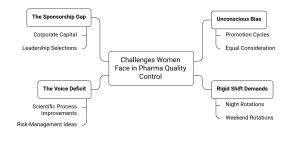
The challenges women encounter in pharma QC are not imaginary. They are structural, cultural, and sometimes deeply personal. Understanding them clearly is the first step toward changing them.
1) Unconscious Bias In Hiring And Promotion — One of the most common challenges is the persistence of unconscious bias during hiring and promotion decisions. Even when a woman has the qualifications, the track record, and the skills to step into a senior QC role, decision-makers may unconsciously favor candidates who fit a traditional profile. This means that women sometimes have to work harder and prove themselves more thoroughly than their male counterparts just to be considered for the same opportunities.
2) Work-Life Balance And Shift Demands — Work-life balance is another significant pressure point. Pharma QC is not a nine-to-five world. Manufacturing plants operate around the clock, and QC professionals are often required to work in shifts, including night shifts and weekends.
For women who are also managing caregiving responsibilities at home, whether for children or elderly family members, this kind of schedule creates a disproportionate burden. Many women in the industry report having to make difficult choices between advancing their careers and managing their personal lives, a tension that men in equivalent roles rarely face to the same degree.
3) Not Being Heard In Male-Dominated Spaces — There is also the challenge of navigating a scientific environment that has historically been male-dominated at the decision-making level. When women bring new ideas to QC settings, whether about process improvements, documentation practices, or risk management, those ideas are not always received with equal weight. Being heard and being given credit for intellectual contributions remains a lived reality that many women in pharma QC quietly deal with.
4) The Mentorship Gap — Mentorship is another gap. Women who are earlier in their careers often struggle to find mentors and sponsors who actively guide them, advocate for their promotion, and help them build strategic visibility within their organizations.
Without this kind of support, talented women frequently plateau or leave the industry entirely, representing an enormous loss of expertise and potential for the companies that fail to retain them.
Women are entering life sciences in greater numbers than ever before, yet leadership representation continues to lag behind.
Understanding where progress is happening and where barriers still exist provides important context for the challenges faced by women across pharmaceutical quality functions.
→ Read: Women In Biopharma Leadership: Progress Or Plateau?
The Opportunities That Are Opening Up Right Now
Despite the challenges, this is genuinely an exciting time for women in pharma Quality Control. The industry is changing, and many of those changes are creating real, tangible opportunities.
Regulatory bodies and international health organizations are placing stronger emphasis on diversity, equity, and inclusion in the pharmaceutical sector. This is not just a social conversation, it is increasingly tied to corporate governance standards and investor expectations. Companies that fail to demonstrate inclusive hiring and leadership practices are being held accountable.
This external pressure is driving internal change, and the result is more intentional investment in programs that support women's advancement in technical and quality roles.
The digital transformation of pharma QC is also creating new pathways for women to lead. As Quality Control increasingly incorporates the following technologies, professionals with strong analytical and systems thinking skills are becoming more valuable than ever:
- Data analytics for trend monitoring and batch release decisions
- Artificial intelligence for defect detection and anomaly flagging
- Electronic batch records replacing paper-based documentation
- Automated testing platforms reducing manual error and speeding up results
Women who upskill in these digital QC competencies are positioning themselves at the cutting edge of the industry's evolution. There is also growing momentum around women's leadership programs within major pharmaceutical companies.
Organizations like Pfizer, Novartis, AstraZeneca, and several Indian pharma majors have launched structured mentoring programs, leadership accelerators, and internal networks specifically designed to develop women for senior roles in quality, regulatory affairs, and operations.
These programs are producing real results, with measurable increases in the number of women reaching director and VP-level positions in quality functions.
The rise of remote and hybrid work models in non-manufacturing QC functions such as regulatory documentation, quality systems management, and compliance auditing is also reducing some of the structural barriers that have historically made it harder for women to stay in the field during demanding personal phases of life.
Flexibility, when offered thoughtfully, allows women to remain engaged and advance without being forced to choose between their career and everything else.
Supporting women in pharma goes beyond representation.
Long-term progress depends on inclusive leadership, equitable growth opportunities, and a workplace culture that enables talent to succeed.
→ Read: Diversity And Inclusion In Pharma Leadership: Best Practices
What The Industry Must Do Differently?
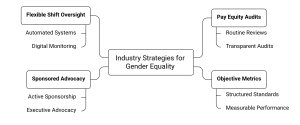
Progress is real, but it is not automatic. For women in pharma Quality Control to truly thrive, organizations need to take deliberate action rather than waiting for change to happen on its own.
Companies must look at their promotion data honestly. If women are entering QC roles in large numbers but are not advancing at the same rate as men, that is a signal that something in the organizational culture or process needs to change. The following practical steps can make a meaningful difference:
- Conduct transparent pay equity audits to identify and close compensation gaps between men and women in equivalent QC roles.
- Define structured promotion criteria so that advancement decisions are based on clear, measurable performance standards rather than subjective judgment.
- Mandate inclusive leadership training for all managers in quality functions, with a specific focus on recognizing and countering unconscious bias.
Mentoring programs need to go beyond informal support and become formal, sponsored advocacy. A mentor gives advice, but a sponsor actively uses influence to open doors. Women in QC need more sponsors, senior leaders willing to say, in the rooms where decisions are made, that this person is ready for more.
Organizations should also rethink how they structure QC shifts. Where automation and digital monitoring allow for flexible oversight, those options should be explored. Supporting women through parental leave, offering return-to-work programs, and building a culture where career breaks are not treated as disqualifying are practical ways companies can retain the talent they have invested in developing.
Conclusion: A Future Worth Building
Women in pharma Quality Control are doing extraordinary work in a field that directly protects human health. They bring scientific rigor, ethical commitment, and precision to every test, every batch record, and every compliance decision. The challenges they face are real, but so is the growing recognition that the industry cannot overlook their talent and leadership potential.
The future of pharmaceutical Quality Control will be defined by professionals who handle complexity, embrace innovation, and uphold the highest safety standards. Women are already proving every day that they are exactly those professionals. The opportunity now lies in building an industry that fully reflects and rewards that reality. The medicines of tomorrow deserve nothing less.
FAQs
1. Why Are Women Playing An Increasingly Important Role In Pharma Quality Control?
Women have established a strong presence across pharmaceutical Quality Control functions, including laboratory testing, microbiology, validation, stability studies, and compliance management. Their work helps ensure that medicines meet strict quality, safety, and regulatory standards before reaching patients. As the industry continues to grow, more women are taking on leadership responsibilities and contributing to critical quality decisions. Their expertise plays a vital role in maintaining product integrity and protecting public health.
2. What Challenges Do Women Commonly Face In Pharma Quality Control Careers?
Many women in pharma QC face challenges such as unconscious bias in hiring and promotions, limited access to mentorship opportunities, and difficulties balancing shift-based work with personal responsibilities. Representation in senior leadership positions also remains lower than at entry and mid-career levels. These challenges can sometimes slow career progression despite strong performance and qualifications. Addressing these barriers requires both organizational commitment and supportive workplace policies.
3. What Opportunities Are Emerging For Women In Pharma Quality Control?
The increasing adoption of digital technologies, data analytics, automation, and AI in Quality Control is creating new opportunities for women to develop specialized skills and advance into leadership roles. Many pharmaceutical companies are also investing in diversity initiatives, mentorship programs, and leadership development pathways designed to support women's career growth. Flexible work arrangements and evolving workplace practices are helping improve career sustainability for many professionals. These developments are opening new avenues for women to contribute, lead, and shape the future of pharmaceutical quality management.
Reporting on the science, business and regulation shaping the pharmaceutical industry.
More in HR in Pharma
All articles →
Crisis Management: HR's Role in Business Continuity in the Pharmaceutical Industry

Top HR Strategies for Successful Pharma Mergers: People, Culture, and Integration 2025

Discussion