Women In Biopharma Leadership: Real Progress Or A Hidden Plateau?
Women lead 52% of biopharma's workforce but barely 24% of its C-suite. The leadership gap is real, persistent, and hiding in plain sight.


The biopharmaceutical industry stands at the crossroads of cutting-edge science, global health impact, and innovation-driven growth. Yet, behind the scenes, one of its most persistent challenges remains the uneven representation of women in leadership roles.
Over the past decade, biopharma has been vocal about its commitment to gender equity, diversity, and inclusion, but the real question today is whether the sector is still progressing or quietly plateauing.
In 2023, women represented 52% of the overall biopharma workforce, a number frequently cited to demonstrate strong entry-level parity. But the illusion of balance dissolves quickly when you climb the leadership ladder.
Women held only about 24% of C-suite roles in global life sciences companies last year, and merely 10–12% of CEO positions. Even more concerning, many progress indicators have remained stagnant over the last three to four years, suggesting that the pipeline despite being well-stocked with talented women, thins dramatically at mid-career and senior levels.
As the industry faces mounting pressure to accelerate drug discovery, expand access, and navigate economic uncertainties, leadership diversity becomes more than a moral or social objective, it becomes a strategic necessity.
Against this backdrop, it’s worth asking: Are women still advancing steadily into biopharma leadership, or has the industry hit a ceiling masked by corporate optimism?
This blog explores that question through today’s realities, emerging data, and the human experiences shaping the leadership journeys of women across biopharma!
A Shifting Landscape: Why Women Are Entering Biopharma in Higher Numbers than Ever?
One clear sign of progress is the strength of the talent pipeline. Over the past decade, women have been graduating in STEM and life sciences at record rates. In the U.S. and Europe, women now represent nearly 60% of life sciences graduates, and many are entering biopharma early in their careers.
This strong foundation has helped the sector maintain one of the most gender-balanced entry-level workforces compared to other science-driven industries like tech or engineering.
Several factors continue to draw women into the biopharma space:
a) Purpose-Driven work — Biopharma’s mission, improving and saving lives, resonates strongly with women entering the STEM workforce. Surveys show that close to 70% of female graduates cite purpose and societal impact as key motivators for choosing life sciences roles.
b) Increasing Visibility Of Women In Scientific Roles: The pandemic amplified the contributions of women scientists, clinical researchers, regulatory experts, and epidemiologists. For many early-career women, this visibility has reinforced the idea that the industry values scientific rigor and thought leadership regardless of gender.
3) Flexible Work Options Becoming Mainstream: Post-2020, biopharma companies were among the fastest to formalize remote or hybrid policies. Women report 30–40% higher retention in workplaces offering structured flexibility, making biopharma more appealing compared to historically rigid clinical or laboratory environments.
Despite these positive trends, the challenge lies not at the point of entry but in retaining and advancing women into decision-making roles.
The Mid-Career Bottleneck: Where Women’s Leadership Trajectory Begins To Narrow?
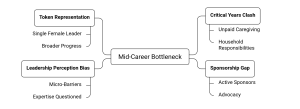
Although women enter the industry in strong numbers, a consistent and troubling pattern emerges between years 7 and 14 of their careers. This is the stage where managerial, departmental, and strategic leadership roles become accessible but it is also where many women exit the leadership pipeline.
The reasons for this bottleneck are layered and often interconnected:
1) The “Critical Years” Clash: Mid-career progression often overlaps with life-stage responsibilities such as caregiving, parenting, and household management, roles women continue to disproportionately shoulder globally. Data from 2024 shows that women in biopharma spend nearly 1.8x more time on unpaid care work than men, creating friction between personal responsibilities and leadership expectations.
2) The Sponsorship Gap: While mentorship is common in the industry, sponsorship, active advocacy from senior leaders is far less accessible to women. Only 18% of women in biopharma report having a sponsor, compared to around 32% of men. Without sponsorship, high-visibility projects and accelerated advancement remain out of reach.
3) Bias In Leadership Perception: Women consistently face bias around scientific authority, decision-making style, and leadership presence. Recent studies show that nearly 40% of women scientists report being questioned about their expertise more than male peers, even at similar competence levels. These micro-barriers compound over time, slowing career velocity.
4) The “One Woman On The Panel” Effect: When companies highlight a single female leader repeatedly across events, committees, or PR campaigns, it creates a false sense of gender progress internally. Meanwhile, the broader leadership composition remains unchanged, and younger women struggle to identify realistic role models.
The mid-career bottleneck isn’t just a talent loss, it’s a strategic leak that hinders innovation, continuity, and organizational resilience.
The pipeline looks full until you check where it breaks.
Pharma's talent gap is a forecasting failure hiding in plain sight.
→ Read: The Growing Talent Gap In Pharma: And the Forecasting Models That Can Fix It
Numbers Tell The Story: What The Latest Data Says About Biopharma’s Progress?
While progress is undeniable, data reveals a more nuanced and sometimes sobering picture of gender representation in biopharma leadership.
Here are some critical statistics shaping today’s landscape:
- 52% of the global biopharma workforce is female, but
- Only 35–38% reach director-level roles.
- Only 24% of C-suite leaders are women.
- Just 10–12% of biopharma CEOs are women, depending on the region.
- Women lead less than 15% of R&D organizations across major pharma companies.
- Women of color represent less than 5% of senior leadership roles, a number that has not shifted meaningfully since 2019.
- In VC-backed biotech, women founders secured just about 2% of total funding in 2023, one of the lowest levels in the decade.
Between 2020 and 2023, the share of women in senior roles grew by only 2–3 percentage points, suggesting a clear slowdown. The pandemic initially boosted flexibility, enabling more women to stay in the workforce, yet it also intensified pressures that made leadership advancement more challenging.
These numbers suggest that while representation at lower levels remains strong, the real barriers lie in ascending to influential, capital-intensive, science-led, or high-pressure leadership domains.
The Rise Of Inclusive Leadership: A Turning Point Or A Temporary Shift?
One of the most promising signs for women in biopharma leadership is the increasing emphasis on inclusive leadership models. Traditional top-down hierarchies are gradually giving way to collaborative, empathetic, cross-functional leadership styles, traits often associated with improved gender diversity.
Organizations implementing inclusive leadership practices have reported:
- 30% higher employee engagement,
- 22% stronger innovation performance, and
- up to 40% better retention rates among women leaders.
More women today are being recognized for leading high-impact teams, managing complex clinical programs, scaling scientific operations, or driving global market expansions through inclusive, people-first approaches.
Leadership behaviors such as emotional intelligence, strategic empathy, and collaborative decision-making, skills that women are frequently (and often unfairly) required to over-demonstrate are now gaining appreciation as assets rather than deviations from traditional executive norms.
However, the concern is whether these changes will remain permanent. Some organizations adopted inclusive leadership frameworks under social or investor pressure during 2020–2022. With shifting economic priorities in 2024–2025, companies must choose whether to maintain these commitments or revert to old leadership molds that historically excluded women.
The next two to three years will determine whether inclusive leadership becomes a defining feature of biopharma culture or a temporary trend supported only during a period of heightened diversity awareness.
Inclusive leadership doesn't fail quietly, it collapses under fatigue.
Here's the hidden risk draining pharma's transformation from the inside.
→ Read: Leadership Fatigue In Pharma: The Hidden Risk Undermining Continuous Transformation
What Companies Can Do Now: Practical Pathways To Break The Plateau?
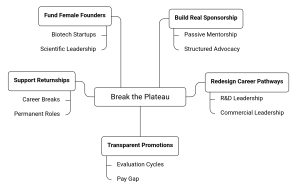
If the industry wants to avoid stagnation, it must transition from awareness to structural change. Today’s most progressive organizations are not only setting quotas or forming committees, they are redesigning the rules of advancement.
Key actions shaping the future include:
1) Building Real Sponsorship, Not Symbolic Mentorship: Companies introducing structured sponsorship programs have seen 2x higher promotion rates for women into VP-level roles. The shift from passive support to active advocacy is proving transformational.
2) Redesigning Career Pathways In R&D & Commercialization: Women remain underrepresented in scientific leadership roles, partially because career ladders in these functions remain inflexible. By creating multiple entry points into leadership such as technical, operational, strategic, companies broaden the pool of potential female leaders.
3) Closing The Pay & Promotion Gap With Transparent Processes: The pay gap in biopharma is smaller than in many industries but still stands at 10–15% at senior levels. Transparent promotion criteria and structured evaluation cycles have helped some companies reduce this gap by half.
4) Supporting Women Returning From Career Breaks: Returnship programs in biopharma have shown over 85% conversion into permanent roles, particularly in clinical ops, regulatory affairs, and medical functions. This addresses a major mid-career dropout point.
5) Investing In Women-Led Innovation: Only a sliver of biotech funding goes to women founders. Some investors and pharma companies are now building dedicated funds or partnering with women-led startups, an essential step to diversify scientific leadership beyond corporate roles.
With these initiatives, biopharma can transform an uneven playing field into a sustainable leadership ecosystem.
Conclusion: A Future That Depends On Momentum, Not Assumptions
The question — progress or plateau? — does not have a simple answer. The sector has made meaningful progress in building a strong early-career pipeline and elevating the visibility of women in scientific and operational roles. Yet the data makes it clear that advancement into senior leadership is not keeping pace with industry growth, corporate commitments, or the sheer volume of qualified women in the workforce.
The future of women in biopharma leadership depends on whether companies choose to maintain momentum or grow comfortable with symbolic progress. Real transformation requires intentional, measurable action, building sponsorship pathways, redesigning leadership models, ensuring equitable access to high-impact roles, and funding women-led innovation.
Biopharma sits at a moment where science is accelerating faster than ever and global health challenges are becoming more complex. To meet this moment, the industry doesn’t just need more leaders, it needs diverse leaders who reflect the world it aims to heal. Women are not just part of that future; they are essential to it.
FAQs
1. Why Does The Leadership Gap Persist Despite Strong Female Representation At Entry Levels?
Although women make up more than half of the biopharma workforce and nearly 60% of life sciences graduates, their presence drops sharply as roles become more senior and strategically influential. This disconnect stems from mid-career bottlenecks, sponsorship gaps, and biases that slow advancement despite a strong talent pipeline. The persistent drop-off suggests systemic barriers, not a lack of qualified women, continue to shape leadership trajectories.
2. What Makes The Mid-Career Stage The Most Critical Turning Point For Women In Biopharma?
Between years 7 and 14 of their careers, women encounter overlapping pressures: caregiving responsibilities, higher leadership expectations, and limited access to influential sponsors. These factors converge precisely when decision-making roles open up, creating a bottleneck that disproportionately impacts women. The result is a thinning pipeline that affects senior-level diversity years later, even when early-career representation appears balanced.
3. Are Current Industry Efforts Enough To Prevent A Plateau In Women’s Leadership Representation?
While companies have launched initiatives such as flexible work models, DEI commitments, and inclusive leadership programs, the overall pace of advancement has slowed to just 2–3 percentage points in recent years. This indicates that awareness alone is not translating into structural change at scale. Sustained progress will depend on whether biopharma organizations continue investing in sponsorship, equitable career pathways, and women-led innovation beyond periods of social pressure.
Reporting on the science, business and regulation shaping the pharmaceutical industry.
More in HR in Pharma
All articles →
Crisis Management: HR's Role in Business Continuity in the Pharmaceutical Industry

Top HR Strategies for Successful Pharma Mergers: People, Culture, and Integration 2025

Discussion