Capsules IP And Tablet Uses: A Complete Overview For Pharma Professionals And Patients
Understand Capsules IP and Tablets IP, their uses, differences, and how Indian Pharmacopoeia standards ensure medicine quality.

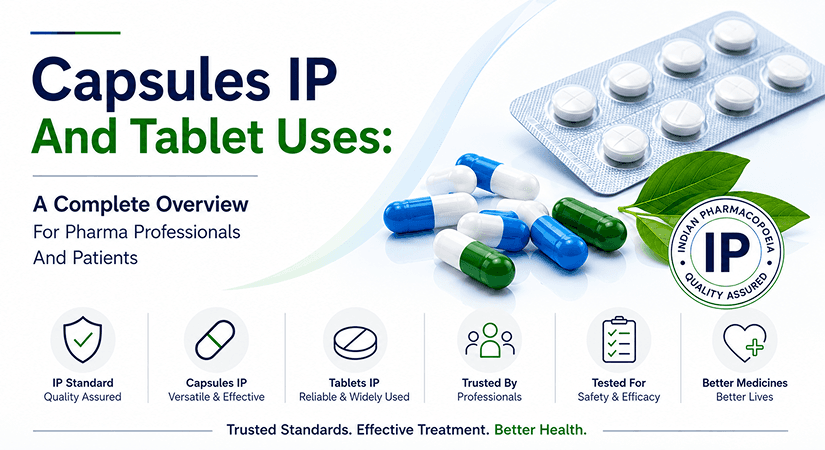
If you have ever looked closely at a medicine pack in India, you have probably noticed two letters after the drug name — "IP." Most people ignore them. But those two letters carry a lot of meaning. IP stands for Indian Pharmacopoeia, the official standard set by the Indian Pharmacopoeia Commission (IPC), an autonomous body under the Ministry of Health and Family Welfare.
When a medicine is labelled with IP, it has been formulated, manufactured, and tested in compliance with those official standards, designed to ensure the medicine's identity, purity, strength, quality, and safety.
The Indian Pharmacopoeia is updated regularly. The 10th edition, IP 2026, was released on 2 January 2026 and now contains 3,340 monographs, each one a detailed written standard specifying what a drug must contain, how it must perform, and how it must be tested.
Medicines that carry the IP label must comply with these monographs, giving patients and healthcare providers a reliable assurance that what is written on the label is exactly what is in the medicine.
Capsules IP and Tablets are two of the most widely prescribed dosage forms in India. They differ in structure, manufacture, release mechanism, and which situations suit them best. Understanding those differences is useful for pharmacists, prescribers, students, and informed patients alike.
What Are Capsules IP?
A Capsule IP is a solid dosage form in which the active pharmaceutical ingredient (API), along with excipients like fillers and lubricants, is enclosed inside a shell. The shell is typically made of gelatin, hard or soft, though hydroxypropyl methylcellulose (HPMC) shells are now widely used in vegetarian and vegan formulations.
There are two main types of capsules used in pharmaceutical practice:
- Hard gelatin capsules (HGC) is the most common type. The drug is filled inside a two-piece shell in powder, pellet, or granule form, and used for a wide range of therapeutic categories.
- Soft gelatin capsules (SGC), used when the drug is an oil, liquid, or a drug that is better absorbed from a lipid-based system. Vitamin E, fish oil, and many hormonal preparations are delivered in soft gel form.
The "IP" suffix on a capsule formulation confirms it meets Indian Pharmacopoeia standards, covering shell quality, fill weight uniformity, disintegration time, dissolution performance, moisture content, and microbial limits.
What Are The Most Common Uses Of Capsules IP?
Capsules IP are prescribed across virtually every therapeutic category in the Indian healthcare system. Some of the most widely used include:
1) Antibiotics: Amoxicillin Capsules IP and Ampicillin Capsules IP are first-line treatments for respiratory, urinary, and skin infections. Doxycycline Capsules IP is used for bacterial infections, acne, and malaria prophylaxis.
2) Antifungals: Fluconazole Capsules IP is used for fungal infections including candidiasis and tinea.
3) Analgesics & Anti-Inflammatory Drugs: Celecoxib Capsules IP is prescribed for pain, arthritis, and post-operative inflammation.
4) Gastrointestinal Drugs — Omeprazole Capsules IP and Pantoprazole Capsules IP are proton pump inhibitors used for acid reflux, gastric ulcers, and GERD.
5) Vitamins & Supplements: Vitamin D3 Soft Gelatin Capsules IP, Vitamin E Capsules IP, and multivitamin preparations are among the most dispensed forms in both clinical and over-the-counter settings.
6) Cardiovascular Drugs: Atorvastatin and calcium channel blocker preparations are available in capsule form for better patient compliance.
7) Antidepressants: Duloxetine Capsules IP is prescribed for major depressive disorder, generalised anxiety disorder, and diabetic neuropathic pain.
Capsules are often preferred when the drug is bitter-tasting, sensitive to compression, or when the formulator wants controlled or extended-release delivery through pellet technology inside the shell.
India's pharmaceutical quality standards have helped make the country the world's leading supplier of generic medicines.
Discover the companies driving this global success.
→ Read: Top 11 Generic Pharma Exporters In India Fueling Global Healthcare
What Are IP Tablets?
According to the Indian Pharmacopoeia, tablets are solid, flat or biconvex unit dosage forms prepared by compressing a drug or mixture of drugs, with or without diluents, into a defined shape. They are the most widely manufactured dosage form globally and form the backbone of most essential medicine lists and standard treatment guidelines in India.
What are IP Tablet Quality Control Parameters?
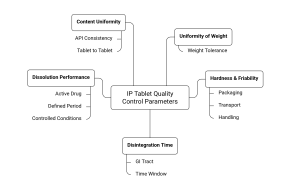
Tablets IP must comply with monograph specifications covering:
- Uniformity Of weight: Each tablet must fall within a specified weight tolerance
- Hardness & Friability: The tablet must be robust enough to survive packaging, transport, and handling
- Disintegration Time: It must break down within a defined period in the gastrointestinal tract
- Dissolution: A defined percentage of the active ingredient must dissolve within a specified time under controlled conditions
- Content Uniformity: the amount of API in each tablet must be consistent from tablet to tablet
What Are The Most Common Uses Of Tablets IP?
Tablets IP cover the broadest therapeutic range of any dosage form in the Indian pharmaceutical market. Some key categories and examples include:
a) Antipyretics & Analgesics — Paracetamol Tablets IP 500 mg is the most dispensed medicine in India, used for fever and pain. Ibuprofen Tablets IP is used for pain and inflammation.
b) Antibiotics — Metronidazole Tablets IP treats bacterial and protozoal infections including amoebic dysentery. Ciprofloxacin Tablets IP is a broad-spectrum antibiotic for urinary, respiratory, and gastrointestinal infections.
c) Antihypertensives — Amlodipine Tablets IP, Telmisartan Tablets IP, and Atenolol Tablets IP are prescribed for high blood pressure and cardiac conditions.
d) Antidiabetics — Metformin Tablets IP is the first-line oral medicine for Type 2 diabetes. Glibenclamide Tablets IP is used in combination for better glycaemic control.
e) Antiulcer Drugs — Ranitidine and Famotidine Tablets IP are used for acid-related disorders.
f) Antimalarials — Chloroquine Tablets IP and Hydroxychloroquine Tablets IP are used for malaria treatment and autoimmune conditions.
g) Hormones — Levothyroxine Tablets IP is used for thyroid disorders. Combined oral contraceptive tablets IP are widely used in reproductive healthcare.
Capsules Vs. Tablets: Which Is Better?
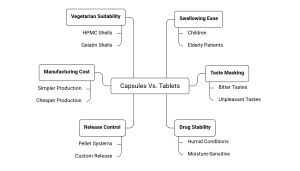
There is no universal answer to this question. The choice depends on the drug's physical and chemical properties, the patient's needs, and the clinical context. Here is a quick practical comparison:
- Swallowing Ease: Capsules are generally easier to swallow, especially for elderly patients and children
- Taste Masking: Capsules completely mask bitter or unpleasant drug taste; coated tablets also help but capsules are inherently better
- Drug Stability: Tablets are more stable in humid conditions; soft gelatin capsules can be moisture-sensitive
- Release Control: Both forms support modified release, but capsule-based pellet systems offer more flexible release profile options
- Manufacturing Cost: Tablets are generally cheaper to manufacture at scale
- Vegetarian Suitability: HPMC capsule shells are preferred for vegetarian patients; standard gelatin shells are animal-derived
Want to dive deeper into capsule formulations?
Explore how hard and soft gelatin capsules differ in structure, manufacturing, fill materials, bioavailability, and pharmaceutical applications.
→ Read: Difference Between Hard and Soft Gelatin Capsules
Conclusion: The IP Mark Is A Quality Guarantee
Whether you are picking up an Amoxicillin Capsule IP for an infection or a Metformin Tablet IP for diabetes, the IP mark is your assurance that the medicine was made and tested to meet India's official quality standards.
It is not just a label. It represents a comprehensive monograph, a regulatory commitment, and a quality system that protects the patient at every step, from raw material to final dosage form.
Understanding what capsules IP and tablets IP are, how they differ, and what they treat helps patients ask better questions, helps pharmacists counsel more effectively, and helps prescribers make more informed choices. In a country that is the world's largest supplier of generic medicines, these standards matter and knowing them matters too.
FAQs
1. What Does The "IP" Label Mean On Capsules And Tablets?
The "IP" label stands for Indian Pharmacopoeia, indicating that the medicine complies with the official quality standards established by the Indian Pharmacopoeia Commission (IPC). These standards ensure the medicine meets specific requirements for identity, purity, strength, quality, and safety before it reaches patients. Medicines bearing the IP mark are also tested according to approved pharmacopoeial methods. This provides healthcare professionals and patients with confidence in the product's quality and consistency.
2. What Is The Difference Between Capsules IP And Tablets IP?
Capsules IP contain the active ingredient inside a hard or soft shell, while Tablets IP are produced by compressing the drug and excipients into a solid dosage form. Capsules are often preferred for taste masking, easier swallowing, and certain modified-release formulations, whereas tablets are generally more stable, cost-effective, and widely used for a broad range of medications. The choice between the two depends on the drug's properties, patient needs, and treatment goals. Both dosage forms must comply with Indian Pharmacopoeia standards when labelled as IP.
3. Why Are Capsules IP And Tablets IP Important For Patients And Healthcare Professionals?
Capsules IP and Tablets IP provide assurance that medicines have been manufactured and tested according to India's official pharmacopoeial standards. This helps ensure consistent quality, safety, effectiveness, and reliable therapeutic performance across different batches. Understanding these dosage forms also enables healthcare professionals to prescribe and counsel patients more effectively. For patients, recognizing the IP mark promotes greater confidence in the medicines they use.
Reporting on the science, business and regulation shaping the pharmaceutical industry.
More from the Knowledge Hub
All articles →
Pharmaceutical Regulatory Affairs: Challenges, Innovations, and Global Harmonization

Cold Chain Logistics in Pharma: Building Resilient Supply Chains

Discussion