Isolator and RABS adoption curves in sterile fill-finish
Annex 1 is reshaping barrier technology choices, here's where isolator and RABS adoption stands, and why isolators are pulling ahead.

Introduction
Sterile injectable manufacturing runs on one core promise: nothing unwanted touches the product. For decades, that promise depended heavily on trained operators working carefully inside cleanrooms. Today, it increasingly relies on machines and barriers that keep operators entirely away from the product. This shift is best seen in how fast isolators and Restricted Access Barrier Systems (RABS) are being adopted across the industry, and why the two technologies are no longer competing on equal footing.
This research summary looks at where isolator and RABS adoption stands today, what is driving the shift, and how manufacturers are deciding between the two under the revised EU GMP Annex 1.
Why Barrier Technology Matters for Sterility Assurance
Human operators are the single biggest contamination risk in an aseptic filling line. Skin, hair, breath, and even routine movement shed particles and microorganisms. Every intervention an operator makes near an open vial or syringe is a moment of risk. Barrier technology exists to remove or reduce that risk by physically separating people from the product.
This is not a new idea. RABS and isolators have existed in some form since the 1990s and early 2000s. What has changed is the regulatory expectation. Contamination control is no longer treated as a facility feature; it is now documented as a formal, risk-based strategy that covers people, processes, environment, and equipment.
RABS and Isolators: The Core Difference
Both technologies create a barrier between the operator and the Grade A critical zone, but the degree of separation is different.
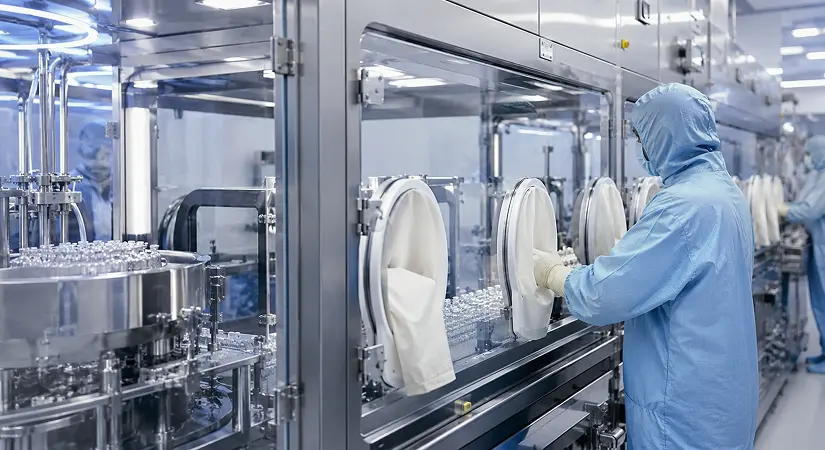
RABS (Restricted Access Barrier Systems) use rigid walls and glove ports to physically restrict access to the critical zone, while the barrier itself sits inside a Grade B cleanroom. Operators can open RABS doors during defined, controlled interventions, in accordance with strict procedures.
Isolators go a step further. They provide a sealed, continuously monitored enclosure with its own air handling, and they are decontaminated using automated systems, most commonly vaporised hydrogen peroxide (VHP). Isolators provide continuous isolation of the interior from the external environment. They can be built as either closed or open systems, depending on how materials move in and out during operation. Because the enclosure is sealed, isolators can sit in a lower-grade background room, which is a major design and cost advantage.
What Annex 1 Actually Requires
The revised EU GMP Annex 1, which took effect in August 2023, reshaped how manufacturers think about barrier technology. The guidance recognises both RABS and isolators as beneficial technologies, and requires that technology selection, or any alternative approach, be justified through a site-specific Contamination Control Strategy.
Annex 1 also sets clear background classification expectations. The background environment for open isolators should generally be at least Grade C, and for closed isolators at least Grade D, based on a documented risk assessment. RABS used for aseptic processing, by contrast, need a background of at least Grade B. That single difference in background grade has a major effect on HVAC design, gowning requirements, and ongoing environmental monitoring costs.
Annex 1 also tightened expectations for glove systems, since gloves remain a common point of breach in both technologies. Glove materials must have appropriate resistance; glove replacement frequency must be defined within the CCS; isolator gloves must undergo a minimum integrity testing frequency; and RABS gloves must be sterilised or bio-decontaminated before each manufacturing campaign.
The Adoption Curve: Where the Industry Stands
Adoption has clearly bent toward isolators, but the shift has not been instant. Many facilities built before 2020 were designed around open RABS or manual gloveboxes, and retrofitting an entire suite is expensive. Many traditional facilities were designed for legacy technologies and have since been retrofitted with RABS to adapt to newer standards, though such stopgap measures may not fully meet Annex 1 expectations.
New builds tell a different story. The revised Annex 1 has generally favoured the adoption of isolators since it took effect. Industry commentary now frames RABS retrofits as a transitional step rather than an end state, with isolators positioned as the long-term standard for new sterile lines. Isolators reduce contamination risk and minimise manual intervention by separating operators from critical processing areas, and customers are increasingly requesting isolator-based technology rather than RABS.
Demand growth is reinforcing this curve. The fill-finish manufacturing market is expected to expand by nearly $10 billion between 2026 and 2031, driven by demand for biologics, biosimilars, vaccines, and injectable therapies. Manufacturers are investing in isolator technology, automation, and digital manufacturing systems to meet that demand. The rise of complex, high-value modalities is a big part of this. The growing use of antibody-drug conjugates, cell and gene therapies, and mRNA products is driving manufacturers to adopt greater automation and isolators.
Barrier technology adoption is just one piece of the bigger fill-finish capacity crunch, see why announced capacity still isn't closing the gap.
→ Read: Every Company Announced Fill-Finish Capacity: Still Scarce?
Why Isolators Are Pulling Ahead
A few practical reasons explain the tilt toward isolators:
- Lower background grade requirement reduces HVAC load and facility footprint over the life of the plant.
- Automated bio-decontamination (VHP cycles) replaces manual disinfection, cutting variability between batches.
- Fewer open interventions during filling reduce both the risk of contamination and the burden of aseptic technique training.
- Better fit for potent and high-value products, including ADCs and cell and gene therapies, where operator protection matters as much as product protection.
- Stronger inspection posture, since isolators are easier to defend during regulatory audits when data show minimal human intervention.
Where RABS Still Makes Sense
Isolators are not automatically the right answer for every facility. RABS still holds ground in specific situations:
- Multi-product, high-mix facilities that need to switch formats and products frequently, since isolator changeover and re-qualification can take longer.
- Capital-constrained projects, where the lower upfront cost of RABS fits the budget and timeline better.
- Existing Grade B suites, where a full isolator installation would mean a major facility redesign.
- Shorter campaign runs, where the flexibility of open- or closed-RABS interventions outweighs the isolator throughput advantages.
Hybrid approaches are also gaining attention, combining isolator-grade separation with some of the operational flexibility of RABS. However, they remain a smaller part of the installed base than conventional systems.
Comparison Table: Isolators vs RABS
Feature | Isolators | RABS |
Background grade needed | Grade C (open) / Grade D (closed) | Grade B minimum |
Decontamination | Automated (typically VHP) | Manual disinfection |
Operator intervention | Minimal, through gloves only | Controlled door openings allowed |
Capital cost | Higher upfront | Lower upfront |
Changeover time | Longer | Shorter |
Best fit | High-value, single-product, long campaigns | Multi-product, flexible lines |
Annex 1 alignment | Strongly favoured for new builds | Acceptable with strong CCS justification |
Capital and Operational Cost Realities
Isolators cost more to install because of the enclosure, VHP generators, and integrated monitoring systems. But the lower background grade requirement can offset this over time by reducing gowning, cleaning validation, and environmental monitoring costs tied to a Grade B room. RABS remains attractive where capital is limited or where a facility is retrofitting an existing suite rather than building new. The right choice depends on product value, campaign length, and how much flexibility the facility genuinely needs.
Beyond compliance, isolators vs RABS is also an ROI question, see how the cost-benefit debate plays out over a facility's lifecycle.
→ Read: RABS vs Isolators: The ROI of Sterility Assurance
CCS Documentation Checklist for Barrier Technology
Whichever system a facility chooses, Annex 1 expects the decision to be backed by paperwork, not just engineering judgment.

Documented risk assessment justifying isolator or RABS selection
Background grade classification linked to the CCS
Glove integrity testing schedule and replacement frequency defined
Decontamination cycle validation records (VHP or manual disinfection)
Intervention log and frequency tracked against media fill data
Airflow visualisation studies for the critical zone
Personnel qualification and gowning records tied to the background grade
What This Means for Fill-Finish Planning
For manufacturers planning new sterile lines, the direction is fairly clear: isolators are becoming the default expectation, especially for biologics, ADCs, and cell- and gene-therapy products. RABS is not disappearing, but it is increasingly positioned as a transitional or flexibility-driven choice rather than the long-term standard. Whatever the choice, the deciding document is the CCS. Regulators are less interested in which barrier a facility uses and more interested in whether that choice is justified, monitored, and backed by data.
FAQs
1. Are isolators mandatory under EU GMP Annex 1?
No. Annex 1 recognises both isolators and RABS as acceptable, provided the choice is justified through a documented CCS.
2. What background cleanroom grade does an isolator need?
Generally Grade C for open isolators and Grade D for closed isolators, based on risk assessment.
3. Why do isolators cost more than RABS?
Isolators need sealed enclosures, automated VHP decontamination systems, and integrated monitoring, which raises upfront capital cost.
4. Can existing RABS lines still pass inspection?
Yes, if supported by a strong, risk-based CCS, though regulators increasingly favour isolator technology for new builds.
5. Which is better for biologics and ADCs?
Isolators are generally preferred for high-value, potent, or long-campaign products due to lower intervention risk and operator protection.
Reporting on the science, business and regulation shaping the pharmaceutical industry.
More from the Knowledge Hub
All articles →
Pharmaceutical Regulatory Affairs: Challenges, Innovations, and Global Harmonization

Cold Chain Logistics in Pharma: Building Resilient Supply Chains

Discussion