Decentralized Manufacturing Models: Bringing Production Closer To The Patient
Decentralized Manufacturing Models spread production across smaller local sites instead of one factory. Here's how they work and what's still holding them back.


Introduction
For over a century, manufacturing, especially in industries like pharmaceuticals has followed a simple logic: build one large, highly controlled factory, make products in bulk, and ship them out to the rest of the world. This centralized approach has worked well for consistency and cost control, but it comes with a hidden weakness.
If that one factory faces a disruption — a natural disaster, a supply chain breakdown, or a quality issue, the ripple effects can be felt globally, sometimes leading to shortages of essential products, including life-saving medicines.
Decentralized manufacturing offers a different way of thinking. Instead of relying on one central factory, production is spread across multiple smaller sites, sometimes even down to a hospital pharmacy or a specialized clinic, while still being tightly controlled by a central quality and oversight system.
In simple terms, it's the difference between one giant kitchen cooking meals for an entire city versus many smaller, connected kitchens each cooking fresh meals closer to the people who need them, all following the same trusted recipe and safety standards.
This article breaks down what decentralized manufacturing models are, why they are gaining momentum, especially in pharma, how they actually work, and what challenges still need to be solved before they become mainstream.
What Is Decentralized Manufacturing?
Decentralized manufacturing (also called distributed manufacturing) is a production model where the final stages of making a product happen at multiple smaller, often local, sites instead of one large central facility. These smaller sites are usually closer to the end user, a hospital, a pharmacy, or even a mobile production unit.
Importantly, decentralization doesn't mean a loss of control or quality. In most working models, a central authority, often called a "control site", still manages the core quality system, sets the standards, and oversees every smaller site. This is frequently described as a “hub-and-spoke model”, where:
The hub (central site) manages quality standards, documentation, training, and oversight.
The spokes (local sites) carry out the final production step, close to where the product will actually be used.
This structure allows companies to keep the consistency and safety of centralized manufacturing while gaining the speed and flexibility of local production.
Why Decentralized Manufacturing Is Gaining Ground?
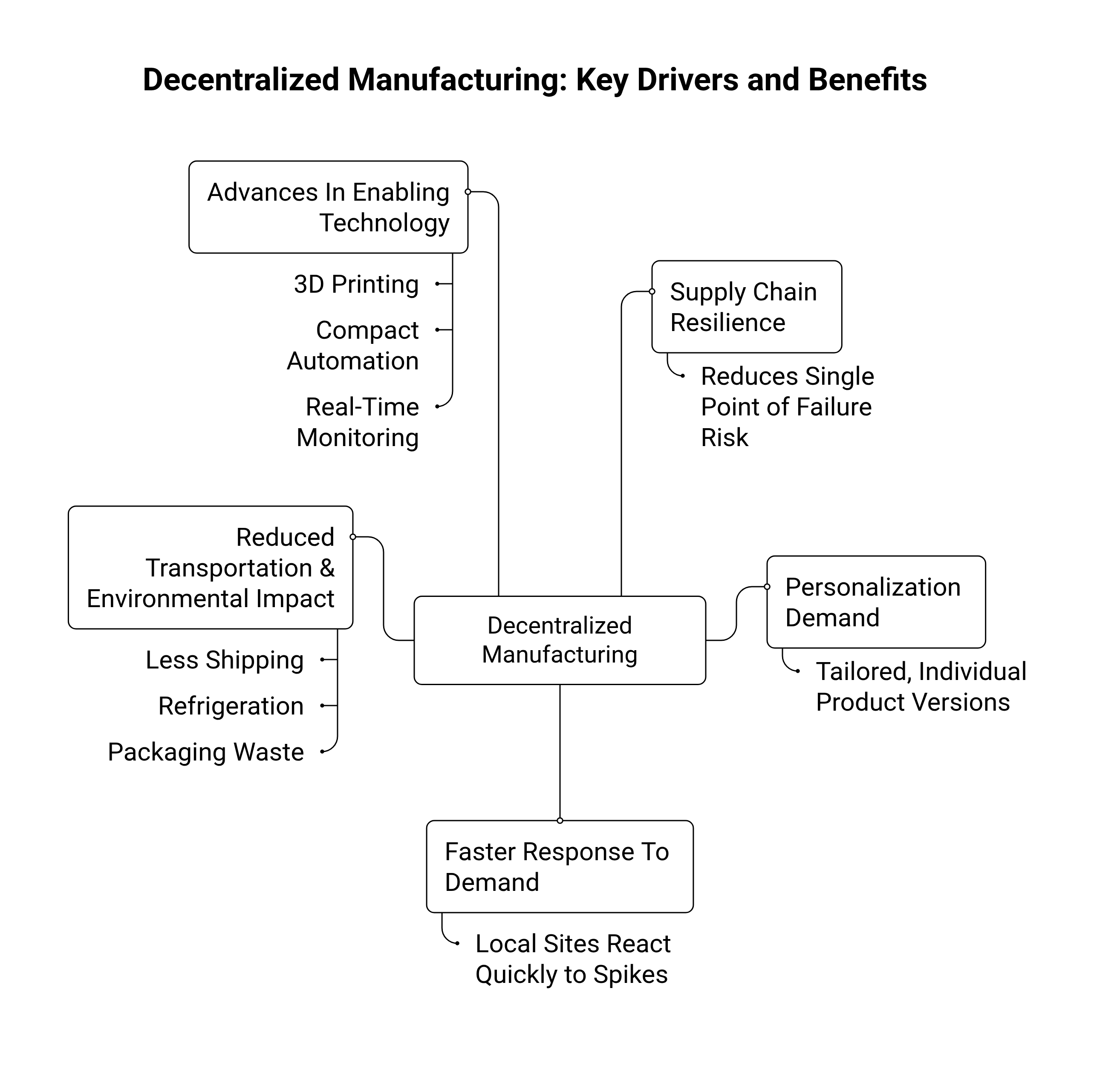
Several forces are pushing industries, especially pharmaceuticals, toward this model:
1) Supply Chain Resilience: Centralized manufacturing means a single point of failure. If one factory shuts down, an entire region can face shortages. Spreading production across multiple sites reduces this risk.
2) Personalization Demand: Some products, especially medicines, work better when tailored to an individual. A single centralized factory struggles to efficiently produce thousands of unique, personalized versions of a product.
3) Faster Response To Demand: Local production sites can respond quickly to sudden spikes in demand for a specific product in a specific area, without waiting on long shipping timelines.
4) Reduced Transportation & Environmental Impact: Producing closer to the point of use cuts down on long-distance shipping, refrigeration needs, and packaging waste.
5) Advances In Enabling Technology: Tools like 3D printing, compact automated equipment, and real-time digital monitoring now make small-scale, high-quality local production genuinely feasible in ways it wasn't a decade ago.
How It Works In Practice?: The Pharma Example
Pharmaceutical manufacturing is one of the clearest and most advanced examples of decentralized manufacturing in action today, largely thanks to 3D printing technology. Here's a simplified breakdown of how it typically works:
a) Core Materials Are Made Centrally – A licensed manufacturing site produces the base materials, sometimes called "pharma-inks" such as powders, filaments, or granulated blends, under strict quality control.
b) Materials Are Distributed To Local Sites: These quality-controlled materials are shipped to smaller, decentralized locations, such as hospital pharmacies or specialty clinics.
c) Final Production Happens Locally: At the local site, equipment such as a 3D printer transforms the material into the final, ready-to-use product, for example, a tablet with a dosage tailored exactly to a specific patient.
d) Data Flows Back To The Central Hub: Throughout this process, production data is transmitted in real time to the central quality system, allowing continuous oversight even though production is happening in a different physical location.
e) Quality Checks Confirm The Final Product: Local sites use quality-control tools to verify the final product meets required standards before it reaches the patient.
This is sometimes referred to as point-of-care manufacturing, and it has already moved from theory into real practice. In fact, regulators have started building formal legal frameworks around it — the United Kingdom introduced dedicated legislation in 2025 recognizing this kind of "modular manufacture”.
This is the first country to establish a specific legal pathway for decentralized medicine production. Other regulators, including the U.S. FDA and the European Medicines Agency, have also been actively working on guidance for this emerging model.
3D printing is the technology making point-of-care manufacturing possible right now. See where else it's reshaping pharma production.
Read: Latest Trends in Pharma Manufacturing Innovations
Types of Decentralized Manufacturing Approaches
Not all decentralized manufacturing looks the same. Depending on the industry and product, a few different variations have emerged:
Modular Manufacturing - Prefabricated, self-contained production units that can be installed at various local sites, following standardized designs.
Mobile Manufacturing – Micro-factories built into specialized vehicles, allowing production to physically travel to where it's needed, such as disaster zones or remote areas.
Point-Of-Care / Home-Based Manufacturing – Production that happens directly where the product will be used, such as a hospital or clinic, minimizing the gap between creation and use.
Satellite Or Regional Production Hubs – Smaller regional facilities that serve a specific geographic area, reducing reliance on a single global or national plant.
3D printing machines are the core equipment enabling decentralized, personalized production. See how they compare to other pharma machinery shaping 2025.
Read: Top 10 Pharma Machines to Watch in 2025
Benefits Beyond Pharma
While pharmaceuticals offer one of the clearest examples, the principles behind decentralized manufacturing apply across many industries:
Consumer goods and electronics companies use regional micro-factories to reduce shipping costs and respond faster to local market trends.
Automotive and industrial parts manufacturers use distributed 3D printing to produce spare parts on demand, reducing the need to store large, costly inventories.
Food production increasingly uses localized, smaller-scale facilities to reduce spoilage and transportation emissions.
Across these industries, the common thread is the same: shifting some production closer to the end user, while keeping quality and design standards centrally controlled.
Key Challenges That Still Need Solving
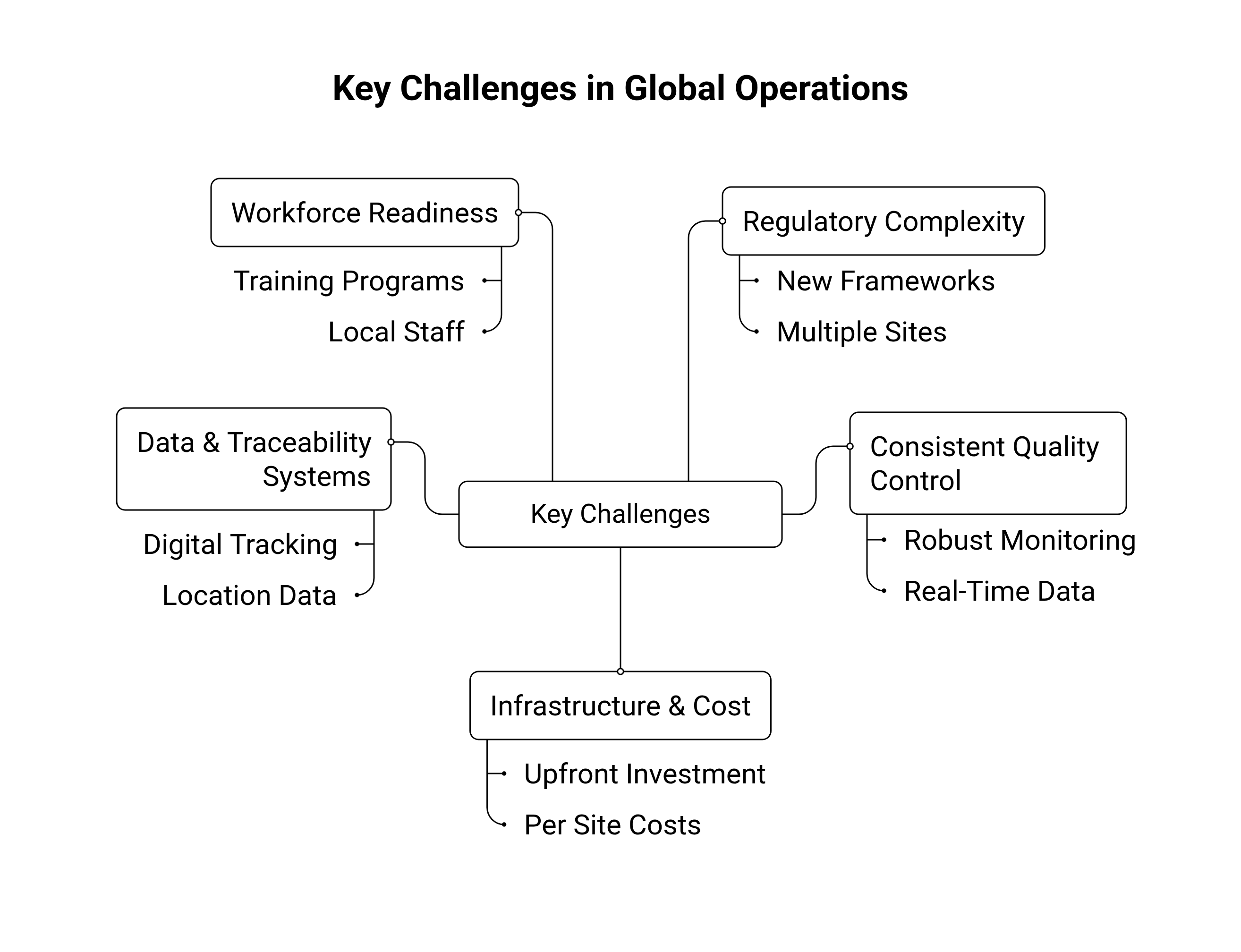
Despite its promise, decentralized manufacturing is not a simple switch that industries can flip overnight. Several real challenges remain:
Regulatory Complexity – Because production now happens across many locations instead of one, regulators need new frameworks to ensure every site meets the same safety and quality standards. This is still an evolving area in most countries.
Consistent Quality Control – Ensuring that a product made at one local site is just as safe and effective as one made at another requires robust, real-time monitoring tools and standardized testing methods.
Infrastructure & Cost – Setting up multiple smaller production sites, each with the right equipment and trained staff, can require significant upfront investment.
Data & Traceability Systems – Since production is spread out, companies need strong digital systems to track every batch, no matter where it was made, to maintain full traceability.
Workforce Readiness – Local sites need trained personnel capable of operating specialized equipment and following strict quality procedures, which requires new training programs.
In Conclusion
Decentralized manufacturing represents a meaningful shift in how products, especially medicines, are made and delivered. Rather than relying entirely on a single, centralized factory, this model spreads production across multiple smaller, closely monitored sites, bringing manufacturing physically closer to the people who need the product most. The result is a system that is more resilient to disruptions, better suited to personalization, and often more environmentally sustainable.
The pharmaceutical industry, driven by advances in 3D printing and supported by new regulatory frameworks, is leading the way in showing what this model can look like in practice. Yet the transition isn't without real hurdles, from regulatory alignment to quality assurance and workforce readiness.
As technology matures and regulators continue building clearer pathways, decentralized manufacturing is likely to move from an emerging concept to a standard part of how industries, especially healthcare, think about getting the right product to the right place — closer, faster, and more reliably than ever before.
FAQs
1. What Is Decentralized Manufacturing?
Decentralized manufacturing is a production model where products are made at multiple smaller sites closer to the people who need them, while a central system maintains quality, safety, and production standards. It reduces dependence on a single large manufacturing facility. This can also make production more flexible and responsive to local needs.
2. How Does Decentralized Manufacturing Benefit The Pharmaceutical Industry?
It can improve supply chain resilience, support personalized medicines, reduce transportation needs, and help healthcare providers respond faster to local demand. Local production can be particularly useful when demand changes suddenly or supplies are disrupted. It may also reduce the time between manufacturing and delivering a medicine to the patient.
3. What Is Point-Of-Care Manufacturing?
Point-of-care manufacturing means producing a product, such as a personalized medicine, close to or at the location where it will be used, such as a hospital or specialized clinic. This can help create products suited to specific patient requirements. It also reduces the need to transport finished products over long distances.
4. What Technologies Support Decentralized Manufacturing?
Technologies such as 3D printing, compact automated equipment, digital monitoring, and real-time data systems make it possible to produce products locally while maintaining centralized oversight. These technologies help smaller sites follow standardized production processes. Digital systems can also allow the central hub to monitor production and quality data remotely.
5. What Are The Main Challenges Of Decentralized Manufacturing?
Key challenges include maintaining consistent quality across locations, meeting regulatory requirements, building suitable infrastructure, ensuring data traceability, and training skilled local workers. Every production site needs to follow the same strict standards to ensure product safety and consistency. Strong digital systems, clear regulations, and proper workforce training are therefore essential for successful implementation.
Reporting on the science, business and regulation shaping the pharmaceutical industry.
More from the Knowledge Hub
All articles →
Pharmaceutical Regulatory Affairs: Challenges, Innovations, and Global Harmonization

Cold Chain Logistics in Pharma: Building Resilient Supply Chains

Discussion