Hantavirus in India 2026: What ICMR Says, How It Spreads, and What You Need to Know
Hantavirus cases linked to Indian travellers sparked concern. Learn how it spreads, what ICMR says, and who may be at risk.


The sudden news of two Indian nationals testing positive for hantavirus aboard a cruise ship in May 2026 set off a wave of concern across the country. Within days, social media was buzzing with questions: Is there an outbreak? How does it spread? Should we be worried? The Indian Council of Medical Research (ICMR) and its National Institute of Virology (NIV) stepped in quickly to provide clarity, and their message was measured, data-backed, and clear. This article brings together everything ICMR and India's public health authorities have communicated about hantavirus, the country's diagnostic preparedness, who is actually at risk, and what precautions make sense.
What Is Hantavirus? A Quick Scientific Overview
Hantavirus is a group of RNA viruses belonging to the family Hantaviridae. These viruses are primarily carried by rodents, and humans typically become infected through contact with infected rodents or their waste products, including urine, faeces, and saliva. There are multiple strains of hantavirus circulating globally, and they cause two main clinical syndromes:
- Hantavirus Pulmonary Syndrome (HPS): Mainly associated with strains found in North and South America, this syndrome causes severe respiratory illness with a case fatality rate of up to 40%.
- Haemorrhagic Fever with Renal Syndrome (HFRS): Predominantly linked to strains in Europe and Asia, including Hantaan, Seoul, Puumala, and Dobrava viruses. This causes kidney involvement along with fever and bleeding tendencies.
The strains most relevant to India's immediate context are those associated with HFRS. The Seoul virus, for instance, has a global rodent reservoir (the common brown rat, Rattus norvegicus) and has been detected across Asia. However, the South American Andes virus, which caused the 2026 cruise ship cluster, has its own distinct reservoir and is not endemic to India.
The 2026 Cruise Ship Incident: What Happened
In early May 2026, reports emerged of a small cluster of hantavirus infections aboard the MV Hondius, a cruise ship. Two of those affected were Indian nationals. The World Health Organisation (WHO) confirmed the cluster and noted that health authorities were monitoring contacts and taking precautionary measures.
WHO Director General Dr Tedros Adhanom Ghebreyesus acknowledged the seriousness of the incident but assessed the public health risk as low. He noted that, given the virus's incubation period, additional cases could not be ruled out, but the scope remained contained.
ICMR-NIV Director Dr Naveen Kumar promptly provided India-specific context in an official PTI statement, clarifying that the cases appeared to be isolated and that there was no evidence of community spread in India.
ICMR's Official Position: No Immediate Public Health Threat
The ICMR-NIV Director's statement in May 2026 was unambiguous. Dr Naveen Kumar confirmed the following key points on behalf of India's top virology research institution:
- The hantavirus cases linked to Indian nationals were isolated incidents with no community transmission detected.
- There is currently no evidence of hantavirus spreading within India's general population.
- Human-to-human transmission of hantavirus is extremely uncommon. Most hantavirus strains found in Asia and Europe, the strains most likely to be relevant in India, do not spread between people at all.
- The only documented person-to-person transmission in history has been associated with the Andes virus strain in South America, which is not endemic to India.
- India has adequate diagnostic infrastructure in place to detect and confirm suspected hantavirus cases should they arise.
The ICMR's position aligns with that of the WHO, which has consistently classified hantavirus as a low pandemic-risk pathogen compared to respiratory viruses like influenza or SARS-CoV-2, precisely because it does not transmit efficiently from person to person.
India's hantavirus story didn't start with MV Hondius.
The surveillance gaps were already there.
→ Explore India's Hantavirus Evidence
India's Diagnostic and Surveillance Capacity in 2026
One of the most important aspects of ICMR's response was its transparency about India's testing readiness. India is not starting from scratch when it comes to hantavirus detection.
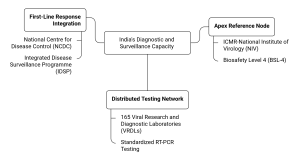
Dr Kumar confirmed that India has diagnostic capacity for hantavirus through two key systems:
1. ICMR-National Institute of Virology (NIV), Pune. The NIV in Pune is India's premier virology research institution, operating at Biosafety Level 4 (BSL-4). It carries out reservoir-host surveillance and serological screening on suspect samples. The NIV has the technical expertise and infrastructure to confirm hantavirus infection through molecular and serological testing.
2. The Viral Research and Diagnostic Laboratory (VRDL) Network India has a nationwide VRDL network of 165 laboratories spread across states and union territories. These labs are equipped with RT-PCR (Reverse Transcription Polymerase Chain Reaction) facilities, the gold-standard molecular diagnostic method for confirming hantavirus infection in suspected cases. This network ensures that testing capacity is not limited to a single centre but is geographically distributed across the country.
In addition, existing public health infrastructure, including the National Centre for Disease Control (NCDC) and the Integrated Disease Surveillance Programme (IDSP), forms part of the first-line response system. The 2026 MV Hondius cases prompted the Ministry of Health to issue a routine traveller advisory for returnees from South America who develop respiratory symptoms within 8 weeks of their return.
How Hantavirus Actually Spreads
Understanding the transmission route of hantavirus is critical to understanding why it is not spreading through Indian communities in the same way a respiratory pathogen would.
Hantavirus does not spread through coughing, sneezing, or casual human contact. The primary route of transmission is inhalation of aerosolised viral particles from rodent urine, droppings, or saliva, particularly in enclosed, poorly ventilated spaces. People can also get infected through direct contact with infected rodents or their nest materials, or through a rodent bite.
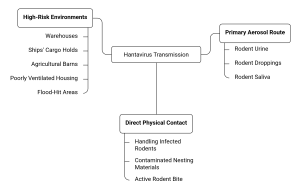
The environments where exposure is most likely include:
- Warehouses and grain storage facilities
- Ships and cargo holds
- Farm buildings, barns, and agricultural storage areas
- Poorly maintained housing with rodent infestations
- Flood-affected areas where rodent movement increases
Dr Kumar specifically highlighted that the occupational and environmental settings on a cruise ship, with enclosed spaces and potential rodent presence in cargo and food storage areas, are consistent with the type of environments where hantavirus exposure can occur.
The India story is only one piece of a much larger outbreak map.
See where hantavirus is emerging worldwide.
→ Read the Global Threat Analysis
Symptoms: What to Watch For
According to ICMR-NIV, hantavirus has an incubation period of one to five weeks after exposure. This means symptoms may not appear immediately, and early presentation can be mistaken for other common illnesses, such as influenza or dengue.
Early Symptoms (first few days):
- Sudden high fever
- Severe body aches and muscle pain
- Headache and fatigue
- Chills and sweating
- Nausea, vomiting, and abdominal pain
- Dry cough
Warning Signs of Severe Disease:
- Breathing difficulty or shortness of breath (suggests progression to HPS)
- Low blood pressure
- Kidney involvement with reduced or absent urine output (suggests HFRS)
- Fluid accumulation in the lungs
The overlap with dengue, leptospirosis, and severe influenza makes clinical diagnosis challenging without laboratory confirmation. This is why India's RT-PCR network across 165 VRDL labs is especially important for anyone presenting with these symptoms and a relevant exposure history.
Who Is at Risk in India?
The ICMR's guidance and public health experts are aligned on which groups in India carry a higher risk of hantavirus exposure:
The general public in urban India, who do not regularly encounter rodent habitats in enclosed spaces, faces a very low risk. This is consistent with ICMR's assessment that hantavirus poses no immediate public health threat at a population level.
Why Human-to-Human Spread Is Not a Major Concern
A critical reason ICMR and WHO are not raising a public health alarm about hantavirus in India is its transmission biology. Unlike COVID-19, influenza, or measles, hantavirus does not have a respiratory human-to-human transmission pathway for most strains.
Dr Kumar explained this clearly: "Human-to-human transmission is extremely uncommon. Most hantaviruses, especially those reported in Asia and Europe, do not spread between humans. Limited person-to-person transmission has only been documented with some South American strains such as the Andes virus."
This biological reality fundamentally limits the potential for hantavirus outbreaks in India. Without efficient human-to-human spread, the virus cannot sustain community-level transmission chains. Standard public health measures, rodent control, hygiene, and ventilation, are sufficient to break any exposure cycle.
The Role of Climate Change and Urbanisation
While the immediate threat is low, ICMR-NIV Director Dr Kumar flagged a longer-term concern that warrants attention from public health planners. Environmental and demographic changes are increasing the risk of rodent-borne infections globally, and India is not immune.
Key risk-amplifying factors he identified include:
- Climate change and flooding: Heavy rainfall and flooding increase rodent populations, displacing them into human dwellings and food storage areas, thereby increasing the likelihood of exposure.
- Unplanned urbanisation: Rapid urban growth with inadequate sanitation creates conditions where rodent populations thrive alongside dense human populations.
- Poor waste management: Garbage and food waste disposal practices directly influence rodent presence in human environments.
- Encroachment into rodent habitats: As forests are cleared and natural habitats are disturbed, rodent species are pushed into proximity with human settlements.
India's National One Health Mission, launched in April 2022, explicitly includes pandemic preparedness for novel zoonotic viruses, including hantavirus. This mission integrates ICMR, the Department of Animal Husbandry, ICAR-NIVEDI, and state health departments into a coordinated surveillance framework, which is the right structural foundation for long-term hantavirus risk management.
Personal Protection Checklist
If you live or work in a high-risk environment, or are travelling to areas with known hantavirus activity, follow these precautions:
At home and workplace:
- Seal all gaps and holes in walls, floors, and roofing through which rodents can enter
- Store food (including grains and dry goods) in rodent-proof sealed containers
- Remove clutter, leaf piles, and debris from around the home where rodents can nest
- Dispose of garbage in sealed bins and maintain regular waste collection
- Clean rodent droppings using a diluted bleach solution (1:10 ratio) and damp-wipe, never sweep or vacuum, as this aerosolises viral particles
For occupational exposure:
- Wear an N95 or higher-grade respirator before cleaning enclosed spaces with potential rodent activity
- Use gloves and eye protection when handling materials from rodent-prone areas
- Ventilate enclosed spaces (warehouses, storage rooms) thoroughly for at least 30 minutes before entering to clean
- Report any unusual rodent die-off events to local health or veterinary authorities
For travellers:
- Avoid camping near rodent burrows or nesting sites
- Do not touch or handle wild rodents
- Seek medical attention promptly if fever and respiratory symptoms develop within 8 weeks of return from South America.
The Bottom Line: ICMR's Guidance Is Reassuring, Not Complacent
India's public health response to the 2026 hantavirus situation demonstrates a system that is alert but not alarmist. The ICMR-NIV has been transparent about what is known, what is being monitored, and where the limits of current evidence lie. A nationwide RT-PCR network of 165 laboratories, a BSL-4 facility in Pune, and integration with the IDSP and NCDC give India a solid diagnostic foundation.
The two cases involving Indian nationals were linked to a specific exposure event on a cruise ship, not to any domestic transmission chain. The biology of the virus itself, with no efficient human-to-human spread for Asian and European strains, places a natural ceiling on outbreak risk in India's context.
What the incident has done is serve as a useful prompt to strengthen serological surveillance in high-risk communities, farmers, flood-affected populations, and warehouse workers, to establish whether hantavirus circulates at low, silent levels in India's rodent populations. Experts and the Indian Journal of Medical Research have previously flagged this as a surveillance gap that warrants attention.
For the general public, the message from ICMR is straightforward: maintain good rodent control, avoid enclosed spaces with rodent infestation, and seek medical care if you develop flu-like symptoms with a relevant exposure history. Panic is not warranted. Preparedness is.
FAQs
Q1. Has ICMR confirmed a hantavirus outbreak in India in 2026?
No. ICMR-NIV Director Dr Naveen Kumar confirmed in May 2026 that the hantavirus cases involving Indian nationals were isolated incidents linked to a cruise ship. There is no confirmed outbreak or community spread within India.
Q2. How does hantavirus spread in India?
Hantavirus spreads through contact with infected rodents or their excreta, urine, faeces, and saliva. Inhaling aerosolised particles in enclosed, poorly ventilated spaces is the most common route of exposure. It does not spread from person to person in the context of India's relevant strain.
Q3. What labs in India can test for hantavirus?
India has a network of 165 Viral Research and Diagnostic Laboratories (VRDLs) with RT-PCR capacity for hantavirus, in addition to the ICMR-National Institute of Virology (NIV) in Pune, which serves as the apex reference laboratory.
Q4. What are the early symptoms of hantavirus infection?
Early symptoms include sudden fever, severe body aches, headache, fatigue, chills, nausea, and dry cough. These appear one to five weeks after exposure. Severe cases may lead to breathing difficulties or kidney involvement.
Q5. Who is most at risk of hantavirus in India?
Farmers, agricultural workers, flood-affected communities, seafarers, warehouse workers, and travellers returning from South America are the highest-risk groups in India. The general urban population carries a very low risk.
Reporting on the science, business and regulation shaping the pharmaceutical industry.
More from the Knowledge Hub
All articles →
Pharmaceutical Regulatory Affairs: Challenges, Innovations, and Global Harmonization

Cold Chain Logistics in Pharma: Building Resilient Supply Chains

Discussion