De-Risking AI Biotech: How Institutional Investors Value Tech-Bio Platforms
AI biotech platforms can't be valued like traditional pipelines. Here's the checklist, metrics, and methods institutional investors use to price them.


Biotech investing has always carried a high failure rate. But the rise of AI-driven drug discovery companies has added a new layer of complexity to how institutional investors assess risk and value. These platforms promise to compress timelines, reduce R&D costs, and improve the probability of clinical success. The harder question is: how do you price that promise before a single drug reaches the market?
For institutional investors — pension funds, sovereign wealth funds, large biotech-focused hedge funds, and crossover funds, the challenge is building a valuation framework for companies that are part software, part science. Traditional biotech valuation models were not designed for this hybrid. And that mismatch is where both the risk and the opportunity sit.
What Makes AI Biotech Different from Traditional Biotech
A traditional biotech company is valued largely on its pipeline. Investors assess the clinical stage of each asset, apply probability-of-success estimates based on historical approval rates, and discount future cash flows to present value. It is a well-worn model, imperfect but understood.
AI biotech platforms do not fit cleanly into that model for several reasons. First, many of these companies generate multiple drug candidates simultaneously, sometimes dozens, making asset-by-asset valuation time-consuming and structurally awkward. Second, the platform itself has value that is independent of any single drug.
If the AI engine consistently identifies better targets or predicts toxicity earlier than conventional methods, that capability is worth something, even before clinical proof-of-concept. Third, the data assets underlying these platforms are often proprietary and difficult to replicate, giving them a competitive moat that has no real equivalent in traditional biotech.
The result is a two-part valuation problem: how do you value the platform, and how do you value the pipeline it generates?
The Investor's De-Risking Checklist
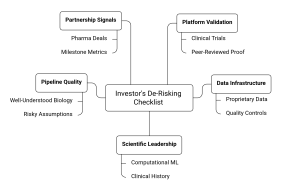
Before committing capital, institutional investors typically screen AI biotech companies against a structured set of criteria. Below is a representative checklist used in diligence:
Platform Validation
- Has the AI platform generated at least one compound that has entered clinical trials?
- Are there published or peer-reviewed validation studies for the platform's core technology?
- Has the platform been tested across multiple disease areas or target classes?
Data Infrastructure
- Does the company own or have long-term access to proprietary training data?
- Is the data quality auditable, and are there processes to prevent data leakage or contamination?
- How defensible is the data canal? Can it be replicated by a well-funded competitor within 2 years?
Scientific Leadership
- Does the leadership team combine deep computational expertise with clinical drug development experience?
- Are there scientific advisory board members with track records in the relevant disease areas?
Pipeline Quality
- Are the pipeline assets in validated or well-understood target biology, or does the clinical thesis itself carry unproven assumptions?
- What is the expected IND filing timeline for the lead asset?
Partnership and Revenue Signals
- Has the company signed pharma partnerships, and do the deal structures include meaningful milestone payments?
- Is there a royalty or co-development structure that aligns with partners' incentives?
A checklist tells you what to look for.
These are the platforms actually clearing the bar.
Here are the 20 AI drug discovery companies ranked by real-world impact in 2026.
→ Read: Top 20 AI Drug Discovery Companies in 2026 — Ranked by Impact
How Valuations Are Structured
There is no single standard method, but institutional investors have converged on a combination of approaches depending on the company's stage.
The most common approach for mid-stage AI biotech companies is a sum-of-parts model. Investors assign a risk-adjusted NPV to the clinical pipeline while applying a separate platform premium, typically derived from comparable licensing deals or acquisition multiples, to reflect the AI infrastructure's standalone value.
The platform premium is the contentious number. It can range from near zero for companies where the AI contribution is mostly a marketing narrative to a significant multiple of pipeline value for companies that can demonstrate reproducible, data-backed drug-discovery advantages.
The Metrics That Matter Most
When investors are building conviction on an AI biotech platform, a handful of metrics carry outsized weight.
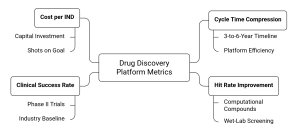
Cycle Time Compression.
Can the company demonstrate that it takes substantially less time to move from target identification to an IND-ready candidate than the industry average? The historical average for a pre-clinical development program is three to six years. Platforms claiming to halve this need supporting data, not just claims.
Hit Rate Improvement
What percentage of compounds generated by the platform advance through internal screening? A demonstrably higher hit rate relative to conventional approaches is one of the strongest validation signals.
Clinical Success Rate.
For more mature platforms with multiple clinical assets, early signals on Phase I and Phase II success rates matter enormously. The industry average Phase II success rate across all therapeutic areas sits around 40%. Platforms claiming to improve this need credible mechanistic explanations, not just optimism.
Cost per IND.
How much does it cost the company to generate a candidate ready for first-in-human studies? Lower cost per IND means the platform can sustain a broader pipeline at the same burn rate, translating into more shots on goal per dollar invested.
Partnership Deals as Validation Signals
For pre-revenue AI biotech platforms, partnership deals with large pharma companies are among the most credible external validation signals available. When a major pharmaceutical company pays an upfront fee and agrees to milestone payments for access to an AI platform's discovery capabilities, it signals that credible technical experts with access to proprietary comparison data have reviewed the platform and found it valuable.
Investors pay close attention to the structure of these deals, not just the headline value. A deal with a large upfront payment and biologically validated targets is worth significantly more as a signal than a research collaboration with a modest fee and no downstream economics. The former suggests the pharma partner believes in near-term value; the latter may simply reflect exploratory interest.
Partnership deals don't just signal value, they build it.
Here's the full playbook from platform hype to real pharma revenue.
→ Read: Commercialization Strategy | AI Driven Biotech Company
Risk Factors That Investors Watch
Even with strong platform metrics and pharma partnerships, several risk categories remain material for institutional investors:
- Regulatory ambiguity: Regulatory agencies are still developing frameworks for AI-designed drugs. Interpretability of AI-generated data packages is an open question at both the FDA and the EMA.
- Key person risk: Many AI biotech platforms are closely tied to their scientific founders. The departure of a key algorithm developer or chief scientist can meaningfully affect platform reproducibility.
- Model drift: AI models trained on historical biological data can lose predictive accuracy as biological knowledge advances. Continuous retraining requires ongoing investment.
- Overfitting to known biology: Platforms trained on well-characterised targets may not generalise well to novel or underexplored disease biology.
FAQs
Q1. What is an AI biotech platform?
An AI biotech platform is a company that uses artificial intelligence and machine learning to accelerate drug discovery, from target identification through to candidate selection, often generating multiple drug programs simultaneously.
Q2. How do investors value AI-driven drug discovery companies?
Investors typically use a combination of risk-adjusted NPV for the clinical pipeline and a separate platform premium based on comparable deals, data moat strength, and validated discovery metrics.
Q3. What makes AI biotech investments risky?
Key risks include regulatory uncertainty around AI-generated data, reliance on proprietary training datasets, limitations in model accuracy, and the challenge of validating platform claims before clinical proof of concept.
Q4. What signals do institutional investors look for in AI biotech?
Pharma partnership deals, published platform validation data, cycle time compression metrics, and the presence of clinical-stage assets generated by the platform are among the strongest signals.
Q5. Can AI biotech companies be valued without clinical data?
Yes, but with significant uncertainty. Pre-clinical AI biotech companies are often valued using platform-comparable analysis, deal-precedent multiples, and milestone-based frameworks rather than traditional rNPV models.
Reporting on the science, business and regulation shaping the pharmaceutical industry.
More in Leadership
All articles →
Essential Leadership Skills for Success in the Pharmaceutical Industry
Pharmaceutical Regulatory Affairs: Roles, Skills, and Roadmap

Discussion