The mRNA Revolution: Lessons In Speed, Agility & Courage Under Pressure In The Pharmaceutical Industry
The mRNA revolution reshaped pharma innovation, accelerating vaccine development and redefining speed, agility, and collaboration.


When the world shut down in early 2020, the pharmaceutical industry faced a type of pressure it had never encountered before. Conventional vaccine development timelines, often stretching across 10 to 15 years- were suddenly incompatible with the urgency of a global public health emergency. It was in this unprecedented crisis that an extraordinary scientific evolution took center stage: messenger RNA (mRNA) technology.
What had once been considered an experimental therapeutic platform became the backbone of the fastest vaccine development and rollout in human history. However, the story of mRNA is not just about technology; it is also about speed, agility, collaboration, regulatory flexibility, and the courage to face pressure. These qualities have permanently reshaped the pharma ecosystem.
A Technology Decades in the Making—Not an Overnight Breakthrough
While the public narrative often assumes mRNA vaccines were developed in a matter of months, the actual timeline spans more than three decades. Research pioneers like Katalin Karikó and Drew Weissman spent years overcoming mRNA’s biggest technical barriers, its instability and its tendency to trigger harmful immune responses. Their 2005 discovery of nucleoside modifications was one of the most significant scientific milestones, enabling synthetic mRNA to enter cells without triggering destructive inflammatory cascades.
Simultaneously, advancements in lipid nanoparticle (LNP) delivery systems created an effective mechanism for protecting fragile mRNA molecules and facilitating their uptake by antigen-presenting cells. Without these breakthroughs, the rapid development of COVID-19 vaccines would not have been possible.
Thus, when the crisis hit, the science was ready, even if the systems surrounding it were not.
Speed: Redefining the Vaccine Development Clock
The timeline achieved for mRNA COVID-19 vaccines rewrote the speed benchmarks for pharma. Moderna moved from sequence selection to first human dosing in just 63 days. BioNTech and Pfizer delivered a vaccine with Phase III efficacy data in less than a year.
This unprecedented speed was enabled by several technical and operational accelerators:
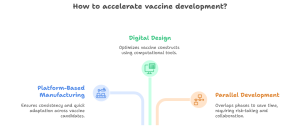
Platform-Based Manufacturing:
Unlike traditional vaccines, mRNA vaccines rely on a modular platform. Once the sequence encoding the antigen is known, the manufacturing process remains largely unchanged. The core steps—IVT (in vitro transcription), capping, purification, and LNP formulation, are consistent across candidates. This allowed companies to pivot quickly while maintaining control of CMC parameters.
Digital Design and Sequence-Level Agility:
Because mRNA vaccines are digitally designed, researchers can optimize constructs using computational tools, rapid codon optimization, structure prediction algorithms, and in silico antigen design. What previously relied on physical cultures could now be streamlined through bioinformatics.
Parallel, Not Sequential, Development:
To save time, companies ran preclinical studies, scale-up, technology transfer, and manufacturing validation in overlapping phases. This approach required unprecedented financial risk-taking and strong collaboration between R&D, manufacturing, regulatory, and supply chain teams.
The success of these strategies demonstrated that speed does not have to compromise scientific rigour, if systems are designed intelligently.
Agility: The New Competitive Advantage in Pharma
The true genius of mRNA platforms lies in their inherent adaptability. Agility emerged as one of the most valuable assets in the pharma industry during the pandemic, and mRNA vaccines showcased it better than any technology before.
Rapid Antigen Switching
One of the most remarkable features of mRNA vaccines is the ability to quickly update sequences. As SARS-CoV-2 variants emerged, developers simply redesigned the mRNA sequence while retaining the same delivery vehicle and manufacturing platform. The ability to reconfigure a vaccine in weeks, rather than months, demonstrates the power of genetic programmability.
Scalable Manufacturing
mRNA manufacturing is cell-free, faster, and more scalable than traditional biologics production, which often relies on mammalian cell cultures or egg-based systems. Companies invested in flexible facilities capable of switching between different mRNA candidates with minimal revalidation.
Global Collaboration Networks
mRNA vaccines accelerated a new era of partnership models. From contract manufacturing organizations (CMOs) and analytical labs to lipid suppliers and cold-chain distributors, global networks operated with agility to meet explosive demand. These collaborations were no longer linear arrangements; they became dynamic ecosystems where information flowed continuously.
Agility, once viewed as a nice-to-have attribute in large pharmaceutical companies, is now considered a fundamental capability of future-ready organisations.
Regulatory Courage: Flexibility Without Compromising Safety
Regulators worldwide demonstrated that innovation in oversight is as important as innovation in science. Rolling submissions, real-time data monitoring, and emergency use authorizations (EUAs) allowed companies to accelerate timelines without bypassing essential safety checkpoints.
Regulatory bodies also demonstrated courage by embracing:
- Novel CMC approaches, particularly around LNP characterization, encapsulation efficiency, and IVT purity profiles
- Adaptive clinical trial designs, enabling faster cycle times and early-stage insights
- Global harmonization, where agencies shared data and aligned expectations to avoid redundant delays
The success of mRNA vaccines proved that regulatory agility can coexist with patient safety, a lesson that continues to influence how agencies evaluate new modalities like gene editing, siRNA therapeutics, and personalized cancer vaccines.
Courage Under Pressure: A Human Story as Much as a Scientific One
Behind the extraordinary scientific progress were thousands of individuals making high-stakes decisions under intense pressure. Scientists who spent years defending mRNA research—often dismissed by colleagues and funders, finally saw their work validated. Manufacturing teams spent months scaling processes that had never been scaled before. Regulatory professionals worked around the clock to evaluate data in real time. Leadership teams placed billion-dollar bets on facilities and supply chains without knowing whether the vaccines would succeed.
Courage was not only present in science; it was embedded in leadership, operations, and decision-making.
This is one of the biggest lessons from the mRNA revolution: progress in pharma is not driven only by technology, but by the courage to trust the science before it becomes conventional wisdom.
The Post-Pandemic Impact: How mRNA Is Rewriting Pharma’s Future
The pandemic may have accelerated mRNA adoption, but its influence is just beginning. The long-term impact is clear: mRNA is not just a pandemic-era technology, but a transformative engine for the next generation of medicines.
Today, dozens of mRNA candidates are advancing across multiple therapeutic areas:
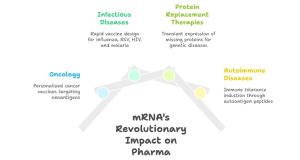
Oncology
Personalised cancer vaccines, such as those targeting neoantigens, rely heavily on mRNA’s ability to encode individualised sequences rapidly. Early trials in melanoma and pancreatic cancer show promising immunogenicity.
Infectious Diseases Beyond COVID-19
mRNA pipelines are expanding into the treatment of influenza, RSV, CMV, HIV, and even malaria. The ability to rapidly design vaccine constructs could overhaul seasonal vaccine development cycles.
Protein Replacement Therapies
mRNA offers a transient yet efficient method for expressing missing or defective proteins, potentially addressing rare genetic diseases without requiring permanent genomic alterations.
Autoimmune Diseases
mRNA platforms are being tested for the induction of immune tolerance by encoding autoantigen peptides.
Key Lessons the Pharmaceutical Industry Must Carry Forward
While the pandemic was an extraordinary circumstance, the principles that emerged are universally applicable:
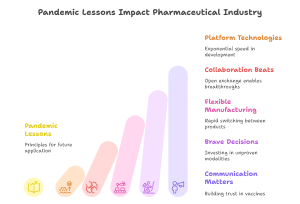
1. Platform technologies unlock exponential speed.
mRNA has demonstrated that modular manufacturing and digital design can significantly reduce development timelines.
2. Collaboration beats competition during crises.
Open exchange among regulators, scientists, manufacturers, and suppliers enabled breakthroughs unimaginable under traditional siloed structures.
3. Flexible manufacturing is the future.
Pharma companies are now investing heavily in multi-modal facilities that support rapid switching between products.
4. Brave decisions drive innovation.
Companies that took bold risks, investing in unproven modalities at scale, led the world out of crisis.
5. Communication matters as much as science.
Clear, transparent communication with the public, regulators, and global health bodies was essential to building trust in mRNA vaccines.
Conclusion: The mRNA Era Has Only Just Begun
The success of mRNA vaccines during the COVID-19 pandemic was more than a scientific milestone; it was a turning point in how the pharmaceutical industry approaches innovation. Speed, agility, and courage—once considered conflicting with traditional pharma norms, have emerged as necessities for future growth.
The mRNA revolution has demonstrated that the industry can move quickly, remain safe, and still deliver unprecedented scientific advances. As mRNA therapeutics continue to expand into oncology, rare diseases, infectious diseases, and beyond, the lessons learned under pressure will guide pharma into a new era of smarter, faster, and more adaptive innovation.
The future of medicine is programmable, and the industry is more prepared than ever to embrace it.
FAQs
1. What makes mRNA vaccines faster to develop than traditional vaccines?
mRNA vaccines use a digital, sequence-based design and a standardized manufacturing platform, which drastically shortens development and production timelines.
2. How were mRNA vaccines approved so quickly without compromising safety?
Rolling data reviews, adaptive trials, and emergency authorisations enabled accelerated evaluation while maintaining rigorous safety assessments.
3. Why is mRNA technology considered a platform?
The core manufacturing process remains consistent across vaccines; only the encoded sequence changes, making it modular and scalable.
4. What future diseases could mRNA vaccines target?
Research is ongoing for influenza, HIV, RSV, CMV, Lyme disease, and personalised cancer vaccines.
5. How did the pandemic reshape pharma innovation?
It accelerated digital adoption, cross-industry collaboration, regulatory agility, and investment in flexible, platform-based technologies.
Reporting on the science, business and regulation shaping the pharmaceutical industry.
More in Leadership
All articles →
Essential Leadership Skills for Success in the Pharmaceutical Industry

Pharmaceutical Regulatory Affairs: Roles, Skills, and Roadmap

Discussion