Why Pharma Brands Are Choosing Trust Over Traffic in 2026
From TikTok skinny-shot scandals to AI Overviews, pharma branding now hinges on being trusted, not just seen. Here's what's changed.

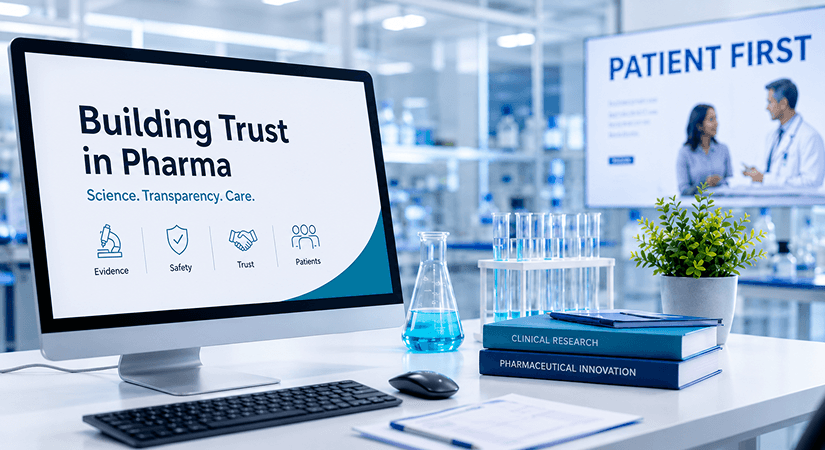
A few years ago, a woman on TikTok held up a pen she'd bought from a stranger online and called it her "skinny shot." She didn't know the drug's real name, didn't know the dose, and definitely didn't know it had come from an unregulated source.
She injected herself anyway. Stories like hers are part of why the semaglutide boom became a cautionary tale for the whole industry, counterfeit pens, black-market sales, and an FDA warning that followed. It was a wake-up call: chasing attention without earning trust can genuinely hurt people.
That lesson has stuck. Walking into the second half of 2026, pharma marketing looks very different from even two years ago. It's not just about being seen anymore; it's about being believed.
The Problem Hasn't Gone Away, It's Just Changed Shape
Doctors are still buried in digital touchpoints. Patients are still scrolling past wellness fads dressed up as medical advice. But there's a new twist: people increasingly aren't searching Google at all. They're asking ChatGPT, Perplexity, or Google's AI Overviews directly, and getting an answer without ever clicking through to a website.
Industry researchers estimate that traditional search volume could drop sharply as generative AI search becomes the default, and that a growing share of health-related questions are now answered in AI chat rather than on search results pages.
This is a real shift for pharma communicators. It's no longer enough to rank on page one. Brands now need their content to be accurate and well-structured enough for an AI assistant to trust it as a source when answering someone's health question. Marketers are calling this "answer engine optimisation," and it's becoming as important as traditional SEO.
Why Trust Still Beats Volume
The core tension from a few years ago hasn't disappeared: evidence-based substance versus attention-grabbing noise. If anything, it's sharper now, because AI tools can also amplify bad information at scale if brands aren't careful.
The good news: patients haven't stopped trusting their doctors. Recent industry surveys suggest the vast majority of patients still rank their healthcare provider as their most trusted source of information, even in an AI-saturated world.
And physicians themselves are leaning on AI more than ever for clinical decision support, many now weigh AI-generated recommendations alongside their own judgment. That means pharma content aimed at HCPs needs to be precise enough to hold up next to a clinical AI assistant, not just persuasive enough to survive a sales call.
Campaigns Getting It Right
The best pharma campaigns of the past two years didn't lean on gimmicks. They led with honesty:
What ties these together is simple: they gave people something useful or something true, not just something loud.
Dermavant's AR game isn't a one-off.See the fuller playbook of trust-first digital tactics reshaping HCP and patient engagement in pharma.
→ Read: Pharma's Digital Reset: Trust, Relevance, and Engagement in 2025
What's New in 2026
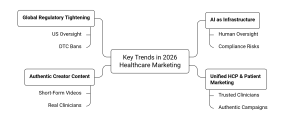
AI is now infrastructure, not an experiment. A couple of years ago, AI in pharma marketing meant testing a chatbot or a segmentation tool. Now it's baked into everyday workflows, predictive analytics, personalised outreach timing, and content creation at scale. The catch: regulators and compliance teams are watching closely, and human oversight hasn't gone away. If anything, it matters more because a compliance mistake made by an AI system is still the brand's mistake.
HCP and patient marketing are merging. Instead of running separate campaigns for doctors and patients, brands are connecting the two, for example, having a trusted clinician speak directly to patients in a way that feels authentic rather than scripted. Care doesn't happen in silos, so increasingly, marketing doesn't either.
Short-form video and creator content keep growing. Clinicians and patient advocates explaining conditions in plain language on TikTok or Instagram are outperforming polished traditional ads for a simple reason: they read as advice from a peer, not a brand pitch.
Regulators are catching up, slowly. In the US, the Protecting Patients from Deceptive Drug Ads Act, which aims to bring paid influencer promotions of prescription drugs under FDA oversight, has been introduced in Congress but has not yet been signed into law. It would require disclosure of payments to influencers and give the FDA clearer power to act against misleading posts.
Until it passes, enforcement in this space remains patchy. In the EU, Japan, and South Korea, direct-to-consumer drug advertising is still banned, keeping the regional focus on disease education rather than promotion.
Sanofi, J&J, and Bayer are already running AI deep into their marketing stacks.
See how they're using it, and where compliance still draws the line.
→ Read: AI in Pharma: Marketing Strategies for Success
What This Means for Pharma Marketers Right Now
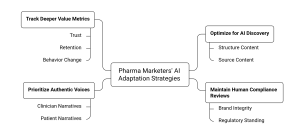
A few practical shifts worth building into any 2026 content strategy:
- Write for AI discovery, not just search rankings. Structured, well-sourced content is more likely to get cited when someone asks an AI assistant a health question
- Keep a human reviewing every AI-assisted output before it goes out; compliance risk doesn't disappear just because a machine wrote the first draft
- Favour real clinician and patient voices over polished brand messaging wherever compliance allows
- Track deeper metrics, trust, retention, behaviour change, rather than clicks alone
The Bottom Line
The digital attention economy hasn't slowed down, but the rules for winning it have changed. In 2026, the pharma brands earning attention are the ones an AI assistant would trust enough to cite, and a patient would trust enough to believe. That's a higher bar than it used to be, but it's the right one.
FAQs
1. Why is trust more important than reach in pharma marketing now?
Because AI search tools and patients alike are filtering out content that isn't credible, so unreliable messaging simply doesn't get seen.
2. Has the Protecting Patients from Deceptive Drug Ads Act become law?
No, as of mid-2026, it remains a bill introduced in Congress and has not yet been passed.
3. What is "answer engine optimisation" in pharma marketing?
It's the practice of structuring content so AI tools like ChatGPT or Google AI Overviews can accurately cite it when answering health questions.
4. Do patients still trust doctors more than social media or AI?
Yes, surveys continue to show patients rank their healthcare provider as their most trusted source of health information.
5. Are direct-to-consumer drug ads allowed in Europe?
No, DTC prescription drug advertising remains banned across the EU, as well as in Japan and South Korea.
Reporting on the science, business and regulation shaping the pharmaceutical industry.
More in Leadership
All articles →
Essential Leadership Skills for Success in the Pharmaceutical Industry
Pharmaceutical Regulatory Affairs: Roles, Skills, and Roadmap
Discussion