10 Leadership Training Programs to Empowering the Next Generation of Pharma Leaders
10 globally respected pharma leadership training programs ranked by career stage for CHROs and senior leaders.

Why Pharma Leadership Needs Re-Skilling
The pharmaceutical industry no longer rewards tenure alone. Today's leaders must execute under regulatory pressure, lead cross-functional teams, manage global supply chains, and translate innovation into compliant outcomes. From GMP shopfloors to R&D labs and commercial war rooms, leadership capability has become a strategic asset.
For CHROs and senior leaders, the question is no longer whether to invest in leadership development, but which leadership programs truly move the needle.
This Pharma Now guide curates 10 globally respected and India-accessible pharma leadership training programs, ranked by career stage and aligned to manufacturing, quality, R&D, and commercial roles.
Career Stage 1: Emerging Leaders & First-Time Managers
20260307120209.svg)
Who This Stage Is For
Supervisors, team leads, senior executives stepping into people management, and high-potential professionals being groomed for leadership.
This stage is less about "inspiring vision" and more about learning to hold the operational fort. You are still close to the shop floor, the batch records, the deviations, and the audit trails, but now people look to you for decisions, clarity, and calm.
1. ISPE Emerging Leaders Program
Provider: International Society for Pharmaceutical Engineering Best for: Manufacturing, Engineering, Quality, Validation Access: Global and India chapters | Hybrid formats
This program is built for professionals who are promoted because they are technically strong and suddenly find themselves managing people, timelines, and compliance together.
Rather than abstract leadership models, ISPE anchors learning in regulated execution. Participants are trained to think like leaders who must deliver under GMP pressure, where every decision leaves a paper trail.
What You Really Gain
- How to lead teams without breaking compliance
- Translating SOPs and regulatory expectations into daily execution
- Managing cross-functional friction between production, quality, and engineering
Key Strengths
- Real-world GMP and manufacturing scenarios
- Heavy focus on operational decision-making
- Access to peers facing the same early leadership challenges
This program quietly teaches an essential truth of pharma leadership: you don't lead around regulations, you lead through them.
2. PDA Training & Leadership Workshops
Provider: Parenteral Drug Association Best for: Quality, Sterile Manufacturing, QA/QC Access: India-accessible | Online and in-person
In sterile and injectable operations, leadership mistakes do not stay theoretical. They show up as deviations, CAPAs, and uncomfortable inspection conversations.
PDA's leadership workshops are valued because they treat leadership as a quality system, not a soft skill.
Why This Matters
PDA trains leaders to:
- Handle deviations with maturity and accountability
- Build inspection-ready teams, not inspection-fearful ones
- Embed quality culture into daily behavior, not posters on walls
This is leadership education where phrases like "decision rationale," "risk-based thinking," and "right-first-time mindset" are not buzzwords, but survival tools.
If ISPE teaches you to execute under regulation, PDA teaches you to think like a regulator-ready leader.
3. Coursera Leadership Programs for Life Sciences
Provider: Coursera Best for: Cross-functional roles, early-career professionals Access: Fully online | Budget-friendly
Coursera does not position itself as pharma-specific leadership training, and that is precisely its value at this stage.
Curated leadership tracks from global universities help emerging leaders build foundational human skills that technical roles rarely teach.
What It's Ideal For
- Communication across functions like R&D, QA, and Manufacturing
- Accountability without authority
- Decision-making under ambiguity
For young professionals preparing for their first formal people-management role, Coursera acts like a leadership gym. You build muscle memory in feedback, delegation, and conflict handling before stepping into high-stakes pharma environments.
In Short
Career Stage 1 leadership is about learning to lead while still doing. You are balancing batch records with team dynamics, SOPs with human emotions, and timelines with quality.
Programs like ISPE and PDA ground you in pharma reality. Platforms like Coursera round out the human side. Together, they prepare emerging leaders to move from "excellent individual contributor" to "dependable first-line leader" without cracking under regulatory pressure.
Career Stage 2: Mid-Level Leaders & Functional Heads
Who This Stage Is For
Department heads, project leaders, site-level function managers, and leaders who now own outcomes, not just activities.
At this stage, leadership shifts gears. You are no longer judged only on how well your team performs, but on how your decisions ripple across quality, cost, supply continuity, and business risk. This is where pharma leaders begin carrying business accountability on their shoulders.
4. IIM Ahmedabad – General Management Programme for Pharma Executives
Provider: Indian Institute of Management Ahmedabad Best for: Manufacturing, Quality, Commercial Access: India | Executive education
This program is designed for pharma leaders who have mastered execution and now need to understand the full enterprise picture.
IIM Ahmedabad places leaders in scenarios where a single decision touches regulatory exposure, supply chain resilience, financial performance, and market trust simultaneously. The learning is less about functional depth and more about decision consequence awareness.
What the Program Builds
- Strategic thinking grounded in pharma realities
- Understanding how plant decisions impact commercial outcomes
- Financial and risk literacy for technical leaders
CHRO Insight
This is a strong option for leaders transitioning from technical excellence to business ownership. It helps quality heads, manufacturing leaders, and commercial managers speak a common leadership language.
This is where leaders stop asking, "Is this compliant?" and start asking, "Is this sustainable for the business?"
5. IIM Calcutta – Leadership Programme for Manufacturing Excellence
Provider: Indian Institute of Management Calcutta Best for: Manufacturing, Operations, Supply Chain Access: India | Executive format
If IIM Ahmedabad broadens perspective, IIM Calcutta sharpens operational discipline.
This program is deeply rooted in execution under constraint, something pharma manufacturing leaders know all too well. Capacity limits, regulatory pressure, cost controls, and human variability are treated as leadership design problems, not excuses.
What Sets It Apart
- Strong focus on process excellence and continuous improvement
- Decision-making at plant and shop-floor leadership levels
- Systems thinking for complex manufacturing environments
It is particularly effective for leaders responsible for multi-line plants or sites preparing for regulatory inspections while scaling output.
In short, this program teaches leaders how to run a plant like a system, not a firefight.
6. ISB Certificate Programme in Leadership & Change Management
Provider: Indian School of Business Best for: Cross-functional pharma leaders Access: India | Blended learning
Modern pharma organizations are matrixed, global, and heavily regulated. Authority is often diffused, but expectations are not. ISB's leadership programs are particularly valued for addressing this paradox.
The program focuses on leading change when you do not control all the levers, a daily reality for pharma leaders managing cross-functional programs, tech transfers, or transformation initiatives.
Core Leadership Capabilities Developed
- Influencing without positional authority
- Driving change across quality, manufacturing, and commercial teams
- Managing resistance in regulated environments
This program is ideal for leaders spearheading digital transformation, operational excellence initiatives, or cultural change where alignment matters more than hierarchy.
In Short
Career Stage 2 is where pharma leaders move from managing teams to managing systems. Your success depends on how well you:
- Balance strategy with operational reality
- Align quality, cost, and speed without trade-offs
- Influence across functions rather than command within silos
IIM Ahmedabad broadens strategic and business thinking. IIM Calcutta deepens operational leadership. ISB equips leaders to move people and systems through change.
Together, these programs prepare leaders for the next leap, where leadership becomes less visible but far more consequential.
Career Stage 3: Senior Leaders, Site Heads & Directors
Who This Stage Is For
CXOs, site heads, business unit leaders, and enterprise decision-makers carrying regulatory, financial, reputational, and human risk simultaneously.
At this level, leadership is no longer visible in daily operations. It appears in the questions you ask, the trade-offs you allow, and the culture you tolerate. Decisions echo across regulators, investors, patients, and markets, often long after the meeting ends.
7. Harvard Business School – Leadership in Regulated Industries
Provider: Harvard Business School Best for: Enterprise leadership, global roles Access: Online and on-campus options
This program is designed for leaders operating where regulation, ethics, and performance collide. Rather than treating regulation as a constraint, HBS reframes it as a strategic landscape that must be navigated with judgment and moral clarity.
Senior pharma leaders explore how decisions are interpreted not only by internal teams, but by regulators, media, and the public.
What the Program Sharpens
- Regulatory strategy across FDA, EMA, and global agencies
- Ethical decision-making under public and political scrutiny
- Crisis leadership in high-stakes, low-margin-for-error environments
Strategic Value
Ideal for leaders carrying global regulatory exposure and brand risk, especially those accountable for patient safety and corporate integrity at scale.
This is leadership training for moments when there is no SOP to hide behind.
8. INSEAD Advanced Management Programme (AMP)
Provider: INSEAD Best for: Global leadership, strategy roles Access: Europe, Asia, Online
Pharma is global by design. Molecules travel, regulations differ, cultures collide. INSEAD's AMP is chosen by pharma leaders who must operate comfortably across continents without losing strategic coherence.
The program emphasizes global mindset, cultural intelligence, and strategic alignment across geographies.
Why Pharma Leaders Choose It
- Exposure to truly global peer cohorts
- Deep work on leadership presence and executive decision-making
- Strategy execution across culturally diverse organizations
INSEAD does not teach you what to think. It teaches you how to lead when the room speaks multiple business languages.
9. Wharton Executive Education – Strategic Leadership Program
Provider: Wharton School Best for: Commercial, strategy, transformation leaders Access: Online and global campuses
Wharton's executive programs are built for leaders who believe strategy must be measurable, defensible, and economically sound.
For pharma leaders managing portfolio decisions, pricing pressure, digital transformation, or market expansion, Wharton sharpens the ability to connect leadership choices with financial and market outcomes.
What Distinguishes Wharton
- Data-driven strategy and decision frameworks
- Financial acumen for complex, regulated markets
- Aligning innovation, execution, and shareholder value
This is leadership education for executives who want their intuition backed by numbers and their vision anchored in market reality.
In Short
Career Stage 3 leadership is about stewardship. You are no longer optimizing functions; you are protecting trust.
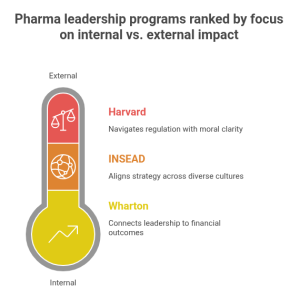
- Harvard sharpens regulatory judgment and ethical leadership
- INSEAD builds global fluency and executive presence
- Wharton anchors strategy in data, finance, and market logic
Together, these programs prepare leaders to carry the full weight of pharma leadership, where decisions must satisfy regulators, investors, employees, and patients all at once.
Career Stage 4: Role-Specific & Future-Focused Leaders
Who This Stage Is For
Innovation heads, R&D directors, digital pharma leaders, and transformation champions driving next-generation therapies, technologies, or operational models.
At this level, leadership is less about hierarchy and more about foresight. Leaders are expected to convert scientific breakthroughs, digital solutions, or transformational ideas into compliant, scalable, and market-ready outcomes. Success is measured not by daily operational control, but by how well they future-proof the organization and deliver sustainable innovation.
10. MIT Sloan – Leadership for Innovation
Provider: MIT Sloan School of Management Best for: R&D, Digital Pharma, Innovation Heads Access: Online & Global
MIT Sloan's Leadership for Innovation program is designed for leaders who sit at the intersection of science, technology, and business impact. The curriculum emphasizes translating scientific and digital potential into real-world results while navigating regulatory, ethical, and market constraints.
What the Program Develops
- Innovation-to-implementation skills: Convert lab discoveries into patient-ready products
- Agile leadership mindset: Lead cross-functional teams through uncertainty and high-risk environments
- Regulatory foresight: Integrate compliance into the innovation lifecycle from ideation to launch
- Strategic influence: Align stakeholders across R&D, commercial, regulatory, and executive leadership
Why It Matters for Pharma Leaders
In industries like pharma, success is not just invention — it's responsible scaling. MIT Sloan equips leaders to balance speed, risk, and compliance, ensuring that breakthrough science can safely reach patients while driving business value.
Key Outcomes
- A mindset to anticipate and shape the future of pharma innovation
- Practical frameworks for leading transformative digital or scientific projects
- Confidence to influence decision-making in highly matrixed, technically complex organizations
This stage of leadership is about vision with discipline: seeing opportunities others can't, but translating them into tangible, measurable, and compliant results.

Checklist: How CHROs Should Choose the Right Pharma Leadership Program
1. Assess Career Stage & Readiness
Identify whether the participant is an emerging leader, mid-level manager, senior leader, or future-focused innovator. Confirm that the program's learning outcomes match the individual's current responsibilities and growth trajectory.
2. Ensure Functional Alignment
Check if the program addresses the participant's function: Manufacturing, Quality, R&D, Commercial, or cross-functional. Verify relevance to day-to-day challenges and strategic responsibilities.
3. Evaluate Regulatory Exposure
Determine whether the program covers regulated environments, GMP execution, FDA/EMA compliance, or quality culture. Assess if it prepares leaders for real-world inspection and compliance scenarios.
4. Check Accessibility & Scalability in India
Confirm availability for India-based participants, including online, hybrid, or on-campus options. Consider scalability for larger teams or multiple cohorts.
5. Measure Post-Program Application & ROI
Look for programs that emphasize practical, actionable skills, not just theory. Evaluate frameworks for translating learning into measurable business impact. Assess networking opportunities and long-term mentorship potential.
Key Reminder
Leadership training fails when it stays theoretical. The best programs show how work actually breaks down and teach leaders how to fix it — bridging skills, behavior, and business outcomes.
Final Thought: Leadership Is the New Manufacturing Asset
In pharma, plants, pipelines, and portfolios matter. But leadership capability determines whether they deliver. As regulatory expectations rise and execution windows shrink, investing in the right leadership training programs is no longer optional, it is strategic.
FAQs
1. Are Pharma Leadership Programs Different From General Leadership Programs?
Yes. Pharma leadership programs address regulatory pressure, quality systems, validation, and inspection readiness, which general programs often overlook.
2. Which Leadership Programs Are Best for Pharma Manufacturing Leaders?
Programs from ISPE, IIM Calcutta, PDA, and internal pharma academies are particularly effective for manufacturing and operations leaders.
3. Are There Good Pharma Leadership Programs Available Online in India?
Yes. ISB, Coursera, Harvard Online, and ISPE offer India-accessible or fully online options.
4. Should Technical Experts Pursue Leadership Training Early?
Absolutely. Early leadership training prevents the common trap of promoting technical experts without preparing them for people and execution management.
5. How Do CHROs Measure ROI From Leadership Training?
ROI improves when programs are tied to execution metrics, such as deviation reduction, project delivery, inspection outcomes, and team engagement.
Reporting on the science, business and regulation shaping the pharmaceutical industry.
More in Leadership
All articles →
Essential Leadership Skills for Success in the Pharmaceutical Industry
Pharmaceutical Regulatory Affairs: Roles, Skills, and Roadmap

Discussion