Why Pharma Projects Fail Quietly: A Forensic Analysis Of Delays, Deviations, And Decision Gaps
A forensic analysis of delays, deviations, and decision gaps that quietly derail pharma projects.


In the pharmaceutical industry, project timelines and budgets can look strong on paper, yet many initiatives struggle, lose momentum, or underperform without ever making headlines. These are quiet failures, projects that don’t explode in crisis, but slowly drift off course, slipping deadlines, creeping costs, and missed expectations. Behind this often subtle decline lies a junction of issues: operational delays, process deviations, and decision gaps that, when untreated, compound into significant project risk.
To understand why pharma projects fail quietly, we must look deeper than surface symptoms. We must examine how complex variables, dynamic regulatory requirements, interdisciplinary dependencies, and human decision patterns interact in everyday project execution.
This blog offers a forensic analysis of the key drivers, delays, deviations, and decision gaps, unpacking how they occur, why they erode project integrity, and what leaders can do to prevent them.
Pharma Projects Are Complex Systems, Not Linear Timelines
A key reason pharma projects fail quietly is that they are complex adaptive systems, not simple conveyors from point A to point B. A drug development lifecycle, facility construction, process validation, or regulatory submission involves multiple teams, external partners, shifting requirements, and critical decision nodes.
Unlike building a static product, pharmaceutical programs must satisfy:
- Scientific uncertainties
- Regulatory scrutiny (multiple agencies and regions)
- Quality and compliance frameworks (GMP, GLP, GCP)
- Cross-functional dependencies (R&D, QA/QC, Manufacturing, Regulatory, Supply Chain)
Misalignment in any one of these areas doesn't immediately look like failure; delays may be attributed to “routine adjustments,” cost impacts may be hidden, and deviations may be rationalised as exceptions. The cumulative effect, however, silently drains project viability.
Common Drivers of Quiet Failure
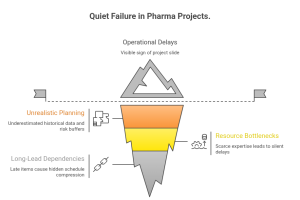
1. Operational Delays: The First Domino
Delays are the most visible sign of a silent project slide, yet they often go unchallenged until it’s too late. These delays typically originate from:
a) Unrealistic Planning
Many pharma plans assume ideal conditions. Historical data, risk buffers, and realistic task durations are often underestimated. Teams are pressured to promise aggressive timelines, leading to fragile schedules that break under normal variability.
Even a two-week delay in regulatory documentation review can ripple through subsequent tasks such as stability testing, validation protocols, or technical transfer meetings.
b) Resource Bottlenecks
Projects often share scarce expertise in areas like biostatistics, regulatory writing, quality assurance, or validation engineering. When a team member becomes unavailable due to reassignment or attrition, the delay is absorbed silently, and adjustments are made on the fly.
c) Long-Lead Dependencies
Pharma projects depend on long-lead items, specialised equipment, custom reagents, external lab slots and external approvals, ethics committees, and CRO confirmations. If these are late, project teams may compensate by compressing future activities without addressing the core delay.
Over time, this creates hidden schedule compression, tasks may start before prerequisites are complete, sowing the seeds of deviation later.
2. Deviations: From Minor to Major Without a Bang
In pharma terms, a deviation is an unintended departure from a planned procedure, protocol, or specification. Deviations aren’t inherently destructive; many are managed daily in labs and manufacturing. The issue arises when small deviations are tolerated repeatedly, decisions are deferred, and corrective actions are superficial.
Consider the following pattern:
- A test method shows slight variability.
- The team documents it as a minor deviation.
- No root cause analysis (RCA) is performed.
- Future tests use the same method without correction.
Now you have chronic deviations; each individual event seems small, but their accumulation degrades data integrity, quality, and predictability.
Some underlying causes include:
a) Tolerance for Variance
Teams may rationalise minor departures as acceptable if they don’t immediately affect product quality. This creates a culture in which deviations are normalised rather than investigated.
b) Inadequate Training and Awareness
Operators and scientists may not fully understand the impact of a deviation. If they view deviation reporting as corrective rather than preventative, they may underreport or stop at superficial explanations.
c) Faulty Corrective Actions
A deviation report that ends with “retrained personnel” or “updated document language” without addressing systemic root causes rarely stops recurrence. Meaningful corrective actions require rigorous RCA, preventive action planning, and ongoing monitoring.
3. Decision Gaps: The Silent Governance Leak
If delays are the first domino and deviations are the cracks in the foundation, decision gaps are the unseen weathering that leads to building collapse.
A decision gap occurs when a critical choice is postponed, deferred, or passes without adequate evidence. Pharma projects revolve around decisions, from protocol changes and vendor selection to regulatory strategy and Go/No-Go milestones. When decisions lag or lack data support, several negative effects emerge:
a) Increased Ambiguity
Teams without clear direction default to assumptions. Scientists proceed based on experience, project managers fill in missing scope, and stakeholders interpret outcomes differently. Ambiguity breeds inconsistency.
b) Escalating Risk
Delayed decisions force teams to act with partial information. As risk tolerance increases over time, later decisions become even more frantic.
c) Accountability Gaps
When decisions are postponed, no one fully owns the next step. This leads to finger-pointing, redundant work, and further delays.
Decision gaps occur for many reasons:
- Leadership avoidance of uncomfortable choices
- Insufficient data to inform options
- Overlapping authority without clear ownership
- Fear of regulatory or quality consequences
Yet paradoxically, avoiding decisions often leads to worse outcomes than making a timely, informed choice, even if it needs reevaluation.
Hidden Patterns that Signal Quiet Failure
Projects that fail quietly almost always leave trace patterns if you look closely:
• Repeated schedule slips with soft justification: If every phase ends with “data still coming” or “pending review,” the planning baseline itself may be flawed.
• Increasing deviation reports with similar descriptions: This points to systemic issues rather than isolated errors.
• Escalating meetings but fewer outputs: More meetings often indicate confusion or lack of clarity.
• Reactive rather than proactive communication: When teams respond to issues only as they arise, rather than anticipate them, risk awareness is low.
• Deferred decisions moving between functions: This creates cross-functional misalignment.
Recognising these patterns early requires active project health monitoring, not just reporting status but interpreting signals.
Practical Weak Links and Their Impact
Below are specific areas where quiet failure often originates:
Regulatory Strategy Missteps
Pharma projects require regulatory alignment from the start. Misinterpretation of regional guidelines, late engagement with health authorities, or assumptions about approval pathways can cause months of rework.
An example: A product developed under a certain regulatory standard may later be found non-aligned with another jurisdiction’s requirement (e.g., analytical method validation expectations). This leads to parallel testing, delaying submission.
Quality Management System (QMS) Disconnects
When a QMS doesn’t integrate well with project execution, deviations are treated as isolated events rather than system indicators. A strong QMS embeds risk management, effectiveness checks for corrective actions, and trending analysis. Weak QMS approaches hide patterns.
Vendor and CRO Dependencies
Outsourcing is common in pharma. Contract Research Organisations (CROs), Contract Manufacturing Organisations (CMOs), and third-party labs fill capacity and expertise gaps. However, delays or quality issues from external partners often show up late, when rework or alternative sourcing becomes costly.
Transparent communication, contractual expectations with penalties, and early performance indicators are essential but often underemphasized.
Data and Documentation Bottlenecks
Pharma documentation is vast and rigorous. Electronic systems can help, but poor integration or inconsistent use creates bottlenecks. When teams work in disconnected silos, tracking version history, approvals, and cross-referencing becomes error-prone.
The Human Element: Why Good People Don’t Always Save Projects
Many pharma professionals are highly skilled and dedicated. Yet projects still slide. Why?
Complacency Toward Incremental Problems
Small issues don’t trigger alarms, especially if past project stages overcame similar problems. This leads to a gradual tolerance for slipping standards.
Fear of Escalation
Teams may avoid escalating issues due to fear of appearing incompetent, excessive bureaucratic workload, or a desire to preserve project harmony. This delays appropriate attention until it’s too late.
Communication Silos
Scientific, regulatory, and operational teams often speak different “languages.” Without a shared frame of reference, critical knowledge gets lost between handoffs.
Overemphasis on Milestone Reporting Over Issue Reporting
Metrics tend to focus on “on-time completion” rather than “quality of result.” A task completed on schedule but with poor data is a hidden risk.
Turning the Tide: How Leaders Can Prevent Quiet Failure
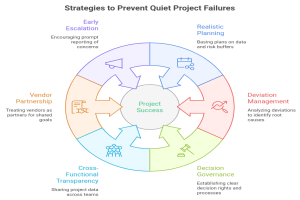
Understanding the root causes of quiet project failures is the first step. The next is applying practices that expose risk early and strengthen decision quality.
1. Build Realistic, Data-Driven Plans
Instead of aspirational timelines, base plans on historical performance, risk buffers, and scenario mapping. Conduct pre-mortems where the team imagines failure and identifies potential causes in advance.
2. Make Deviation Management Strategic
Deviations should trigger serious inquiry, not superficial responses. And track repeat deviations as early warning signals. Adopt structured root cause analysis methods such as:
- Fishbone Diagrams
- 5-Why Analysis
- Fault Tree Analysis
3. Strengthen Decision Governance
Establish clear decision rights. Define who decides, what data is required, and what timelines apply. Escalation paths must be frictionless and ensure accountability for timely resolution.
Decision checkpoints should have:
- Clear criteria (data, regulatory input, risk assessment)
- Defined owners
- Scheduled review rhythm
4. Enhance Cross-Functional Transparency
Use platforms that centralise project data, risks, issues, and decisions. Transparency reduces ambiguity and aligns teams.
Practices such as weekly cross-functional reviews, living issue logs, and decision dashboards help identify patterns early.
5. Treat Vendors as Partners, Not Contractors
Establish shared goals, frequent communication, milestone validations, and quality expectations. Don’t wait for a quarterly review to address performance concerns. Continuous vendor performance monitoring can prevent late surprises.
6. Promote a Culture of Early Escalation
Encourage teams to raise concerns promptly. Rewarding transparency over superficial compliance reduces hidden issues.
Case Example: The Cost of Delay in a Validation Protocol
Imagine a small-molecule drug nearing Phase III. The validation protocol for a critical analytical assay is written, but multiple iterations are required as the data shifts slightly. Rather than freezing the protocol early and documenting a robust risk assessment, the team chooses to refine repeatedly, waiting for the “perfect” version.
This decision gap delays final validation by six weeks. Because stability studies could not begin until validation was complete, the entire submission window slips. Regulatory filing, previously planned for Quarter 4, must now wait until the next cycle.
This quiet delay, stemming from a decision gap, cost months and millions in opportunity costs. Yet no single dramatic event occurred. It was a slow drift.
The Bigger Picture: Quiet Failure Erodes Trust and Confidence
Pharma projects aren’t just about meeting timelines. They are about delivering safe, effective therapies to patients who depend on them. Quiet failure not only impacts business outcomes but also damages organisational credibility, demoralises teams, and strains stakeholder trust.
When projects miss expectations without a clear explanation, investors question leadership, regulatory auditors probe systemic weaknesses, and teams become resigned to inefficiency.
Stopping quiet failure requires elevating project health metrics from superficial status to integrity indicators, metrics that reflect quality, predictability, and early risk signals.
Conclusion: Diagnose Early, Act Decisively
Pharma projects fail quietly, not because of one destructive event, but because of many small, interrelated issues:
- Planning that does not account for complexity,
- Deviations that go unexplained,
- Decisions that are postponed or underinformed.
Leaders must treat these patterns as a serious risk. With deliberate planning, disciplined deviation management, effective decision governance, and cross-functional transparency, pharma organisations can transform quiet risks into visible opportunities, ensuring projects stay on track, on schedule, and aligned with quality expectations.
Success in pharma isn’t just about avoiding failure. It’s about recognising the early whispers of issues before they become the quiet story of what could have been.
FAQs
1. Why do pharmaceutical projects often miss deadlines?
Pharma projects miss deadlines due to unrealistic planning, resource bottlenecks, regulatory changes, and complex dependencies. When timelines are overly optimistic and risks are underestimated, small delays snowball into larger schedule slips.
2. What is a project deviation in pharma?
A deviation is an unintended departure from an approved process or protocol. It can be procedural, technical, or documentation-related. If not addressed at the root cause level, deviations can recur and undermine quality and compliance.
3. What causes decision gaps in pharma project management?
Decision gaps occur when leaders delay critical choices due to a lack of data, fear of impact, unclear ownership, or conflicting priorities. These gaps create ambiguity and increase risks across interconnected project activities.
4. How can pharma teams prevent quiet project failure?
Teams can prevent quiet failure by using data-driven planning, strong deviation analysis, proactive risk communication, clear decision governance, and cross-functional transparency tools to detect and resolve issues early.
5. What role does quality management play in project success?
A strong quality management system ensures deviations are analysed effectively, corrective actions are durable, and trends are monitored. This prevents minor issues from becoming systemic problems that silently weaken project outcomes.
Reporting on the science, business and regulation shaping the pharmaceutical industry.
More in Leadership
All articles →
Essential Leadership Skills for Success in the Pharmaceutical Industry
Pharmaceutical Regulatory Affairs: Roles, Skills, and Roadmap

Discussion