Reinventing Pharma Leadership: How Unlearning, Not Experience, Prepares Leaders For Today’s Complexity
Why unlearning—not experience—is the key to effective pharma leadership in complex environments


For decades, leadership in the pharmaceutical industry was built on deep technical mastery, regulatory know-how, and long experience inside rigid development and manufacturing systems. Senior leaders often rose through research labs, quality units, supply chains, or commercial organisations, accumulating knowledge that became the foundation for decision-making.
Today, that same experience can become a limitation if it is not continuously questioned. The industry is facing forces that did not exist even ten years ago, such as digital health, real-world evidence, AI-enabled drug discovery, advanced therapy medicinal products (ATMPs), decentralised clinical trials, new regulatory pathways, and constant pressure on pricing and access.
In this environment, the most effective leaders are not those who rely only on what worked before. They are the ones who can unlearn, who can step back from old assumptions, challenge habits, and rebuild their thinking for a system that is far more complex, fast-moving, and interconnected than ever.
Why Traditional Experience Is No Longer Enough
Experience remains valuable in pharma. Understanding GxP systems, validation strategies, clinical development pathways, and regulatory expectations from agencies such as the FDA, EMA, or PMDA is essential. However, the context in which these systems operate has changed dramatically.
Adaptive trial designs and platform technologies are compressing drug development timelines. Manufacturing is shifting toward continuous processing, single-use systems, and digital twins. Regulatory authorities now expect data integrity controls, lifecycle management plans, and quality risk management frameworks that evolve in real time rather than through periodic reviews.
Leaders who grew up in more linear, function-based models may instinctively favour:
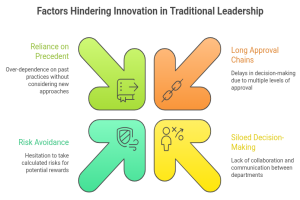
- Long approval chains
- Siloed decision-making
- Risk avoidance over calculated experimentation
- Heavy reliance on precedent
These approaches were once protective in a highly regulated industry. Today, they can slow innovation, create blind spots in emerging science, and limit collaboration across R&D, manufacturing, and market access.
Unlearning does not mean discarding experience. It means separating what is still valid from what no longer fits.
What “Unlearning” Really Means in Pharma
Unlearning is an active process. It is not forgetting facts or ignoring regulatory requirements. Instead, it involves questioning long-held beliefs about how work should be done and being open to new ways of operating.
In pharma leadership, unlearning often includes:
- Moving away from the idea that quality is owned only by QA toward an enterprise-wide quality culture.
- Letting go of stage-gate development models when platform processes and modular manufacturing can reduce handoffs.
- Replacing intuition-only decisions with data-driven insights from real-world evidence, process analytical technology (PAT), and advanced analytics.
- Accepting that regulators can be collaborative partners when engaged early through scientific advice and rolling submissions.
For example, a leader who spent twenty years running large-scale stainless-steel biologics facilities may need to rethink assumptions when overseeing cell and gene therapy manufacturing. Small batch sizes, vein-to-vein logistics, chain-of-identity controls, and rapid release testing require a different mindset from traditional bulk production.
Complexity Is the New Normal
Modern pharma operates inside a web of scientific, regulatory, and commercial complexity. Biologics, biosimilars, mRNA vaccines, antibody-drug conjugates, and personalised therapies all bring distinct development risks and supply chain needs. Clinical programs increasingly involve global sites, digital endpoints, and patient-reported outcomes captured through wearable devices.
At the same time, regulators are issuing new guidance on data integrity, continuous manufacturing, and post-approval change management. Health technology assessment (HTA) bodies demand potent real-world outcomes data to justify pricing and reimbursement decisions.
No single leader can master every domain. The role of leadership has shifted from being the most competent technical expert in the room to creating systems that enable experts to work together, learn quickly, and adjust course.
This shift requires unlearning the belief that authority comes only from seniority. In today’s environment, authority is increasingly tied to:
- The ability to integrate diverse views
- Comfort with uncertainty
- Willingness to run controlled experiments
- Speed in responding to new information
Unlearning in Key Pharma Leadership Areas
1. R&D and Innovation
In research organisations, leaders often need to unlearn rigid portfolio governance that favours incremental projects over bold science. AI-driven target discovery, external collaborations with biotech startups, and academic partnerships demand faster decisions and more tolerance for early failure.
Adaptive trial designs, basket studies, and seamless Phase I/II programs also challenge traditional clinical development thinking. Leaders must become comfortable approving protocols that evolve based on interim data, while still maintaining statistical rigour and regulatory alignment.
2. Manufacturing and Quality
Historically, manufacturing leaders focused on compliance through procedures, audits, and inspections. Those remain critical, but modern quality systems emphasise quality by design (QbD), process understanding, and real-time monitoring.
Unlearning here means moving from reactive deviation management to proactive risk control using:
- PAT tools
- Multivariate data analysis
- Digital batch records
- Predictive maintenance systems
It also means empowering operators and engineers to stop processes, raise concerns, and propose improvements, rather than relying only on management review boards.
3. Regulatory and Market Access
Regulatory strategy used to be largely sequential: submit, wait, respond, approve. Today, agencies encourage early scientific dialogue, parallel submissions, and reliance pathways. Leaders must unlearn the idea that regulatory affairs is a back-end function. Instead, it becomes a strategic partner from target selection through lifecycle management.
On the commercial side, experience built in blockbuster-driven models may not apply in a world of niche indications and value-based pricing. Market access now depends on generating evidence for real-world effectiveness, not just clinical trial success.
Building Organisations That Support Unlearning
Individual leaders cannot unlearn in isolation. Companies must design cultures and systems that make it safe to challenge assumptions.
High-performing pharma organisations invest in:
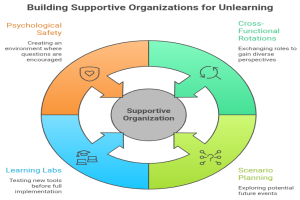
- Cross-functional rotations so scientists understand manufacturing and quality leaders see early development risks.
- Scenario planning workshops that explore regulatory changes, supply disruptions, or technology shifts.
- Learning labs and pilot programs for digital tools before full-scale deployment.
- Psychological safety, where junior staff can question decisions without fear of punishment.
Leadership development programs are also evolving. Instead of focusing only on functional excellence, they now emphasise systems thinking, change management, and ethical decision-making in uncertain environments.
Some companies are introducing “after-action reviews” following major submissions, inspections, or product launches, not to assign blame, but to surface outdated assumptions and redesign processes.
The Role of Humility and Curiosity
Unlearning is uncomfortable, especially for senior leaders whose careers were built on expertise. It requires humility, the acceptance that past success does not guarantee future relevance. Curiosity becomes a core leadership trait. Effective pharma leaders spend time with data scientists, patient advocacy groups, regulators, and manufacturing operators on the shop floor. They ask how new tools work, why processes fail, and what signals are emerging from the market.
This mindset is critical as automation and AI spread across drug discovery, pharmacovigilance, and supply chain planning. Leaders do not need to code models themselves, but they must understand enough to ask the right questions about validation, bias, explainability, and compliance.
From Experience to Adaptability
Experience in pharma still matters; it provides context for risk, ethics, and regulatory responsibility. But adaptability has become just as important.
The most resilient leaders combine:
- Deep industry knowledge
- Willingness to revisit long-held beliefs
- Comfort with experimentation inside controlled, compliant frameworks
- Ability to connect science, operations, and patient needs
In a sector where product lifecycles span decades but technologies change every few years, unlearning is not a one-time event. It is a continuous discipline.
Conclusion: The Future Belongs to Leaders Who Can Let Go
Pharma is no longer a slow-moving, predictable industry. It is a complex ecosystem shaped by rapid science, digital tools, evolving regulations, and rising expectations from patients and payers. Leadership built only on past experience will struggle in this reality.
Leadership that embraces unlearning, questioning assumptions, updating mental models, and designing organisations that learn faster than their competitors will be better prepared to guide medicines from the lab to the patient in an uncertain world. In the end, the leaders who thrive will not be those who know the most about yesterday’s systems, but those who are most willing to rethink them for tomorrow.
FAQs
1. What does unlearning mean in pharmaceutical leadership?
Unlearning means questioning old assumptions and habits so leaders can adapt to new science, regulations, and business models.
2. Why is experience alone not enough for pharma leaders today?
Because digital tools, advanced therapies, and new regulatory pathways have changed how drugs are developed and manufactured.
3. How can pharma companies encourage unlearning?
By promoting cross-functional work, pilot programs, open dialogue, and leadership training focused on adaptability.
4. What skills are most important for future pharma leaders?
Systems thinking, data literacy, collaboration, regulatory insight, and curiosity.
5. How does unlearning improve drug development outcomes?
It helps organisations adopt new methods faster, reduce delays, and design processes that fit modern complexity rather than outdated models.
Reporting on the science, business and regulation shaping the pharmaceutical industry.
More in Leadership
All articles →
Essential Leadership Skills for Success in the Pharmaceutical Industry

Pharmaceutical Regulatory Affairs: Roles, Skills, and Roadmap

Discussion