Gaps in Antimicrobial Stewardship Programmes in Asia: A Survey of 10 Countries
Why Asia's antimicrobial stewardship programmes are falling short — a 10-country survey of 6 gaps blocking real AMR progress

Abstract
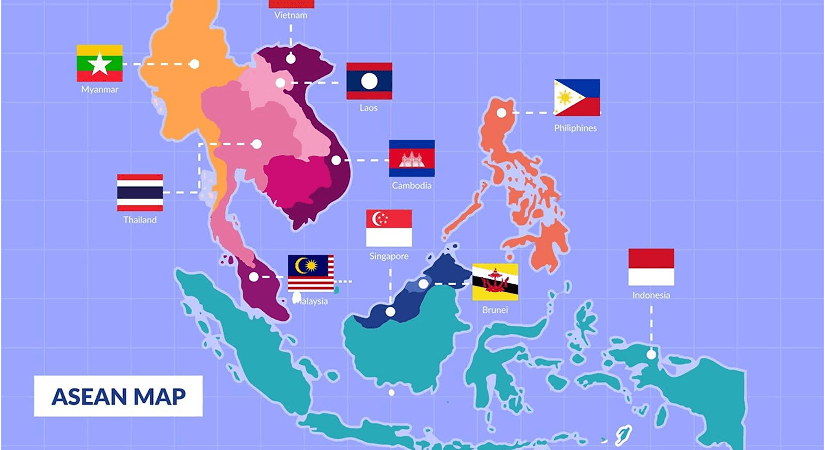
Every year, drug-resistant infections kill hundreds of thousands of people across Asia. To fight back, governments have launched National Action Plans and hospital stewardship programmes designed to ensure antibiotics are used wisely. But good intentions have not always led to real change. This report examines what is actually happening on the ground across 10 Asian countries: Cambodia, India, Indonesia, Japan, Malaysia, Pakistan, the Philippines, Taiwan, Thailand, and Vietnam. It asks a simple but uncomfortable question: why are the programmes not working as well as they should? The answer, as this report shows, lies in six persistent gaps: weak national plans, poorly equipped hospital programmes, unchecked antibiotic sales, broken surveillance systems, undertrained healthcare workers, and chronic underfunding. Until these gaps are honestly acknowledged and urgently addressed, the promise of antimicrobial stewardship will remain largely unfulfilled.
Introduction: A Crisis That Cannot Wait
Imagine a world where a simple wound infection, a routine surgery, or a common bout of pneumonia could kill you because the antibiotics needed to treat it no longer work. That world is not a distant nightmare. It is already taking shape.
In 2019, drug-resistant bacterial infections were directly responsible for 1.27 million deaths worldwide. Asia bore a heavy share of that burden. Southeast Asia, East Asia, and Oceania together accounted for roughly 254,000 of those deaths. The numbers are expected to rise sharply in the decades ahead if nothing changes.
The global community recognised the threat early. In 2015, the World Health Organization launched its Global Action Plan on AMR, calling on every country to build a National Action Plan within two years. The idea was to bring together human health, animal health, and environmental health in one coordinated response, which is known as the One Health approach.
Hospitals were given their own set of tools. Antimicrobial stewardship programmes, or ASPs, were designed to make sure that doctors prescribe the right antibiotic, at the right dose, for the right length of time. Done well, stewardship saves lives and slows the spread of resistance. Done poorly, or not done at all, it makes the problem worse.
Across Asia, the story of ASPs is largely one of good intentions meeting difficult realities. Implementation has been inconsistent across countries and regions, with programmes often lacking core components, particularly in low- and middle-income countries. This report tells that story honestly, country by country and gap by gap.
National Action Plans: Writing the Plan Is Not Enough
Think of a National Action Plan on AMR as a country's promise to its people: we will take this seriously, we will act, and we will be held accountable. Most Asian governments have made that promise. All 10 countries in this survey have developed NAPs that are broadly aligned with WHO guidelines. On paper, the region looks prepared.
But a plan written in a government office is only as good as what happens next. And what has happened next, in too many cases, is very little.
Progress has been made. Implementation rates across South and Southeast Asia improved significantly between 2016 and 2021. But improvement from a very low starting point still leaves much to be desired. Participants' beliefs about the current level of training and awareness regarding AMR, as well as current AMR and AMU surveillance, differed from findings in the Quadripartite AMR country self-assessment survey, suggesting discordance between country and global expectations that should be urgently addressed. In plain terms: countries sometimes believe they are doing better than they actually are. That gap between perception and reality is dangerous, because it reduces the urgency to act.
Across ASEAN countries, analyses of national plans have found repeated weaknesses in accountability structures, governance continuity, and sustained political engagement. Perhaps most telling is the near-universal failure to build a convincing economic case for long-term investment.
If a government cannot show that investing in stewardship saves money as well as lives, it becomes easy to deprioritise. Enforcement of existing regulations, whether in hospitals, pharmacies, or farms, remains weak in most countries, with too few inspectors, too little authority, and too many competing priorities.
The lesson is uncomfortable but clear. Writing a plan is the easy part. The hard part, implementing it, funding it, measuring it, and holding people accountable, is where most countries still fall short.
Hospital Stewardship Programmes: The Gap Between Intention and Reality
Step inside a hospital in Phnom Penh, Karachi, or Jakarta, and you might find a notice on the wall declaring commitment to responsible antibiotic use. You might find a stewardship committee listed in the hospital's organisational chart. What you are less likely to find is a fully functioning programme with the people, tools, and resources to actually make stewardship work.
A major multi-country survey of 349 hospitals across all ten countries in this report found that only 47 hospitals, representing 13.5% of the total, fulfilled all 12 core components considered essential for an effective stewardship programme.
That means more than 86% of surveyed hospitals were running incomplete programmes. The most revealing finding was not what was missing, but where the gap lay. There was a mean positive response rate of 85.6% for a formal hospital leadership statement of support for AMS activities, but this was not matched by budgeted financial support, which had a mean positive response rate of only 57.1%.
Leadership was happy to say yes to stewardship. Far fewer were willing to pay for it.
In Indonesia, a nationwide study painted a similarly sobering picture. The median overall ASP development score was 48.4%, with only 8% of hospitals rated as adequate, 45.9% as basic, and 34.7% as intermediate. Hospital staff described feeling unsupported, unclear about who was responsible for what, and unable to collaborate effectively across disciplines.
This is the reality behind the official commitments: stewardship teams that exist on paper but lack protected time, adequate staffing, or access to the microbiological data they need to do their jobs.

Over-the-Counter Antibiotic Sales: A Leaky Pipeline
Here is a scenario that plays out millions of times across Asia every day. A person feels unwell. Perhaps it is a fever, a sore throat, or a cough that will not go away. Instead of visiting a doctor, they walk to the nearest pharmacy and ask for antibiotics. No prescription needed. The pharmacist, under pressure to make a sale, obliges. The person takes the antibiotics for a few days, starts to feel better, and stops. The bacteria, not fully eliminated, have now had a chance to adapt.
This scenario is not hypothetical. It is routine in much of the region, and it is one of the most powerful engines of antimicrobial resistance. Major drivers of AMR in LMICs include unregulated antibiotic sales, overuse and misuse of antibiotics, weak healthcare infrastructure, poor infection control, and environmental contamination, with socioeconomic factors such as self-medication and limited healthcare access further exacerbating the problem.
Most of the 10 countries surveyed have laws on the books requiring a prescription before antibiotics can be dispensed. But laws without enforcement are just words. In Cambodia, Vietnam, and Pakistan, over-the-counter antibiotic sales continue largely unchecked. Inspection capacity is thin, penalties are low, and the economic incentives for pharmacies to comply are weak.
A survey of healthcare providers across the Asia-Pacific region found that, even among respondents, knowledge gaps were apparent: one respondent each from Australia and South Korea stated that antibiotics could be purchased without a prescription, when in fact this is illegal, reflecting knowledge gaps even among healthcare professionals.
If healthcare professionals themselves are uncertain about the rules, it is hard to expect the public or pharmacists to do better. Closing this gap requires not just tougher regulations, but sustained community engagement, pharmacist training, and genuine political will to enforce the rules that already exist.
Surveillance Systems: Flying Blind
Good stewardship requires good data. To know which antibiotics are working and which are failing, clinicians and policymakers need up-to-date, reliable information about which bacteria are circulating, which drugs are being used, and where resistance is emerging. Without that information, stewardship decisions are based on guesswork.
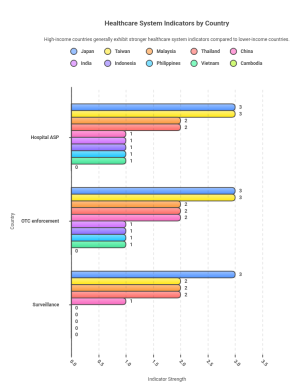
Across much of Asia, that is precisely the situation. Only 39% of high-income countries have implemented comprehensive AMU surveillance systems, while the majority of LMICs currently cannot monitor total antimicrobial sales at the national level. None of the countries studied effectively linked AMR data with antimicrobial consumption and use data for human health.
That last point deserves emphasis. Not a single country in this survey had successfully connected its data on antibiotic resistance with its data on antibiotic use. Without that connection, it is impossible to determine whether stewardship programmes are actually reducing resistance, or whether the resistance patterns clinicians are seeing reflect the drugs they are prescribing.
Inside hospitals, the picture is equally concerning. Approximately 20% of hospitals in the multi-country survey relied solely on conventional techniques for pathogen identification and susceptibility testing, and approximately 15% did not use selective susceptibility reporting. These are hospitals making antibiotic prescribing decisions with incomplete or outdated diagnostic tools.
The consequence is a vicious cycle. Without data, stewardship programmes cannot prove their value. Without proof of value, they cannot attract investment. Without investment, the data systems never improve.
Healthcare Worker Education: The Knowledge Gap
At the heart of every stewardship programme is a person: a doctor deciding which antibiotic to prescribe, a nurse questioning whether the prescription is right, a pharmacist checking the dose. If those people do not have the knowledge, skills, and confidence to act on stewardship principles, no programme in the world will make a difference.
Across Asia, education and training in AMR and stewardship remain weak. Substantial disagreement was found between stakeholders' perceptions of the adequacy of prescriber training and the Quadripartite AMR country self-assessment survey findings, with one-third of participants disagreeing that policymakers are well-informed about the importance of regulating antibiotic sales and use.
In many LMICs across the region, formal training in infectious diseases is rare. Doctors and pharmacists who are expected to lead stewardship activities have often received little or no specialised training in AMR. The stewardship role is added to their existing workload without extra time, pay, or support.
Medical and pharmacy schools across the region continue to underteach AMR. Students graduate without a firm grounding in how resistance develops, how microbiology results should guide prescribing, or what responsible antibiotic use actually looks like in practice. The result is a generation of healthcare workers who mean well but lack the tools to act differently.
The Asia-Pacific region faces a pressing need to develop ASPs to reduce infections caused by multidrug-resistant organisms, and national workgroups and guidelines should be established to identify local capabilities and gaps in order to advance antimicrobial stewardship.
Funding: The Root of All the Other Problems
All of the gaps described in this report share a common thread. They are, at their core, the result of not spending enough money in the right places, for long enough.
Most Asian hospitals do not have ASPs that meet gold-standard requirements, highlighting the need for urgent action to address funding and resourcing deficits. Governments sign NAPs but do not budget for them. Hospitals appoint stewardship teams but do not give them the time or tools they need. Training programmes are launched with donor funding and then collapse when the grant runs out.
Across the region, stewardship too often depends on the enthusiasm of a few dedicated individuals, working against the grain of institutions that have not truly committed the resources to support them. When those individuals move on, the programme quietly dies.
In LMICs, the problem is compounded by dependence on international donors. Project-based funding creates programmes that exist for three or five years and then disappear, leaving no lasting infrastructure. Sustainable progress requires domestic financing, anchored in national budgets and protected from political cycles.
The economic case for investing in stewardship is actually strong. Reducing unnecessary antibiotic use saves money on drug costs. Preventing resistant infections reduces the need for expensive second and third-line treatments. Shorter hospital stays free up beds. But that case has to be made clearly, and made to the people who control the budgets. In too many countries, it has not been made at all.

The Bigger Picture: Themes That Run Through Everything
Reading across all six gaps, a few deeper patterns become clear.
The first is the distance between words and action. Across the region, plans are written, committees are formed, and commitments are made. Then the momentum stalls. The people responsible for turning words into results are given neither the authority nor the resources to do so.
The second is inequality within the region. Japan and Taiwan have invested seriously in stewardship infrastructure, surveillance, and regulation. Cambodia, Pakistan, and Vietnam are working from a much harder starting point, with weaker health systems, fewer specialists, and more competing pressures on limited budgets. A one-size-fits-all regional approach will not work. Each country needs support that matches its actual situation.
The third is the narrow focus of stewardship. Most programmes concentrate on human health and largely ignore what is happening in animal farming and the environment. But resistance does not stay in one sector. Antibiotics used in livestock farming, discharged into waterways, or released from pharmaceutical manufacturing plants all contribute to the same shared resistance pool. A truly effective response has to be built across all three sectors together.
The fourth is the data problem. No data, no accountability. No accountability, no pressure to improve. Until countries can reliably measure what antibiotics are being used and what resistance is emerging, stewardship will remain a matter of faith rather than evidence.
What Needs to Change: Recommendations
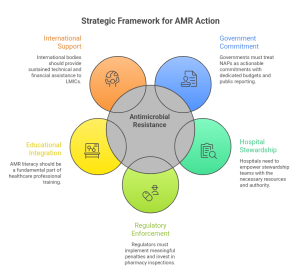
The problems are real, but so are the solutions. What is needed is not more reports or more promises, but concrete, funded, accountable action.
Governments should stop treating NAPs as documents to be submitted and start treating them as commitments to be delivered. That means costed implementation plans, dedicated budget lines, and annual public reporting on progress.
Hospitals should go beyond nominal stewardship teams and ensure that the right people have the time, authority, and tools to do stewardship properly. At minimum, every hospital should be conducting prospective audit and feedback of antibiotic prescriptions.
Regulators should treat uncontrolled antibiotic sales as the public health emergency it is. That means meaningful penalties for dispensing without prescription, investment in pharmacy inspection capacity, and active engagement with community pharmacists as partners in the stewardship effort.
Educators should embed AMR literacy into the core training of every doctor, nurse, and pharmacist, not as an optional module, but as a fundamental competency that every healthcare professional is expected to demonstrate.
International and regional bodies should move beyond producing guidelines and frameworks and instead provide sustained technical and financial support that helps LMICs build the systems, skills, and infrastructure they need.
Conclusion
The story of antimicrobial stewardship in Asia is ultimately a story about the gap between what countries say they will do and what they actually do. The plans exist. The frameworks exist. The science exists. What is missing in too many places is follow-through.
That gap has a cost: lives lost to infections that should have been treatable, healthcare systems strained by resistant organisms, and a future where routine medicine becomes genuinely dangerous.
Closing the gap will not be easy. It will require sustained funding, honest accountability, cross-sector collaboration, and a willingness to prioritise AMR not just when international pressure demands it, but consistently, year after year. The ten countries surveyed in this report are at different stages of that journey. All of them have further to go.
The question is whether there is political will to make that journey. The evidence reviewed here suggests that, in most cases, the answer is not yet. But it could be. And the cost of failing to try is far higher than the cost of getting it right.
Reporting on the science, business and regulation shaping the pharmaceutical industry.
More in Microbiology & CCS
All articles →
Active Air Sampling vs Settle Plates vs Contact Plates

Setting EM Alert & Action Levels (Grades A–D): A Practical Guide for Pharma Professionals

Discussion