by Simantini Singh Deo
7 minutes
Biofluorescence Monitoring In Cleanrooms: A Simple Guide
Hunting contamination used to be a blind search. Biofluorescence monitoring lights it up in real time, seconds, not days, to spot it.
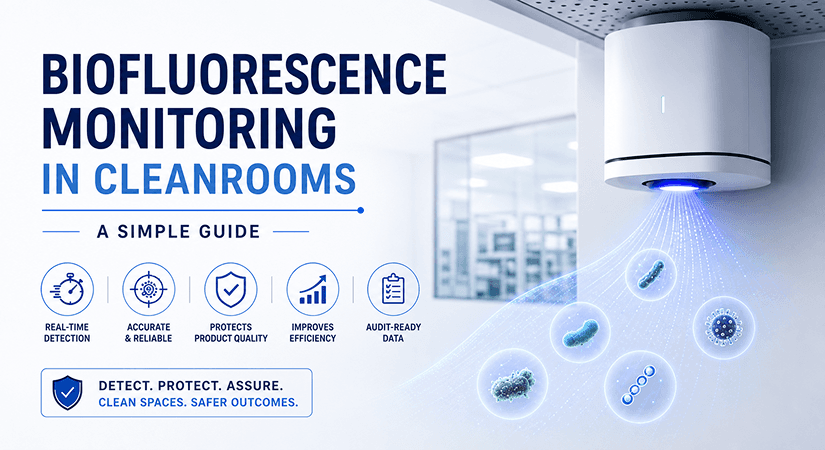
Imagine trying to find a single grain of sand on a football field, at night, with no flashlight. That's what hunting for microbial contamination in a cleanroom used to feel like. Biofluorescence monitoring is the flashlight that changes the game. Let's look at what it is, how it works, and why it matters, in simple terms.
What Is Biofluorescence Monitoring?
Every living cell, whether it's bacteria, mold, or yeast, contains natural molecules like NADH and riboflavin. These molecules glow faintly under a specific wavelength of light. Biofluorescence monitoring simply catches that glow and uses it to detect life in real time.
Cleanrooms are tightly controlled spaces used in pharmaceutical manufacturing, semiconductor production, and medical device assembly. Even a tiny bit of microbial contamination can ruin a batch or put a patient at risk. Traditional testing makes you wait days for results. Biofluorescence gives you a clear answer in seconds.
Why Do Cleanrooms Need This Technology?
Cleanrooms are graded by how many particles of dust or microbes are allowed per cubic meter of air. The stricter the grade, the less contamination is tolerated. Even one overlooked event can push a room out of grade. Here's why old detection methods alone are risky:
- Delayed results let contamination spread before anyone even notices it's there.
- Manual sampling misses real-time events, like a technician's glove briefly brushing a surface.
- Growth-based testing struggles to catch slow-growing or non-culturable organisms.
- Human error in swabbing or plating adds inconsistency to the results.
- Periodic checks leave blind spots between sampling windows.
Biofluorescence monitoring closes these gaps because it watches continuously and reacts instantly, rather than offering a snapshot every few hours.
How Does Technology Actually Work?
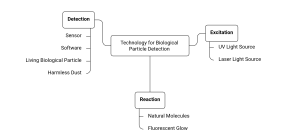
Think of it as a simple three-step relay race:
- Excitation — A UV or laser light source is aimed at the air or surface being monitored.
- Reaction — If microbial cells are present, their natural molecules absorb this light and release it again as a fluorescent glow.
- Detection — A sensor picks up the glow, and the software instantly flags it as a "biological particle" rather than harmless dust or fiber.
This is different from older systems that count every particle without knowing whether it's alive. Biofluorescence tools can actually tell a dead skin flake from a living bacterium, and that distinction matters a lot in sterile manufacturing. The system separates the noise from the real signal, so operators aren't chasing false alarms all day.
Key Components Of A Monitoring System
A typical biofluorescence setup includes a few essential parts:
- Light Source — usually a UV LED or diode laser tuned to excite biological molecules.
- Optical Detector — captures the fluorescent signal and turns it into data.
- Air Sampling Unit — draws air continuously past the sensor, like a vacuum pulling in particles.
- Software Dashboard — shows live readings, trends, and alerts to the operator.
- Alarm System — sends a notification the moment contamination crosses a set threshold.
- Data Logging Module — keeps a time-stamped record of every reading, useful during audits and investigations.
Where It's Used?
Biofluorescence monitoring isn't tied to just one industry. You'll find it anywhere sterility can't be compromised:
- Pharmaceutical fill-finish lines
- Biotech manufacturing suites
- Hospital sterile compounding rooms
- Cell and gene therapy production
- Aseptic food and beverage packaging
- Semiconductor fabrication, where even biological residue can throw off microchip precision
Each of these settings shares one thing in common: the cost of missing contamination is far higher than the cost of monitoring for it.
Biofluorescence covers air, but surfaces are a whole separate battleground. Here's how contact plates and swab sampling round out a full contamination control strategy.
→ Read: Surface Monitoring in Pharmaceutical Cleanrooms
Benefits Over Traditional Microbial Testing
Traditional testing, like settle plates or active air sampling followed by lab incubation, has served the industry well for decades. Still, it comes with real limits. Here's a simple comparison:
Factor | Traditional Testing | Biofluorescence Monitoring |
|---|---|---|
Result Time | 2-7 Days | Seconds To Minute |
Detection Type | Culturable Organisms Only | Culturable & Non Culturable |
Monitoring Style | Periodic, Snapshot Based | Continuous, Real Time |
Human Error Risk | Higher | Lower |
Response To Contamination | Delayed | Immediate |
The biggest win here is speed. If contamination happens mid-production, real-time detection lets operators pause, investigate, and fix the problem before an entire batch is lost. That single advantage can save a facility significant money, time, and reputation.
Common Challenges To Keep In Mind
No technology is perfect, so it helps to know the limits going in:
1) False Positives: Some non-biological particles, like plastics or minerals, can fluoresce too and confuse the reading.
2) Cost Of Equipment: Advanced optical sensors cost more upfront than manual sampling.
3) Calibration Needs: Sensors need regular calibration to stay accurate.
4) Regulatory Acceptance: Not every regulatory body has fully standardized how this data should be validated, so many facilities still run both systems side by side.
5) Staff Learning Curve: Teams used to manual methods often need training to trust automated alerts.
Why Regulators Are Pushing This Now: EU GMP Annex 1
The 2022 revision of EU GMP Annex 1, the rulebook governing sterile pharmaceutical manufacturing in Europe, changed the game for environmental monitoring. Two changes matter most:
- Zero tolerance, not average tolerance. The old version allowed an average of less than 1 CFU (colony-forming unit) in Grade A zones. The new version sets the limit at zero.
- Continuous monitoring is now mandatory, not optional, for Grade A and B cleanrooms — the highest-risk zones where sterile products are filled and handled directly.
This is exactly the gap biofluorescence monitoring fills. Traditional culture-based testing simply cannot deliver "continuous" data, it takes days. Regulators writing Annex 1 have effectively pointed the industry toward real-time detection technology like biofluorescence monitoring, even without naming a specific brand or method.
Annex 1 sets the "what" — zero tolerance, continuous monitoring. USP <1116> covers the "how": setting alert and action levels so that continuous data actually means something.
→ Read: USP <1116>: Alert & Action Levels in Cleanrooms
Best Practices For Implementation
If your team is considering or already using biofluorescence monitoring, a few habits go a long way:
a) Place sensors near high-risk zones, such as fill points, doorways, and equipment interfaces.
b) Run biofluorescence data alongside traditional culture methods during validation to build trust.
c) Train staff to read alerts correctly, since not every flagged particle is a real threat.
d) Schedule regular calibration and maintenance to prevent sensor drift.
e) Connect the monitoring software to the facility's wider environmental monitoring system.
f) Review historical trend data periodically, since patterns often reveal issues early.
Getting Started: A Typical Rollout
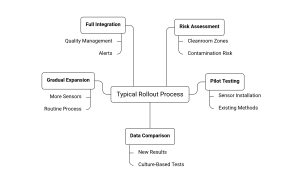
Facilities that adopt biofluorescence monitoring don't usually swap out their old system overnight. The transition tends to follow a fairly predictable path:
- Risk Assessment — Teams identify which zones carry the highest contamination risk.
- Pilot Testing — A small number of sensors are installed and run alongside existing methods for comparison.
- Data Comparison — Results are checked against traditional culture-based tests to confirm accuracy.
- Gradual Expansion — Once confidence is established, more sensors are added, and monitoring becomes routine.
- Full Integration — The system is tied into the facility's quality management program, so alerts feed directly into existing workflows.
This step-by-step approach reduces disruption and gives quality teams the evidence they need to satisfy auditors.
The Business Case: Why The Investment Pays Off?
For many facility managers, the real question isn't whether biofluorescence monitoring works, it's whether it's worth the cost. Looking at it purely as an expense misses the bigger picture. Consider what a single contamination event can cost a facility:
- A rejected or recalled batch can run into hundreds of thousands, even millions, of dollars in lost materials, labor, and downtime.
- Regulatory investigations following a contamination incident can halt production for weeks.
- Reputational damage tends to outlast the financial hit, especially in pharmaceuticals and healthcare.
- Emergency remediation, including deep cleaning and requalifying a room, costs far more than ongoing prevention.
Against that backdrop, the upfront cost of sensors and software looks much smaller. Continuous monitoring doesn't just catch problems faster, it also builds a stronger audit trail, since every reading is logged automatically.
That data becomes valuable during inspections and root-cause investigations, where a clear timeline can mean the difference between a quick fix and a prolonged shutdown. This technology often pays for itself the first time it stops a bad batch from reaching the market.
In Conclusion
Biofluorescence monitoring represents a genuine shift in how cleanrooms manage contamination risk, moving the industry from periodic, after-the-fact testing toward continuous, real-time awareness.
By detecting the natural glow of living cells, it lets operators catch problems within seconds rather than days, which matters enormously in industries where a single missed event can compromise an entire batch or put patient safety at risk.
It isn't a full replacement for traditional microbiology testing, at least not yet, since regulators still rely on culture-based confirmation for many processes. But as a fast, always-watching layer of protection, it's steadily becoming a standard part of how modern cleanrooms are designed and operated.
For facilities weighing the investment, the choice increasingly comes down to this: pay a modest amount now for constant vigilance, or risk paying a far steeper price later.
FAQs
1) What Is Biofluorescence Monitoring In Cleanrooms?
Biofluorescence monitoring is a real-time method that detects living microorganisms by identifying their natural fluorescent molecules, helping cleanrooms identify contamination within seconds. It uses specialised sensors and light sources to distinguish biological particles from non-biological particles. This enables faster contamination detection and supports better environmental monitoring in cleanrooms.
2) Why Is Biofluorescence Monitoring Important For Cleanrooms?
It provides continuous monitoring and rapid detection of microbial contamination, allowing facilities to respond quickly and reduce the risk of product contamination, batch failures, and compliance issues. Early detection helps minimise production downtime and prevents contamination from spreading. It also strengthens quality assurance by providing real-time environmental data.
3) Can Biofluorescence Monitoring Replace Traditional Microbial Testing?
No. Biofluorescence monitoring complements traditional culture-based testing by providing immediate alerts, while conventional methods are still used for confirmation and regulatory compliance. Many facilities use both methods together to achieve comprehensive contamination control. This combined approach improves monitoring accuracy while meeting regulatory expectations.