Rapid Microbiology Methods (RMMs) In Pharma: Accelerating Quality, Compliance, And Manufacturing Efficiency
A 14-day sterility test can outlast a product's shelf life. Here's how RMMs cut detection time and stay FDA, EMA compliant.

InPharma_AcceleratingQuality%2CCompliance%2CAndManufacturingEfficiency20260812190143.webp&w=1920&q=75&dpl=dpl_DBpSA5K4vHC4UUGhboeG7FmE5z5L)
Traditional microbiological testing in pharmaceutical manufacturing has always shared a fundamental flaw: it is slow. Compendial sterility tests require a 14-day incubation period before a result can be confirmed. Microbial limits testing takes days.
Environmental monitoring samples must be cultured, read, and recorded over timelines designed around the biology of microbial growth, not around the commercial and operational realities of a modern pharmaceutical facility.
By the time a contamination event is confirmed by a conventional method, the product at risk may already have been further processed, packaged, or distributed downstream.
Rapid Microbiological Methods, commonly referred to as RMMs, were developed to close that gap. They represent a family of alternative technologies that detect, enumerate, and identify microorganisms significantly faster than conventional culture-based approaches.
Depending on the technology platform and application, RMMs can reduce testing timelines from days to hours, and from hours to minutes in some cases. The implications for quality assurance, manufacturing efficiency, patient safety, and regulatory compliance are substantial.
Two facts frame exactly how significant this shift has become:
- Regulatory agencies worldwide, including the FDA, EMA, MHRA, and Japanese PMDA, have formally recognised RMMs as acceptable alternatives to compendial methods, provided they are appropriately validated and demonstrated to be equivalent or superior in performance
- RMMs are no longer considered an optional technological upgrade. As BactiQuant and industry observers summarised in 2025, they are becoming an expected component of modern pharmaceutical quality strategies
What Rapid Microbiology Methods Are And How They Work?
The term "Rapid Microbiological Methods" covers a broad range of technology platforms, each operating on different scientific principles and suited to different applications within pharmaceutical quality control. What they share is speed. What distinguishes them from one another is the mechanism by which they detect microbial presence.
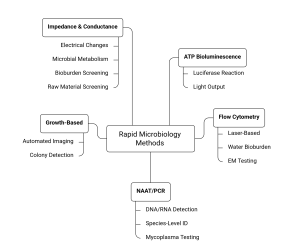
The most widely adopted RMM technologies in pharmaceutical manufacturing include:
a) ATP Bioluminescence: This method detects adenosine triphosphate, the universal energy molecule present in all living cells, using a luciferase enzyme reaction that produces measurable light. Because ATP is present in all viable microorganisms, this technique can confirm the presence or absence of viable microbial contamination within minutes.
The very first FDA PAT approval for a rapid microbiological method was granted for an ATP bioluminescence platform replacing the compendial Microbial Limits Test, a landmark that established the regulatory precedent for all RMMs that followed.
b) Flow Cytometry: Flow cytometry passes cells through a focused laser beam, measuring optical properties including light scattering and fluorescence to count and characterise individual microbial cells with extraordinary speed and precision. It is increasingly used for water bioburden testing, environmental monitoring, and rapid sterility applications, offering results in hours rather than days.
c) Nucleic Acid Amplification Techniques (NAAT), including PCR: Polymerase chain reaction and related amplification techniques detect microbial DNA or RNA directly, enabling species-level identification with very high specificity.
Regulatory authorities, including the EMA and the Ph. Eur., have formally accepted NAAT-based methods, particularly when validated against compendial chapter Ph. Eur. 2.6.7 for sterility and related monographs. PCR-based methods are especially powerful for mycoplasma testing, where they have largely replaced the lengthy conventional culture approach.
d) Growth-Based Rapid Methods: Systems such as the Growth Direct® platform from Rapid Micro Biosystems use automated imaging to detect microbial colonies earlier in the growth phase than conventional visual inspection allows.
By imaging samples at defined intervals using fluorescent staining, these platforms can identify early colony formation hours before colonies are visible to the naked eye, dramatically accelerating both environmental monitoring and sterility testing workflows.
e) Impedance & Conductance Methods: These electrochemical techniques detect microbial growth by measuring changes in the electrical properties of culture media as microorganisms metabolise substrates and produce ionic byproducts. They are used in bioburden testing and raw material screening applications.
The Quality And Patient Safety Case For RMMs
The primary argument for adopting RMMs in pharmaceutical manufacturing is not operational convenience alone. It is patient safety. Faster microbiological data means faster detection of contamination events, earlier root cause investigation, more timely interventions, and reduced risk of contaminated products reaching a patient.
Consider what this means concretely across three critical quality applications:
- Sterility Testing: Under the compendial 14-day sterility test, a contamination event detected on day 12 of a batch's shelf life has already consumed most of the product's usable lifespan. A rapid sterility platform capable of detecting contamination in 3–5 days allows meaningful intervention while the product can still be quarantined, investigated, and replaced before distribution. For short-shelf-life products, injectable biologics, certain blood products, and some advanced therapy medicinal products (ATMPs), this difference is not marginal. It is the difference between a usable and an unusable safety net.
- Environmental Monitoring: Rapid environmental monitoring with ATP bioluminescence or flow cytometry allows manufacturing facilities to obtain real-time contamination data from cleanrooms and critical process areas. Trend analysis based on rapid data can identify a contamination event developing over days rather than discovering it weeks later during traditional EM review. This supports the contamination control strategy (CCS) frameworks now required under EU GMP Annex 1 (2023) — a regulatory expectation that aligns perfectly with the data density that RMMs can provide.
- Water System Monitoring —Pharmaceutical water systems, including purified water and water for injection (WFI), require continuous bioburden surveillance. Traditional plate count methods take 48–72 hours for results. ATP-based or flow cytometry-based rapid water testing can produce results in under two hours, enabling far more responsive action when action limits are breached.
Annex 1 doesn't just permit rapid methods, it explicitly encourages them.
Here's the full contamination control strategy reshaping how cleanrooms get monitored.
→ Read: Annex 1 Changes: EM & CCS in Cleanrooms
Regulatory Framework: Accepted, Encouraged, & Increasingly Expected
One of the most persistent misconceptions among pharmaceutical manufacturers considering RMMs is that regulatory acceptance is uncertain or hard to obtain. The regulatory reality is the opposite. The FDA, EMA, MHRA, and other major agencies have not only accepted RMMs, they actively encourage their adoption.
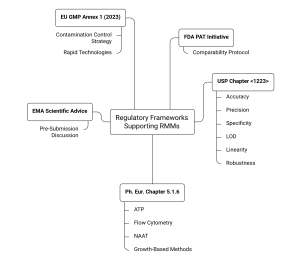
The key regulatory instruments supporting RMM implementation include:
A) FDA Process Analytical Technology (PAT) Initiative (2004) — The PAT framework explicitly supports the introduction of rapid and automated testing technologies as part of a science-based, risk-managed approach to pharmaceutical manufacturing. The FDA Comparability Protocol, one of PAT's most practical tools, allows manufacturers to submit an RMM validation plan for regulatory review and approval before full implementation, significantly reducing approval timeline uncertainty.
B) USP Chapter <1223> (Validation Of Alternative Microbiological Methods) — This provides the performance characteristic framework within which RMMs must be validated, covering accuracy, precision, specificity, limit of detection, linearity, and robustness. Demonstrating equivalency or superiority to compendial methods under <1223> is the primary validation pathway for RMMs in the United States.
C) Ph. Eur. Chapter 5.1.6 (Alternative Methods for Control of Microbiological Quality) — The European Pharmacopoeia's equivalent framework for RMM validation, which explicitly recognises ATP bioluminescence, flow cytometry, NAAT, and growth-based methods as legitimate alternatives to compendial culture methods.
D) EMA Scientific Advice & Post-Approval Change Management Protocol — The EMA's scientific advice mechanism allows manufacturers to discuss RMM validation plans with regulators before submission. Experience shows that companies which engage EMA scientific advice upfront achieve significantly more streamlined validation approvals than those that do not.
E) EU GMP Annex 1 (2023) — The revised Annex 1 requires a formal contamination control strategy for sterile manufacturing. While it does not mandate specific RMM technologies, its requirements for systematic contamination monitoring and real-time data are most efficiently met with rapid technologies.
Validation: The Path From Technology To Approved Method
For all their advantages, RMMs do not enter a pharmaceutical quality system without a structured validation programme. Regulatory agencies worldwide require manufacturers to demonstrate that their chosen RMM is accurate, reliable, reproducible, and fit for its intended purpose before it can replace or supplement a compendial method.
The core elements of a robust RMM validation programme include:
1) Method Equivalency Or Superiority Studies — Parallel testing comparing RMM results with compendial reference methods, typically plate counts or membrane filtration, across the key validation parameters: accuracy, precision, sensitivity, specificity, and linearity.
2) Limit Of Detection Determination — The RMM must demonstrate a limit of detection at least equivalent to the compendial method. For growth-based rapid systems, sensitivity is often superior to conventional methods, which is a significant regulatory advantage.
3) Robustness & Ruggedness Testing — The method must perform consistently across minor variations in operating conditions, including temperature, humidity, and formulation matrix effects.
4) Product-Specific Matrix Assessment — In sterility testing and bioburden applications, the sample matrix, meaning the product itself, can affect RMM performance. Bacteriostatic or fungistatic properties of some pharmaceutical formulations must be evaluated and, where necessary, overcome through validated dilution or neutralisation strategies.
5) Training, SOPs, & Ongoing Performance Verification — Validation is not a one-time event. Ongoing system suitability testing and regular performance verification are required to maintain validated status and demonstrate continued equivalency throughout the method's operational lifecycle.
Rapid methods speed up detection. Media fills still prove the process holds up under stress.
Here's how Annex 1 has sharpened expectations for sterility assurance.
→ Read: Media Fill Design in Annex 1 Era for Sterility Assurance
Conclusion: From Optional Upgrade To Strategic Imperative
Rapid Microbiological Methods have moved from an emerging technology option to a true strategic quality imperative in pharmaceutical manufacturing. The evidence for their adoption is compelling on every dimension that matters to a modern pharmaceutical manufacturer, quality, safety, compliance, and operational efficiency.
They detect contamination sooner. They support real-time manufacturing decisions. They reduce the testing timelines that hold up batch release. And they align with regulatory frameworks that are explicitly designed to encourage and reward their use.
The manufacturers who have adopted validated RMMs consistently report three categories of benefit that compound over time:
- Quality Benefits — earlier contamination detection, faster root cause investigation, and richer environmental monitoring data all translate directly into improved contamination control and reduced quality failures
- Compliance Benefits — validated RMMs are audit-ready, reduce the risk of FDA 483 observations, and align with Annex 1 contamination control strategy requirements inspected globally
- Efficiency Benefits — faster microbiological release decisions shorten batch cycle times, improve manufacturing throughput, and reduce the inventory holding costs associated with long testing wait times
The question for pharmaceutical manufacturers today is no longer whether rapid microbiology methods are ready for routine GMP use. They are. The question is whether each manufacturer is ready to invest in the validation work that makes them a regulated reality and to capture the patient safety, quality, and operational advantages that follow.
FAQs
1. What Are Rapid Microbiology Methods (RMMs)?
Rapid Microbiology Methods (RMMs) are advanced technologies used to detect, count, or identify microorganisms much faster than traditional culture-based microbiological tests. Depending on the method used, they can reduce testing times from several days to just a few hours or even minutes. Common RMM technologies include ATP bioluminescence, flow cytometry, PCR, growth-based imaging systems, and impedance methods. These technologies help pharmaceutical manufacturers obtain microbiological results more quickly while maintaining product quality and regulatory compliance.
2. Why Are Rapid Microbiology Methods Important In Pharmaceutical Manufacturing?
Rapid Microbiology Methods enable manufacturers to detect microbial contamination much earlier than conventional testing methods. Faster detection allows quality teams to investigate issues sooner, take corrective actions quickly, and reduce the risk of contaminated products reaching patients. They also help shorten batch release timelines and improve manufacturing efficiency by reducing waiting periods for microbiological results. Overall, RMMs support better quality control, stronger contamination prevention, and improved patient safety.
3. Are Rapid Microbiology Methods Accepted By Regulatory Authorities?
Yes, Rapid Microbiology Methods are widely accepted by major regulatory agencies, including the FDA, EMA, MHRA, and PMDA, when they are properly validated. Regulatory guidelines such as USP Chapter <1223> and the European Pharmacopoeia provide frameworks for validating alternative microbiological methods. Manufacturers must demonstrate that an RMM performs as well as or better than the traditional compendial method for its intended use. Once validated, RMMs can become an integral part of GMP-compliant pharmaceutical quality systems.
Reporting on the science, business and regulation shaping the pharmaceutical industry.
More in Microbiology & CCS
All articles →
Active Air Sampling vs Settle Plates vs Contact Plates
Setting EM Alert & Action Levels (Grades A–D): A Practical Guide for Pharma Professionals
Discussion