Turbulence: The Hidden Enemy In Sterile Manufacturing
Turbulence is the hidden contamination risk in sterile manufacturing, First Air, smoke studies, isolators and Annex 1 explained.

20260813122022.webp&w=1920&q=75&dpl=dpl_J2KbDhdxArrScAn5UKtuEWBP5vnq)
Sterile manufacturing is built on a single non-negotiable premise: no microbial or particulate contamination must reach the product. Every design decision, from room architecture to personnel gowning, from material selection to cleaning validation, exists in service of that one objective. And yet, one of the most persistent and underappreciated contamination risks in aseptic processing is not a pathogen, not a human error, and not a failed sterilization step. It is airflow itself, when it fails to behave as designed.
Turbulence — disordered, irregular air movement that disrupts controlled flow patterns, is the hidden enemy inside the cleanroom. It carries particles. It reverses pressure gradients. It deposits microbes onto exposed product surfaces. And it can be generated by the most routine events in manufacturing: a door opening, an operator reaching across a filling line, a piece of equipment placed millimetres outside its validated position.
Three regulatory benchmarks frame why this matters at industry level:
- EU GMP Annex 1 (2023) mandates unidirectional airflow (UDAF) at 0.36–0.54 m/s across all Grade A critical zones, with first-air protection required at every open product surface
- The FDA specifies airflow velocity of 0.45 m/s ± 20% for UDAF systems in aseptic processing, in accordance with ISO 14644
- 2024 FDA inspection trends identified inadequate airflow visualization studies as one of the most frequently cited observations in 483 letters issued to sterile injectable manufacturers
These are not abstract technical standards. They are the regulatory system's acknowledgment that turbulence is a real, recurring, and consequential problem — one that can allow contamination to reach products in facilities that look, on paper, fully compliant.
Laminar Versus Turbulent Airflow: Why The Distinction Is Everything?
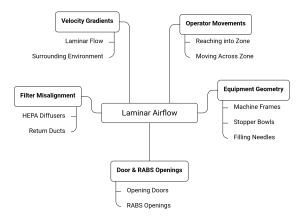
To understand why turbulence is so damaging in sterile manufacturing, it is first necessary to understand what unidirectional or laminar airflow is actually doing in a Grade A environment, and precisely what happens when it breaks down.
Laminar airflow moves in parallel layers in one direction, typically vertically from ceiling to floor through HEPA filters rated at 99.97% efficiency or higher. In a correctly validated Grade A zone, this creates a sweeping curtain of filtered air across the critical surface, an aseptic filling line, an open vial nest, a stopper bowl.
The physics ensure that any particle generated within the zone is continuously swept away from the product and directed toward return air ducts before it can settle on or enter an exposed container.
Turbulent airflow behaves fundamentally differently. It creates eddies, vortices, and recirculation zones, areas where airborne particles are not swept away but instead circulate, concentrate, and eventually deposit.
The distinction in contamination risk between these two states is not merely quantitative. It is qualitative. A turbulent zone adjacent to an open product surface is not a slightly degraded Grade A environment, it is an entirely different contamination environment.
The conditions that most commonly generate turbulence in aseptic processing include:
- Operator body movements reaching into or across the Grade A zone, particularly over-machine interventions, generate body turbulence that can override UDAF protection entirely
- Equipment geometry such as machine frames, conveyor components, stopper bowls, and filling needles create physical obstacles that disturb laminar flow, producing wakes and recirculation downstream
- Door and RABS panel opening, even a single door opening in a Grade B background can generate a pressure transient sufficient to temporarily disrupt Grade A conditions at the filling point
- Misaligned HEPA filter diffusers, return air duct positioning that deviates from the validated design creates localized stagnant areas where particles concentrate and settle
- Velocity gradients at the UDAF boundary, where the laminar flow zone meets the surrounding environment, velocity differentials generate turbulent mixing that must be managed through physical barriers or dedicated airflow controls
A turbulent Grade A zone isn't theoretical risk, it's how real excursions happen.
Here's the root cause breakdown.
→ Recurring Excursions in Grade A/B Cleanrooms | Root Causes & Solutions
First Air: The Annex 1 Concept That Changed Aseptic Design
The most technically significant concept introduced in EU GMP Annex 1 (2023), which came into effect on August 25, 2023 is the explicit requirement for First Air protection. First Air refers specifically to HEPA-filtered air that must reach the exposed product without first contacting any obstacle, structure, or surface that could introduce contamination or turbulence.
The concept formally codified what experienced aseptic engineers had always understood intuitively but regulatory guidance had never previously written into law: unidirectional airflow is only protective if it arrives at the product completely undisrupted.
The practical implications of the First Air requirement are significant and far-reaching:
1) Equipment layout must be validated to confirm no upstream obstruction exists between the HEPA filter and the open product. Machine components, filling needles, sensors, guide rails that interrupt the air column before it reaches the vial must be redesigned or repositioned before a facility can demonstrate compliance.
2) Horizontal crossflow UDAF at the point of fill does not satisfy First Air. Research published in the European Journal of Pharmaceutical Sciences confirmed that horizontal airflow passing over open containers generates excessive downstream turbulence, creating contamination risk rather than protection. Vertical downflow UDAF is the regulatory baseline.
3) All production interventions are subject to a higher standard of airflow qualification. Annex 1 requires smoke studies to be conducted under dynamic conditions that replicate actual manufacturing interventions — not just static or idle states. Any intervention generating visible turbulence in the Grade A zone during a smoke study now requires a formally documented corrective response before production may continue.
4) Door openings during production are specifically and explicitly addressed. Annex 1 acknowledges that disinfection steps requiring door closure add operational complexity in RABS-based systems, and it explicitly promotes gloveless robotic systems and closed isolator technology as the preferred engineering solution, a clear regulatory signal toward full automation of aseptic operations.
Smoke Studies And Qualification: The Standard For Turbulence Detection
Detecting turbulence inside a cleanroom is not straightforward. Particles are invisible to the naked eye. Airflow patterns cannot be directly observed without a tracer medium. The primary validated method for identifying turbulence, stagnant zones, and disrupted laminar flow in Grade A environments is the airflow visualization smoke study, a technique whose regulatory importance has been substantially elevated by both Annex 1 (2023) and the 2024 FDA inspection cycle.
A properly conducted smoke study for turbulence assessment must satisfy all of the following conditions:
A) Dynamic Operating Conditions: The study must be performed with equipment running, personnel present and moving in the exact patterns used during actual production, with every intervention that occurs during a normal batch simulated in real time
B) Full Critical Zone Coverage: Every point of product exposure, including fill points, stopper insertion, gassing stations, and stopper bowl areas, must be fully visualized and documented
C) Turbulence Identification & Risk Assessment: Any visible eddy, recirculation, or directional reversal of airflow in or near the Grade A zone must be documented, formally risk-assessed, and either corrected or justified with supporting data
c) Video And Photographic Documentation: all findings must be captured in a format that allows independent review by regulatory inspectors, with clear annotation distinguishing compliant and non-compliant airflow patterns
The 2024 FDA trend analysis of 483 observations is unambiguous on this point: facilities that conduct smoke studies only under static conditions without personnel or active equipment present are failing inspections at high rates. The regulatory standard now demands that the smoke study reflect what manufacturing actually looks like, not what it looks like when no one is in the room.
Technology Responses: Isolators, RABS, And Computational Fluid Dynamics
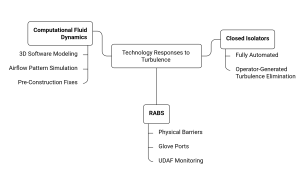
The pharmaceutical industry's response to turbulence risk is accelerating on multiple technological fronts, driven by Annex 1's elevated requirements and a well-documented history of contamination events traced directly to airflow disruption. Three technology categories are currently defining the industry's approach:
1) Closed Isolators eliminate operator-generated turbulence entirely by physically and continuously separating personnel from the aseptic environment. Unlike cleanrooms or RABS, closed isolator systems maintain Grade A conditions without relying on UDAF to compensate for human body turbulence.
This makes them the gold standard for high-sterility aseptic filling. Fully automated isolator production cells from manufacturers like Syntegon can process between 120 and 500 containers per hour with zero glove port interventions, removing the most significant single source of turbulence in conventional aseptic processing.
2) RABS (Restricted Access Barrier Systems) provide a validated intermediate solution between open cleanrooms and full isolators, using physical barriers and glove ports to restrict operator incursion into the Grade A zone. RABS are widely adopted for their operational flexibility.
However, they still depend on UDAF to maintain Grade A conditions, which means turbulence management through equipment design, intervention training, and airflow monitoring remains a continuous operational requirement rather than an engineered-out risk.
3) Computational Fluid Dynamics (CFD) Modeling has become one of the most valuable pre-qualification tools available to sterile manufacturing engineers. CFD allows airflow patterns to be simulated in three dimensions before a room is built or equipment is installed.
Engineers can predict with high accuracy where turbulence will be generated by specific machine geometries, test the impact of proposed interventions on airflow integrity, and optimize HEPA diffuser placement, all before committing to physical construction or conducting a single smoke study.
Conclusion: Airflow Is The Architecture Of Sterility
Turbulence is not a peripheral concern in sterile manufacturing. It is a foundational one. The entire protective architecture of a Grade A cleanroom — HEPA filtration, pressure cascade management, gowning regimens, environmental monitoring programs — is only as effective as the airflow that underpins it.
When that airflow becomes disordered, the layers of protection above it are compromised in ways that standard particle counting and viable monitoring cannot always detect in time to prevent a batch failure or a patient safety event.
What EU GMP Annex 1 (2023) and the 2024–2025 FDA inspection landscape are jointly demanding is a fundamental shift in how the industry conceptualizes and manages turbulence risk:
- From passive assumption to active demonstration — airflow compliance must be shown under real manufacturing conditions, not inferred from static qualification data collected in an empty room
- From equipment-centric to flow-centric design — facility layout, machine positioning, and intervention protocols must all be designed around preserving the integrity of the airflow, not the other way around
- From periodic qualification to continuous operational awareness — turbulence risk must be embedded permanently into change control processes, personnel training programs, and real-time environmental monitoring strategies
The air inside the cleanroom is not simply ventilation. It is the primary, invisible barrier between a sterile product and every particle, microbe, and risk that could harm the patient who ultimately depends on it.
Continuous monitoring isn't optional anymore.
Here's how Annex 1 rewired EM and CCS for every sterile manufacturer.
→ Annex 1 Changes | EM & CCS in Cleanrooms
FAQs
1. Why Is Turbulence Considered A Major Risk In Sterile Manufacturing?
Turbulence disrupts the carefully controlled airflow patterns that are designed to protect sterile products from contamination. When air moves unpredictably, it can carry particles and microorganisms into critical production areas, increasing the risk of product contamination. Even small disturbances caused by personnel movement, equipment placement, or door openings can create turbulent zones. This makes airflow management one of the most important aspects of maintaining sterility in pharmaceutical manufacturing.
2. What Is The Difference Between Laminar Airflow And Turbulent Airflow?
Laminar airflow moves in smooth, parallel layers that continuously sweep particles away from exposed products and critical surfaces. Turbulent airflow, on the other hand, creates eddies and recirculation zones where particles can accumulate and eventually settle onto sterile products. This difference directly impacts contamination control within cleanrooms and aseptic processing areas. Maintaining unidirectional airflow is therefore essential for preserving the integrity of sterile manufacturing environments.
3. What Does "First Air" Mean In Sterile Manufacturing?
"First Air" refers to HEPA-filtered air that reaches an exposed product without first contacting any equipment, surface, or obstruction that could introduce contamination or disturb airflow. The concept is a key requirement under EU GMP Annex 1 and emphasizes the importance of protecting critical product zones with uninterrupted airflow. Ensuring First Air reaches the product helps minimize contamination risks during aseptic processing. It also influences equipment layout, intervention procedures, and cleanroom design decisions.
Reporting on the science, business and regulation shaping the pharmaceutical industry.
More in Microbiology & CCS
All articles →
Active Air Sampling vs Settle Plates vs Contact Plates
Setting EM Alert & Action Levels (Grades A–D): A Practical Guide for Pharma Professionals
Discussion