Agentic AI In Drug Development: Hype Or Reality?
Agentic AI in pharma: Separating the hype from reality. Learn how to scale autonomous R&D workflows in drug development.


For most of the past three years, the pharmaceutical industry's engagement with artificial intelligence has been dominated by a relatively familiar category of tool: large language models that answer questions, summarise documents, generate text, and respond to human prompts. Useful, certainly. Transformative in some operational contexts. But fundamentally reactive — waiting to be asked, producing an output, and then stopping.
Agentic AI is something meaningfully different. An agentic AI system does not wait to be prompted. It reasons, plans, and autonomously executes complex multi-step workflows toward a defined goal, with minimal direct human intervention at each step.
It can propose an experiment, evaluate the result, revise the hypothesis, select the next test, and iterate, in a continuous, self-directing loop. For pharmaceutical drug development, a field defined by multi-year, multi-billion-dollar development workflows that fail at rates exceeding 90%, this is not an incremental upgrade. It is a potential structural disruption.
The question the industry is genuinely grappling with is not whether agentic AI exists, it clearly does. The question is whether it is delivering real, reproducible results in drug development, or whether the current moment is another wave of technology enthusiasm running ahead of the evidence base.
The honest answer is that both things are happening simultaneously, at different layers of the development pipeline, and the distinction between them matters enormously for anyone making investment or adoption decisions today.
What Agentic AI Actually Does In Drug Development?
To evaluate whether agentic AI is hype or reality, it is first necessary to understand precisely what it does and where in the development pipeline it is currently being applied most meaningfully.
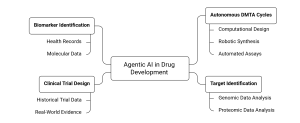
Agentic AI systems in pharmaceutical drug development typically operate within one or more of the following functional modes:
a) Autonomous Design-Make-Test-Analyse (DMTA) Cycle Execution — Traditional DMTA cycles, the iterative loops through which medicinal chemists design candidate molecules, make them, test them in assays, and analyse results to inform the next design, take weeks per cycle. Agentic AI platforms can compress this cycle by connecting computational design models, robotic synthesis platforms, and automated assay systems into a closed loop that operates with minimal human decision-making between steps.
b) Target Identification & Validation — Agentic systems analyse genomic, proteomic, and disease pathway data to identify novel therapeutic targets, rank them by druggability and clinical tractability, and generate hypotheses for experimental validation, tasks that previously required months of human research effort.
c) Clinical Trial Design & Optimisation — Agentic AI analyses vast historical trial data, scientific literature, and real-world evidence to propose optimised protocol designs — patient selection criteria, endpoint selection, dosing regimen, and adaptive design triggers, with a level of data integration that no human team can match across the same timeframe.
d) Biomarker Identification — Multimodal AI models trained on electronic health records, pathology images, and molecular data can identify predictive biomarkers for patient stratification in clinical trials, enabling more precise patient selection and improving the probability of demonstrating efficacy in the enrolled population.
Each of these modes involves an AI system that does not merely assist a human decision-maker by providing information. It actively takes the first several steps autonomously and presents a refined, ready-for-review output at a quality level that previously required weeks of expert effort to produce.
The Evidence: What Agentic AI Has Actually Delivered?
This is where the "hype or reality?" question becomes empirically answerable. The evidence is real, growing, and in some cases genuinely striking. But it is also concentrated at the early stages of the development pipeline, and measured caution about late-stage conclusions is still warranted.
At the discovery and preclinical stage, the results are genuinely impressive and increasingly well-documented:
- Insilico Medicine has reported a 100% success rate in advancing its AI-nominated preclinical candidates to Investigational New Drug (IND) status — meaning none of its AI-designed candidates have been terminated before reaching clinical trials. Its AI-designed small molecule for idiopathic pulmonary fibrosis reached Phase II trials in approximately two and a half years, a timeline that would normally take five or more years through conventional discovery.
- Schrödinger has three clinical-stage oncology programs, SGR-1505 (for lymphomas), SGR-2921 (for acute myeloid leukaemia), and SGR-3515 (a WEE1/MYT1L dual inhibitor for solid tumours), all generated through its physics-based computational platform. Early Phase I data have been promising, with SGR-1505 demonstrating potent target suppression and SGR-2921 achieving pharmacologically relevant exposures with a manageable safety profile.
- BioPharm International analyses (2025) report that AI-discovered molecules have achieved Phase I clinical trial success rates in the range of 80–90%, significantly above traditional historical averages of 40–65%.
- In oncology, a collaboration between a large pharma company and specialist AI providers produced the largest multimodal oncology foundation model to date, trained on electronic health records, laboratory results, and pathology images, now being used to accelerate biomarker identification across multiple cancer indications.
- The Quantitative Continuous Scoring (QCS) computational pathology platform, presented at ESMO Targeted Anticancer Therapies Congress 2026, shortened its development time from an estimated 2.5 years to approximately 5.5 months through the use of state-of-the-art frontier AI models.
The clinical trial design application is also generating credible data. Statista reports that the average clinical trial cycle from Phase I to Phase III completion rose by seven months between 2020 and 2024.
Agentic AI applied to protocol optimisation, site selection, patient recruitment, and adaptive design management is being deployed to reverse that trend, with early deployments at companies including Owkin, CytoReason, and Medable reporting meaningful reductions in trial setup times.
Five documented examples of AI improving predictability across the drug development pipeline.
→ Read: How AI Improves Predictability in Drug Development: 5 Real-World Case Studies
Where The Hype Outpaces The Reality?
An honest and complete assessment of agentic AI in drug development requires acknowledging clearly where enthusiasm is running ahead of the evidence.
The most significant gap is at the late-stage clinical development level. Phase I success rates for AI-discovered molecules being 80–90% is genuinely compelling, but Phase I success has always been primarily about demonstrating safety and initial tolerability, not therapeutic efficacy.
The harder tests, Phase II proof-of-concept and Phase III efficacy confirmation, are where most drug failures occur historically, and where agentic AI's track record is still too limited and too young to draw strong conclusions. The field is, collectively, still waiting for the first AI-discovered molecule to complete a successful Phase III trial and receive regulatory approval on that basis.
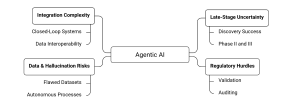
There are also important structural and governance challenges that agentic AI does not solve on its own and may in some cases actively complicate:
1) Regulatory Acceptance Of Agentic Outputs — The FDA and EMA have not yet established clear frameworks for how agentic AI contributions to drug discovery and clinical trial design should be documented, validated, and submitted in regulatory dossiers.
The emerging FDA framework for AI credibility assessment (January 2025 draft guidance) covers AI-generated data generally, but agentic systems, which make sequences of autonomous decisions, present attribution and auditability challenges that point-in-time AI models do not.
2) Data Quality & Hallucination Risk — Agentic AI systems are only as reliable as the data they operate on and the models that interpret it. In a drug development context, a cascade of autonomous decisions built on a flawed hypothesis or a poorly curated training dataset can compound errors across many steps before a human reviewer identifies the problem.
3) Integration Complexity — Connecting computational chemistry platforms, robotic synthesis systems, automated assay readers, and data management infrastructure into a genuinely closed agentic loop requires technology and data interoperability that most pharmaceutical organisations have not yet achieved.
The Companies Building The Infrastructure For What Comes Next?
The clearest signal that agentic AI in drug development is genuinely real, not hype, is the quality, credibility, and scale of the organisations investing in it. These are not speculative bets placed by early-stage startups on unproven science. They are large, strategic commitments from companies and investors with direct, privileged access to performance data.
The organisations most actively shaping this space in 2025 and 2026 include:
- Recursion Pharmaceuticals / Exscientia (Merged 2024): building an end-to-end TechBio platform combining Recursion's phenomics data generation engine with Exscientia's precision small-molecule design capabilities
- Insilico Medicine — pursuing a $2.75 billion deal with Eli Lilly to bring AI-developed drugs to market, with $115 million upfront
- Isomorphic Labs (Google DeepMind) — applying AlphaFold-derived structural biology insights to autonomous drug design with landmark partnerships with Eli Lilly and Novartis
- Owkin — deploying a specialised multi-agent architecture using patient data feedback to optimise clinical trial design and biomarker identification, with an explicit target of achieving a 50% clinical success rate, more than five times the current industry average
- CytoReason — launched an AI agent at the 2026 JPMorgan Healthcare Conference focused on immunology target identification and patient stratification
- Pistoia Alliance — launched a dedicated Agentic AI Initiative in September 2025, seeking industry funding to drive safe and validated adoption of agentic systems across pharma R&D
Recursion. Insilico. Isomorphic. The names are familiar, but the full field is much wider.
Here are 19 startups already building the agentic drug discovery infrastructure that comes next.
→ Read: 19 Pharma Startups Shaping AI-Driven Drug Discovery
Conclusion: Real, Early, And Earning Its Credibility
Agentic AI in drug development is neither pure hype nor fully proven reality. It is something more nuanced and, ultimately, more interesting: a genuine technological inflection point that is delivering measurable, reproducible results at the discovery and early clinical stages, while its late-stage impact remains to be demonstrated and confirmed over the next three to five years of accumulating clinical evidence.
The evidence from Insilico Medicine, Schrödinger, Owkin, and the broader AI drug discovery landscape makes a clear case that agentic systems are genuinely compressing timelines, improving early-stage success rates, and enabling forms of multi-modal data integration that no human research team can replicate at comparable speed or scale.
What they have not yet done is produce a regulatory approval that traces its origins directly to an agentic discovery process from end to end. That approval, when it comes and most serious, well-informed observers expect it will come before 2030 — will be the moment the question "hype or reality?" retires permanently.
Until then, the most accurate and useful answer is this: it is real enough to invest in, and early enough to shape. The organisations that build their agentic AI capabilities now, while the regulatory and scientific frameworks are still being formed, will be best positioned to lead when the full evidence base is finally complete.
FAQs
1. What Is Agentic AI In Drug Development?
Agentic AI refers to artificial intelligence systems that can independently plan, reason, and execute multiple steps toward a defined objective instead of simply responding to user prompts. In drug development, these systems can help design experiments, analyse results, generate new hypotheses, and recommend the next course of action with minimal human intervention. This enables researchers to automate complex workflows that traditionally required significant manual effort. As a result, agentic AI has the potential to accelerate various stages of the drug discovery and development process.
2. How Is Agentic AI Being Used In Pharmaceutical Research?
Agentic AI is being applied across several stages of pharmaceutical research, including target identification, drug molecule design, biomarker discovery, and clinical trial optimization. It can analyse large datasets from genomics, proteomics, scientific literature, and patient records to identify promising drug candidates and improve research efficiency. Some platforms also integrate with laboratory automation to support continuous Design-Make-Test-Analyse (DMTA) cycles. These capabilities help researchers make faster, data-driven decisions throughout the development pipeline.
3) Has Agentic AI Already Proven Its Value In Drug Development?
Agentic AI has shown promising results, particularly during the discovery and preclinical stages of drug development. Several pharmaceutical and AI companies have reported faster molecule identification, shorter development timelines, and encouraging early clinical outcomes using AI-assisted approaches. However, most of the available evidence comes from early-stage research, and long-term success through Phase III clinical trials and regulatory approval is still limited. While the technology has demonstrated significant potential, more clinical evidence is needed before its full impact can be confirmed.
Reporting on the science, business and regulation shaping the pharmaceutical industry.
More in Pharma Manufacturing
All articles →
Compliance In Pharma Manufacturing 2025: Key Regulations And Best Practices You Need to Know

Improving Pharmaceutical Manufacturing Flexibility: Agile Manufacturing and Rapid Scale-Up

Discussion