How Binding Agents Hold Every Tablet Together: A Complete Guide
Every tablet, from painkillers to multivitamins, depends on one quiet ingredient to keep its shape. Here's how binding agents work.


Table Of Content
- What Is a Binding Agent?
- Why Binders Matter in Tablet Manufacturing
- How Binders Are Added: Wet vs Dry Methods
- Common Types of Binding Agents
- How Manufacturers Select the Right Binder
- Binder Selection Checklist
- Common Challenges with Binders
- Final Thoughts
- Frequently Asked Questions
Every tablet you see, whether it's a small painkiller or a large multivitamin, depends on one quiet ingredient to keep its shape: the binding agent. Without it, tablets would crumble the moment they left the press.
This guide explains what binding agents are, how they work, the main types used in the industry, and how manufacturers pick the right one.
What Is a Binding Agent?
A binding agent, also called a binder, is an excipient used in tablet formulation to hold powder particles together. It creates the mechanical strength needed so a tablet can survive packaging, shipping, and handling without breaking apart, while still dissolving properly once swallowed.
Binders work by forming bonds between drug particles and filler particles during granulation or compression. These bonds can be based on:
- Adhesion, where the binder sticks to the surface of particles
- Cohesion, where binder molecules bond to each other, trapping powder in between
- Solid bridges, formed when a liquid binder dries and hardens between particles
Why Binders Matter in Tablet Manufacturing
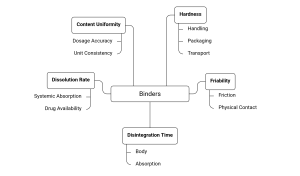
Binders are not just "glue." They directly affect several critical quality attributes of a tablet:
- Hardness – how well the tablet resists breaking during transport
- Friability – how much surface powder is lost from rubbing or handling
- Disintegration time – how fast the tablet breaks apart in the body
- Dissolution rate – how quickly the drug becomes available for absorption
- Content uniformity – ensuring each tablet has the same amount of active drug
Using too little binder gives weak, crumbly tablets. Using too much can slow disintegration and delay drug release, which affects bioavailability. Getting the concentration right is one of the most important steps in formulation development.
How Binders Are Added: Wet vs Dry Methods
Binders can be introduced into a formulation in two main ways, depending on the granulation method used.
Wet granulation is the most common approach. Here, the binder is dissolved or dispersed in a solvent, typically water or alcohol, and the resulting solution is added to the powder mix. The wet mass is then dried and milled into granules before compression. This method gives strong, uniform granules and is widely used for tablets that need good mechanical strength.
Dry granulation and direct compression use the binder in its dry powder form, mixed directly with other ingredients. No solvent is used. This method is preferred for drugs that are sensitive to moisture or heat, since it skips the drying step entirely.
Binders are just one piece of granulation. Here's the complete process guide covering techniques, equipment, and machine selection for every method.
→ Read: Pharma Granulation: Complete Process Guide
Common Types of Binding Agents
Binders are generally grouped based on their origin: natural, synthetic, or semi-synthetic. Each type has its own strengths depending on the tablet's requirements.
Starch has been used for decades because it is cheap, safe, and readily available. It's typically used as a starch paste during wet granulation.
Povidone (PVP) is one of the most widely used synthetic binders today. It works well in both wet and dry processes and produces tablets with good hardness even at low concentrations.
Microcrystalline cellulose (MCC) is popular in direct compression because it has natural binding properties along with good flow characteristics, reducing the need for a separate wet granulation step.
HPMC (Hydroxypropyl Methylcellulose) is often chosen for extended-release tablets because it also controls how the drug is released over time, doing double duty as both binder and release-modifying agent.
How Manufacturers Select the Right Binder
Choosing a binder isn't random. Formulators typically weigh several factors before finalising an ingredient:
- Compatibility with the active pharmaceutical ingredient (API) and other excipients
- Solubility of the API, since some binders can affect how well the drug dissolves
- Required tablet hardness and friability targets
- Disintegration and dissolution goals, especially for immediate-release versus extended-release products
- Cost and regulatory acceptance, since some binders have wider global approval than others
- Manufacturing process, since the method (wet granulation, dry granulation, or direct compression) narrows down which binders will work
Concentration also plays a big role. Binders are usually used at 2% to 10% of the total tablet weight, though this varies depending on the binder's strength and the tablet's design.
Choosing the right binder is only half the equation. See how to select the granulation equipment that actually processes it right.
→ Read: Granulation Equipment Buyers Guide: How to Choose Machines for Pharma Manufacturing
Binder Selection Checklist
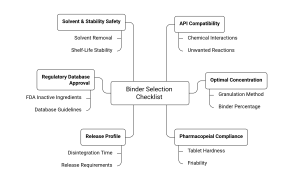
Before finalising a binder for a tablet formulation, it helps to confirm the following:
- Binder is compatible with the API and shows no signs of chemical interaction
- Binder concentration falls within an acceptable range for the chosen granulation method
- Tablet hardness and friability meet pharmacopeial limits
- Disintegration time matches the intended release profile (immediate or extended)
- Binder is listed in relevant regulatory excipient databases (e.g., FDA Inactive Ingredient Database)
- If any Solvent used should be safe and fully removable during drying
- Stability data confirms no degradation of binder or API over the product's shelf life
Common Challenges with Binders
Even experienced formulators run into issues when working with binders. Some frequent problems include:
- Over-granulation - where too much binder solution creates overly hard granules that resist breaking during compression
- Under-binding - leading to capping (where the top of a tablet separates) or lamination (where layers split apart)
- Inconsistent moisture content - which affects how the binder behaves during drying and can cause batch-to-batch variation
- Slow disintegration - when the binder concentration is too high for the intended release profile
Most of these issues are resolved through careful process optimisation, proper binder selection, and thorough testing during formulation development.
Final Thoughts
Binding agents may seem like a small part of tablet formulation, but they influence nearly every physical property of the final product. From how well a tablet survives shipping to how quickly it releases its drug in the body, the binder plays a central role.
Choosing the right type and concentration requires a solid understanding of the API, the manufacturing process, and the intended release profile. Getting this step right is what separates a well-formulated tablet from one that fails quality testing.
Frequently Asked Questions
1. What is the most commonly used binder in tablets?
Povidone (PVP) and starch are among the most widely used binders due to their reliability and low cost.
2. Can a binder affect how fast a drug works?
Yes, binder type and amount can speed up or slow down tablet disintegration, which affects drug release.
3. Is MCC a binder or a filler?
MCC works as both. It has natural binding properties and can serve as a filler in tablet formulations.
4. What happens if too much binder is used?
Excess binder can make tablets too hard, slowing disintegration and delaying drug absorption.
5. Are natural binders as effective as synthetic ones?
Natural binders work well for many tablets, but synthetic binders like PVP often give stronger binding at lower concentrations.
Reporting on the science, business and regulation shaping the pharmaceutical industry.
More in Pharma Manufacturing
All articles →
Compliance In Pharma Manufacturing 2025: Key Regulations And Best Practices You Need to Know

Improving Pharmaceutical Manufacturing Flexibility: Agile Manufacturing and Rapid Scale-Up

Discussion