by Vaibhavi M.
10 minutes
Building KSM Manufacturing Clusters: Opportunities For SMEs In The Pharmaceutical Industry
How KSM clusters drive SME growth, lower costs, and build resilient pharma supply chains.
The story of India’s pharmaceutical rise often begins with a molecule, tiny, invisible, and indispensable. In the early 2000s, many small manufacturers in Gujarat and Andhra Pradesh struggled to compete with cheaper imports of key starting materials (KSMs) from overseas.
One such SME, located on the outskirts of Vadodara, nearly shut down after losing a major client due to the inconsistent supply of raw materials. But what saved them was not luck; it was collaboration.
When they joined a newly formed KSM manufacturing cluster, they gained access to shared effluent treatment plants, common utilities, skilled labour pools, and, most importantly, steady business opportunities. That company not only survived but began supplying KSMs to some of the biggest API plants in India.
This story reflects a broader transformation happening across India and other emerging pharma economies. KSM manufacturing clusters are becoming engines of growth, innovation, and self-reliance, offering SMEs a chance to participate in a high-value segment of the pharmaceutical supply chain that was once dominated by large corporations or imports.
As global supply chains face increasing uncertainty, the race to localise and strengthen KSM production has created a new landscape full of opportunities for small and medium enterprises. Onshoring API manufacturing is now a strategic priority.
Understanding KSMs and Their Role in the Pharma Value Chain
Key Starting Materials (KSMs) are chemical compounds used at the initial stages of API (Active Pharmaceutical Ingredient) synthesis. They determine the efficiency, quality, and cost of downstream manufacturing.
Unlike APIs or intermediates, KSMs are not necessarily pharma-grade materials; however, they must meet specific chemical, purity, and regulatory expectations because they set the foundation for a compliant synthetic pathway.
Pharmaceutical regulators worldwide, including the USFDA and EMA, are increasingly requiring traceability, process control, impurity profiling, and supply-chain transparency for KSMs. This makes domestic production strategically vital for any country aiming to build a robust pharmaceutical ecosystem.

Why KSM Manufacturing Clusters Matter Today
Over the past decade, overdependence on a few global supply hubs for KSMs has exposed serious vulnerabilities. From price fluctuations to supply disruptions during global crises, the need for a diversified, domestic KSM ecosystem became unmistakable.
Clusters address these gaps by creating structured environments where companies share infrastructure, logistics, regulatory support systems, and skilled manpower.
For SMEs especially, standalone KSM manufacturing often becomes prohibitively expensive due to capital-intensive requirements such as solvent recovery units, common effluent treatment plants (CETPs), and advanced analytical laboratories. A cluster-based approach distributes these costs, making entry more feasible.
Cluster-Based KSM Manufacturing: A Strategic Model
Well-designed KSM manufacturing clusters operate on shared infrastructure and collective expertise. This model enables SMEs to focus on core chemistry and innovation, rather than spending disproportionate capital on supporting infrastructure. This model reduces risks, accelerates scale-up, and enables standardisation. Clusters typically include:
- Common utilities such as steam, power, nitrogen, and water systems.
- Shared waste disposal and treatment facilities are compliant with CPCB and local regulations.
- Centralised R&D, testing laboratories, and pilot-scale production blocks.
- Logistics hubs for raw materials and finished goods.
- Skill development centres for chemical engineering and process operations.
- Integrated digital systems for safety monitoring and process compliance.
Government Policies and Incentives Accelerating KSM Clusters
Countries like India have introduced Production Linked Incentives (PLI), financial grants, subsidised land, and regulatory fast-tracking to encourage domestic KSM manufacturing. The PLI scheme impact has significantly improved SME participation.
These policy frameworks make cluster participation far more attractive and viable for SMEs. The goal is clear: reduce import dependence and build long-term strategic capabilities.
Under the PLI scheme for KSMs and APIs, SMEs benefit from:
- Capital subsidies for plant and machinery.
- Preferential access to Pharmacity and Chemical Industrial Parks.
- Lower cost of financing through soft loans.
- Environmental clearance support under single-window systems.
- Incentives for developing indigenous technology platforms.
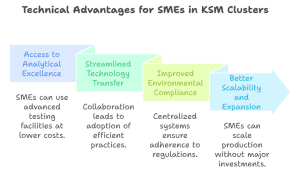
Technical Advantages for SMEs Entering KSM Clusters
KSM manufacturing involves a multi-step organic synthesis process, controlled reactions, impurity management, solvent handling, and stringent safety controls. For SMEs, these technical challenges often become barriers. But clusters reduce complexity through shared capabilities.
Access to Analytical Excellence
KSMs require advanced testing for process-related impurities, intermediates, metal catalysts, solvent residues, and stability. Cluster labs equipped with HPLC, GC-MS, LC-MS/MS, ICP-MS, NMR, and stability chambers allow SMEs to leverage high-end analytical infrastructure at lower cost.
Streamlined Technology Transfer
Clusters facilitate collaboration between research institutions, technology providers, and manufacturers. SMEs can adopt safer, more efficient synthesis routes and green chemistry practices, improving compliance and reducing the cost of goods (COGs).
Improved Environmental and Safety Compliance
Chemical and solvent-heavy KSM production generates hazardous waste. Centralised effluent treatment plants, solvent recovery units, and zero-liquid-discharge (ZLD) systems within clusters ensure SMEs remain aligned with environmental regulations while minimising disposal costs.
Better Scalability and Expansion
Pilot plants, multipurpose blocks, and modular reactor setups within clusters enable SMEs to scale production quickly and meet commercial demands without incurring major capital investments.
Economic Benefits: Why SMEs Stand to Gain the Most
For small and mid-sized companies, KSM clusters offer cost-effective ways to enter high-value markets. Shared infrastructure results in lower capital expenditure (CAPEX), while operational expenditure (OPEX) is reduced due to common utilities and economies of scale.
SMEs also gain access to clients who prefer sourcing from within a regulated cluster environment due to the quality assurance, traceability, and risk mitigation it provides.
Clusters also enhance global competitiveness. With consistent supply, standardised processes, and lower cost structures, SMEs can offer more competitive pricing, secure long-term contracts, and participate in international supply chains. Supply chain visibility improves global competitiveness.
How Clusters Enable Innovation in KSM Chemistry
Innovation is often assumed to be the domain of big companies, but KSM clusters prove otherwise. By creating collaborative ecosystems, they encourage SMEs to experiment with process optimization, flow chemistry, catalytic processes, and greener synthesis pathways.
Some clusters incorporate incubation facilities where small innovators can test new reactions or develop patent-free processes for import-substituted materials. Access to experienced mentors, academic partnerships, and shared facilities accelerates innovation cycles.
Reducing Import Dependence: A Strategic Priority
Local KSM clusters help harmonise domestic supply chains, making API and finished dosage manufacturers less dependent on imports. This enhances national resilience against geopolitical uncertainties and strengthens efforts to achieve pharmaceutical self-reliance.
The ripple effect is significant; stable KSM supply enhances API production, which in turn ensures steady formulation manufacturing. This reliability supports sterile manufacturing continuity. SMEs play a critical role in this cascading chain of value creation.
Export Opportunities for KSM-Focused SMEs
Beyond domestic benefits, KSM clusters open strong opportunities in export markets. Many countries seek reliable suppliers for intermediates and KSMs, especially those aligned with international quality standards. Cluster-based SMEs often find it easier to secure international regulatory certifications due to the systemic support for compliance, making export expansion more accessible.
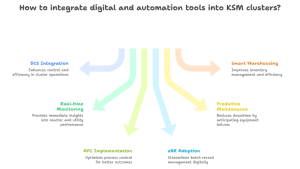
Digital and Automation Opportunities Within KSM Clusters
Modern KSM clusters are increasingly integrating digital tools such as:
- Distributed control systems (DCS)
- Real-time monitoring of reactors and utilities
- Advanced process control (APC)
- Digital batch records (eBR)
- Predictive maintenance for equipment
- Smart warehousing and inventory systems
Building Skilled Workforce Pipelines
KSM clusters often collaborate with universities and institutes to create training centres for chemical operators, QC analysts, safety technicians, and process engineers. SMEs operating within these clusters gain access to trained manpower, reducing recruitment and training costs while improving operational efficiency.
Challenges SMEs Should Consider
Despite substantial benefits, SMEs should approach KSM cluster participation with realistic expectations. Regulatory compliance remains continuous and demanding. SMEs must maintain process documentation, adhere to global quality standards, and invest in training.
Additionally, competition within clusters means companies must differentiate through better chemistry, efficiency, or customer service.
However, for SMEs committed to long-term growth, these challenges are part of building globally competitive capabilities.
The Future of KSM Manufacturing Clusters
The future is strongly aligned with sustainable chemistry, digitisation, biotechnology-driven synthesis, and global integration. KSM clusters will increasingly focus on solvent-free reactions, enzymatic processes, continuous manufacturing, and circular waste management systems. For SMEs, entering now means aligning with the future of pharma manufacturing rather than catching up later.
Clusters will continue to expand across India and other emerging markets, becoming hubs of economic growth, innovation, and export capability. With government support, technological transformation, and global demand for reliable KSM supply, SMEs have a unique opportunity to establish themselves as major contributors to the world’s pharmaceutical ecosystem.
FAQs
1. What is a KSM in pharmaceuticals?
A KSM (Key Starting Material) is a chemical compound used at the beginning of API synthesis. It forms the base of the chemical pathway and must meet specific quality and traceability requirements.
2. Why are KSM manufacturing clusters important?
Clusters reduce costs, enhance compliance, and strengthen domestic supply chains by providing shared infrastructure and resources for SMEs.
3. How do SMEs benefit from KSM clusters?
SMEs gain access to common utilities, analytical labs, skilled manpower, easier regulatory support, and lower CAPEX/OPEX, making KSM production more feasible.
4. What government schemes support KSM manufacturing?
PLI schemes, subsidised land, soft loans, and fast-track approvals are key incentives provided to boost domestic KSM and API manufacturing.
5. Are KSMs essential for reducing import dependence?
Yes. Local KSM manufacturing ensures resilient supply chains, reduced volatility, and stronger national pharmaceutical capabilities.