GAMP 5 Second Edition for MES: A Practical Validation Guide
GAMP 5 Ed.2 recalibrates MES validation around risk, not paperwork. Here's the practical classification framework pharma teams need.

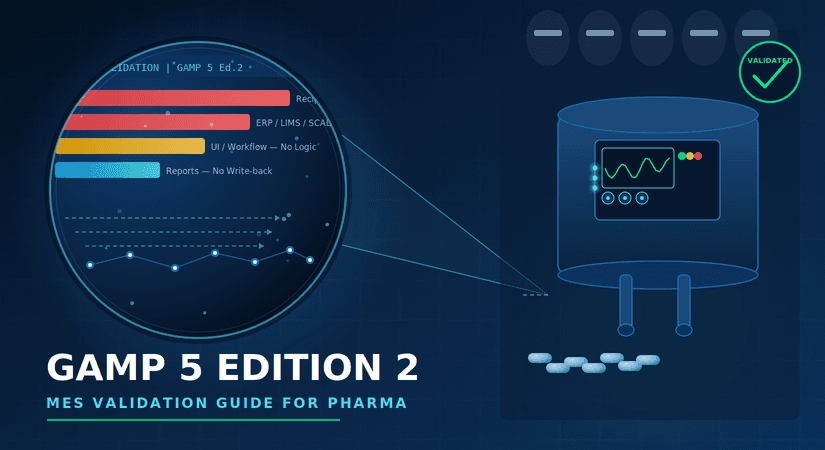
GAMP 5 Second Edition is the most consequential rewrite of pharma's computerised systems validation guidance since the original was published — and Manufacturing Execution Systems sit at the centre of the change. MES is large, frequently reconfigured, and tied directly to batch release, which makes it simultaneously the highest-risk and highest-friction system on the validation master plan. This guide breaks down what Ed.2 actually shifts for MES, in practical terms.
What Changed Between GAMP 5 First and Second Edition
The first edition treated validation largely as a documentation exercise: script every test case in advance, execute it, file the evidence. Ed.2 formalises a risk-based, critical-thinking approach — validation effort should scale with actual patient-safety and product-quality risk, not with how much paperwork a system can generate. It also explicitly references the FDA's Computer Software Assurance (CSA) initiative, which encourages the same shift: less scripted testing for low-risk functionality, full rigour preserved for high-risk functionality.
Why MES Is the Hardest Test Case for This Shift
Most computerised systems in a plant are configured once and largely left alone. MES is not. Recipe changes, line additions, integration updates, and minor UI tweaks happen constantly — and under a traditional CSV mindset, each change can trigger a full revalidation cycle. Ed.2 gives validation and manufacturing IT teams a structured way to classify MES changes: which configuration changes genuinely touch product quality or data integrity, and which are administrative and can move through a lighter change-control path.
Get the classification wrong in one direction and minor configuration tweaks consume months of QA bandwidth. Get it wrong in the other direction and an auditor finds a 'low-risk' classification that does not hold up — which is exactly the kind of finding that turns into a 483 observation.
A Practical Classification Framework
- Recipe/formula parameters that affect batch release: high risk — full validation rigour regardless of how small the change looks
- Integration points with ERP, LIMS, or SCADA: high risk — interface failures propagate silently and are hard to detect post-release
- UI/workflow changes with no data or logic impact: lower risk — unscripted, exploratory testing with documented rationale is defensible under CSA principles
- Reporting and dashboard changes with no write-back to production data: lowest risk — minimal testing burden
Documenting the CSA Rationale So It Survives an Inspection
The single most common failure mode under Ed.2/CSA is not under-testing — it's under-documenting the reasoning behind why something was classified as low-risk. Auditors trained on the old CSV model will ask 'where is the test script?' The answer needs to be a clearly written risk assessment, not a shrug. Every MES change record should capture: the risk classification, who made it, what evidence was reviewed, and why the testing depth chosen was sufficient.
Where This Gets Worked Through With Practitioners Who've Done It
PHARMA MANUFACTURING IT SUMMIT (PMITS) | AHMEDABAD | 7 JULY 2026
Le Méridien, Ahmedabad | Invitation-Only | 130 Seats | A GPACTS 2026 Series Event
Gujarat manufactures roughly 33% of India's pharma output. Most of it still runs on paper. PMITS is built around a single question: what does it take to bring the Indian pharma factory floor into the CSA, GAMP 5 Edition 2, and paperless-batch-record era — without losing the validated state regulators expect?
One day. 130+ of India's most senior pharma manufacturing IT, CSV, and plant IT decision-makers. No vendor expo. 70%+ end-users. Chatham House throughout.
Confirmed Speakers
Vikram Shukla (President, Zydus) delivers the Chief Guest address, alongside Pramod Gokhale (Sr. President & Global CIO, Mankind Pharma), Dr. Bijender Mishra (Global IT Head & CISO, Alkem Laboratories), Ravi Kalla (CIO, Anthem Biosciences), Narinder Sagar (CIO, Corona Remedies), Rahul Songire (Sr. VP – Central Quality, Zydus Lifesciences), and Shyam Khante (former Director, GSK).
What You Leave With
- A Manufacturing IT 2030 Blueprint — ready for your next plant investment review
- A CSV → CSA Migration Playbook — what to retire, retain, and defend in an inspection
- A GAMP 5 Ed.2 & Annex 22 Readiness Checklist — the exact questions coming on AI-in-GMP and paperless batch records
- Unfiltered peer intelligence on real MES, LIMS, and Digital Twin deployments — Chatham House
- 12 months of Pharma Now manufacturing IT intelligence post-event
EARLY BIRD CLOSES 18 JUNE 2026 | Executive Pass: ₹4,990 + GST | 130 Seats, Reviewed Applications
Organised by Pharma Now × Yellow Hive Events & Media | Wave 02 of the GPACTS 2026 Series. → Book your pass
GAMP 5 Ed.2 is not a deregulation of MES validation — it's a recalibration toward effectiveness. Indian pharma manufacturers who get the risk classification framework right now will spend less time revalidating trivial changes and more time on the testing that actually protects patients and product quality.
Reporting on the science, business and regulation shaping the pharmaceutical industry.
More in Pharma Manufacturing
All articles →
Compliance In Pharma Manufacturing 2025: Key Regulations And Best Practices You Need to Know

Improving Pharmaceutical Manufacturing Flexibility: Agile Manufacturing and Rapid Scale-Up

Discussion