by Mrudula Kulkarni
6 minutes
Pharma Serialization And Track-And-Trace: A Compliance Guide For 2026
Pharma serialization and track-and-trace keep shifting for Indian exporters why infrastructure beats one-time projects in 2026.
Serialization and track-and-trace solve a problem that MES and LIMS were never built to handle: proving where a specific unit of product has been, end to end, across the supply chain. For Indian pharma exporters, this isn't a one-time regulatory hurdle. It is one of the most frequently shifting compliance areas in the industry, shaped simultaneously by domestic mandates and export-market rules like the US DSCSA and EU FMD.
That constant shifting is exactly why pharma serialization keeps tripping up manufacturers who treat it as a project instead of permanent infrastructure.
Why Pharma Serialization Needs To Be Infrastructure, Not A Project
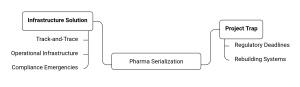
Companies that built their serialization systems purely to hit one regulatory deadline have repeatedly found themselves scrambling the moment requirements changed — new aggregation rules, new reporting formats, new destination-market mandates arriving with little warning.
The pattern that actually holds up over time is different. Manufacturers who treat track and trace pharma systems as ongoing operational infrastructure — built to flex as requirements evolve — avoid the recurring scramble. Those who build once and walk away end up rebuilding under pressure, usually right before an export shipment or an audit.
Where Serialization Shares A Pattern With MES And LIMS
Pharma serialization, MES, and LIMS modernisation are all compliance-driven digital systems. All three succeed under the same condition: clean integration into existing plant and lab operations, not implementation as a standalone checkbox exercise.
A serialization system sitting isolated from the MES generating batch data, or disconnected from the ERP managing shipment data, becomes just another manual reconciliation point. That manual gap is precisely the kind of fragility that undermines the traceability serialization exists to guarantee in the first place.
What This Means For Export-Focused Indian Manufacturers
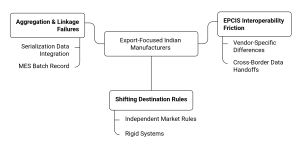
For manufacturers exporting into regulated markets, three operational realities define how track and trace pharma systems actually perform in practice:
EPCIS interoperability is technically standard but practically inconsistent.
Every system speaks the same data-exchange language on paper. In practice, vendor-specific implementation differences create friction at the exact point where cross-border data handoff happens — often the first place a compliance gap becomes visible.
Destination-market requirements vary and shift without much notice.
Serialization architecture built around one export market's current rules needs enough flexibility to absorb the next regulatory update without triggering a full rebuild. Markets update their requirements independently, and a rigid system built for yesterday's rule set becomes a liability the moment a destination market changes its own.
Aggregation and batch-level linkage is where failures concentrate.
The integration between serialization data and the MES batch record is where most operational failures actually occur — not at the printer, not at the scanner. When that linkage breaks, the failure tends to surface only when traceability is actually tested, which is usually during an audit or an export inspection.
Global serialization isn't just about printing codes—it breaks at exceptions and data exchange.
See how DSCSA exceptions and GS1 standards shape real-world compliance.
→ Read: Serialization in the Pharmaceutical Industry: Navigating DSCSA Exceptions and GS1 Standards
The Discipline That Transfers From MES And CSV Modernisation
Serialization and track-and-trace rarely get the same conference-stage attention as MES rollouts or enterprise AI initiatives. But the compliance exposure from a gap that surfaces during an export audit is just as material, if not more, given that it can stop product at the border.
The same discipline that works for MES and LIMS modernisation transfers directly to pharma serialization: risk-based prioritization, workflow-first design, and integration rather than bolt-on implementation. Manufacturers who have already internalized this discipline for one compliance system tend to apply it more easily to serialization, because the underlying failure pattern — isolated systems creating manual reconciliation gaps — is identical across all three.
Flexible systems still fail without risk-based validation.
See how GAMP 5 turns computerized systems into inspection-ready infrastructure.
→ Read: GAMP 5 Simplified: A Practical, Risk-Based Approach To Computerized Systems
Where This Gets Discussed Alongside MES And CSV
★ PHARMA MANUFACTURING IT SUMMIT (PMITS) | AHMEDABAD | 7 JULY 2026 ★
Le Méridien, Ahmedabad | Invitation-Only | 130 Seats | A GPACTS 2026 Series Event
Gujarat manufactures roughly 33% of India's pharma output. Most of it still runs on paper. PMITS is built around a single question: what does it take to bring the Indian pharma factory floor into the CSA, GAMP 5 Edition 2, and paperless-batch-record era — without losing the validated state regulators expect?
One day. 130+ of India's most senior pharma manufacturing IT, CSV, and plant IT decision-makers. No vendor expo. 70%+ end-users. Chatham House throughout.
Confirmed Speakers
Vikram Shukla (President, Zydus) delivers the Chief Guest address, alongside Pramod Gokhale (Sr. President & Global CIO, Mankind Pharma), Dr. Bijender Mishra (Global IT Head & CISO, Alkem Laboratories), Ravi Kalla (CIO, Anthem Biosciences), Narinder Sagar (CIO, Corona Remedies), Rahul Songire (Sr. VP – Central Quality, Zydus Lifesciences), and Shyam Khante (former Director, GSK).
What You Leave With
- A Manufacturing IT 2030 Blueprint — ready for your next plant investment review
- A CSV → CSA Migration Playbook — what to retire, retain, and defend in an inspection
- A GAMP 5 Ed.2 & Annex 22 Readiness Checklist — the exact questions coming on AI-in-GMP and paperless batch records
- Unfiltered peer intelligence on real MES, LIMS, and Digital Twin deployments — Chatham House
- 12 months of Pharma Now manufacturing IT intelligence post-event
Organised by Pharma Now × Yellow Hive Events & Media | Wave 02 of the GPACTS 2026 Series. → Book your pass
FAQs
1. What is pharma serialization?
Pharma serialization is the process of assigning a unique identifier to each saleable unit of a drug product, enabling that unit to be tracked through every stage of the supply chain. It is the foundation that makes track and trace pharma systems functional.
2. Why does track and trace pharma compliance keep changing?
Track and trace pharma requirements shift because each export destination — including the US under DSCSA and the EU under FMD — sets and updates its own rules independently. Indian exporters supplying multiple markets must absorb several sets of evolving requirements simultaneously, which is why compliance keeps shifting rather than settling.
3. Why do serialization systems fail even after implementation?
Most pharma serialization failures don't happen at the equipment level. They happen at the integration points — particularly the link between serialization data and MES batch records, or the handoff of EPCIS data across borders where vendor-specific implementation differences create friction.
4. Should serialization be treated as a one-time project or ongoing infrastructure?
Ongoing infrastructure. Manufacturers who build pharma serialization systems purely to meet a single deadline tend to face repeated scrambles as requirements shift. Systems designed for flexibility from the start absorb regulatory updates without requiring a rebuild.
5. How does serialization relate to MES and LIMS modernisation?
All three are compliance-driven digital systems that succeed only with clean integration into existing operations. The same risk-based, workflow-first discipline that makes MES and LIMS implementations succeed applies directly to track and trace pharma systems — isolated, bolted-on systems fail for the same underlying reasons across all three categories.