GAMP 5 Simplified: A Practical, Risk-Based Approach To Computerized Systems
GAMP 5 simplified for pharma software categories, validation lifecycle, five principles and 2022 second edition updates explained without jargon.


In the pharma, biotech, and medical device industries, the term “GAMP 5” appears often during discussions about compliance and computerized systems. But what does it really mean? Why is it important? And how can it be applied in everyday operations? This guide breaks everything down in a clear and straightforward way — no jargon and no unnecessary complexity!
What Is GAMP 5?
GAMP 5 stands for Good Automated Manufacturing Practices, Issue 5. It's a guideline published by the ISPE, the International Society For Pharmaceutical Engineering and it's specifically designed to help regulated industries manage computerized systems properly.
Here's a crucial point right upfront: GAMP 5 is not a law. It carries no legal obligation. But don't let that make you underestimate it. It is referenced and respected by regulatory bodies worldwide, including the US FDA, making it the closest thing the industry has to a universal standard for computerized systems compliance. Think of it as a highly trusted playbook rather than a rulebook.
GAMP 5 applies to computerized systems used in regulated environments and is intended for use by regulated companies, regulatory authorities, suppliers, and other stakeholders. Its core purpose is to provide a risk-based approach to ensuring that these systems are validated and operate as intended.
Why Does It Actually Matter?
GAMP 5 is designed to work alongside other industry guidelines, standards, and GxP regulations such as Good Manufacturing Practice (GMP), Good Clinical Practice (GCP), Good Laboratory Practice (GLP), Good Distribution Practice (GDP), Good Pharmacovigilance Practices (GVP), Medical Device Regulations, 21 CFR Part 11 (rules for electronic records and electronic signatures), EU GMP Annex 11, and various ISO standards.
It is a commonly accepted framework for the design, development, and maintenance of computerized systems within GxP-regulated environments. The importance of GAMP 5 in GxP settings can be understood through five main outcomes:
- Protecting patient safety, product quality, and data integrity
- Ensuring systems are fit for their intended use and remain compliant
- Offering a cost-efficient and practical approach
- Helping with regulatory understanding and encouraging consistent industry practices
- Enabling innovation and adjusting to changing technologies
A Brief History Of How We Got Here!
Understanding GAMP 5 is easier when you know the story behind it. It didn't appear out of thin air — it evolved over decades in response to real industry challenges.
GAMP itself was founded in 1991 in the United Kingdom, created specifically to deal with evolving US FDA expectations around the management and control of automated systems required for GMP compliance.
A few years later, in 1994, a group of UK-based pharmaceutical experts drafted and shared the first GAMP guideline within industry circles. By 1995, the first formal version was officially published under the auspices of ISPE — marking the beginning of a lasting partnership between GAMP and ISPE.
Multiple revisions followed over the years. The notable ones were GAMP 4 in 2001, and then GAMP 5 in 2008, which was conceptually grounded in science-based risk management strategy in line with 21st century GxP regulations and ICH Q8, Q9, and Q10 guidance.
It was also designed to be compatible with IEEE standards, ISO 9000, ISO 12207, and the IT Infrastructure Library (ITIL). In 2017, the GAMP community of practice leadership kicked off a formal review to determine whether the guideline still met its objectives and where updates were most needed.
That process culminated in the second edition, published in 2022, the most significant update in 14 years. This edition aligned the guideline with the FDA's new Computer Software Assurance guidance (September 2022) and ISO 14971 for medical devices.
What Changed In The 2022 Second Edition?
The original 2008 version was largely focused on compliance — checking boxes, following processes, avoiding inspection findings. The 2022 edition shifts that focus fundamentally. Patient safety, product quality, and data integrity now take center stage over documentation and compliance formalities.
Practically speaking, the second edition introduced updated guidance on cybersecurity, data integrity, and cloud computing. It also brought in support for agile development methodologies and risk-based validation approaches that are more in tune with how software is actually built and maintained today.
To address these areas, several new appendices were added in the second edition, covering topics like:
- IT infrastructure management
- Critical thinking in validation
- Specifying requirements effectively
- Agile software development
- Software tools
- Distributed Ledger Systems (Blockchain)
- Artificial Intelligence (AI) and Machine Learning (ML)
The V-Model — And Why Agile Changed The Game?
For many years, GAMP 5's approach to validation was illustrated using the V-model. The idea is straightforward: system specifications created during development are matched against corresponding tests during verification. The left side of the V represents what you design; the right side represents how you test it.
For example, a configurable product would be tested to verify its requirements, functionality, and configuration specifications. Commercial off-the-shelf software, on the other hand, might not need functional and configuration specifications at all, so the testing scope would be smaller.
The V-model works well in structured, linear development environments. But it's not always practical. Traditional "linear approaches" like the V-model or the waterfall method struggle in agile development environments, where software is built iteratively and updated continuously.
This is especially true for modern systems like SaaS platforms, AI models, and Machine Learning tools, which need rapid rollouts and constant improvement cycles.
That's exactly why the 2022 second edition of GAMP 5 formally introduced support for the agile model. This gives teams the flexibility they need to assess GxP compliance in environments where development is fast-moving and adaptive — without sacrificing the rigour that regulated industries demand.
GAMP 5 And Computer System Validation (CSV)
Computer System Validation, commonly called CSV, is the documented process of proving that a computerized system consistently performs as intended and meets applicable GxP requirements. In pharmaceutical, biotech, and medical device companies, CSV is not optional. It's a core expectation from regulators like the FDA and EMA.
GAMP 5 does not replace the regulatory requirements for CSV. Instead, it provides a practical, risk-based framework for carrying out CSV in a structured and efficient way. It's widely recognised as the industry-standard approach to doing this well.
Under GAMP 5, computer system validation typically includes:
- Defining intended use and requirements through user requirement specifications (URS) and functional specifications
- Performing risk assessments to determine the appropriate level of validation effort
- Assessing suppliers and leveraging their documentation where it's appropriate to do so
- Running verification and testing activities calibrated to the system's category and risk level
- Maintaining the validated state through change control and periodic review
One of the biggest practical advantages of applying GAMP 5 to CSV is scalability. A highly configurable off-the-shelf system doesn't need the same depth of documentation and testing as a fully custom-built application. By keeping the focus on critical functionality and data integrity, GAMP 5 helps organisations avoid over-validation while staying compliant and audit-ready.
The 5 Key Principles Of GAMP 5
GAMP 5 is built on five guiding principles. These aren't abstract ideas — they shape how validation work actually gets done day to day!
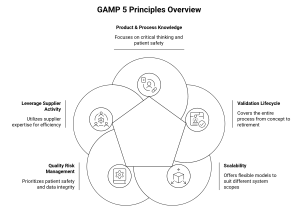
Principle 1 — Product & Process Knowledge
GAMP 5 promotes critical thinking when applying risk-based testing and validation. Rather than applying the same level of scrutiny to everything uniformly, teams are encouraged to draw on their knowledge of the product and its processes to focus attention where it matters most — on aspects that genuinely affect patient safety, product quality, and data integrity.
Principle 2 — Validation Lifecycle
GAMP 5 outlines a four-stage lifecycle that all computerized systems should follow. According to the guideline, all lifecycle stages must be defined within the company's Quality Management System (QMS):
Concept: At this stage, which sits outside the supplier's scope, manufacturers identify automation opportunities, list initial requirements, and begin searching for suitable suppliers.
Project: Once a supplier is identified, the system is designed, developed, deployed, and assessed for GxP compliance. The 2022 edition now supports agile development approaches here, making this stage more flexible than it was under the 2008 version.
Operations: This is typically the longest phase. The system is used in day-to-day operations, and the focus is on maintaining it in a validated state through robust change control and disaster recovery processes.
Retirement: When the system needs to be replaced, it is retired, decommissioned, or migrated. While not formally defined as its own stage in GAMP, the necessary arrangements like data management and migration planning are described during the operations stage.
Principle 3 — Scalability
GAMP 5 encourages scalable approaches to validation. There's no single model that fits every situation. Depending on the scope and complexity of the system, a Waterfall, V-model, Agile, or even a reduced or expanded variant of these approaches may be appropriate. The second edition's inclusion of the agile model directly supports this principle.
Principle 4 — Quality Risk Management
Patient safety, product quality, and data integrity must drive all validation decisions. This means prioritising tests based on the risk associated with system attributes, spending more time and effort on critical areas and less on non-critical ones.
The 2022 edition takes a practical stance here. It supports exception-based reporting, where a simple "Pass" is sufficient when a system works as intended. You don't need screenshots for every test step.
Only high-risk or critical tests may require additional evidence. The guidance also acknowledges that minor documentation errors carry little value and low risk, so attention should focus on issues that actually affect system performance and compliance.
Principle 5: Leverage Supplier Activity
GAMP 5 encourages companies to make full use of supplier expertise during the project stage of a system's lifecycle. Supplier-provided validation packages can help meet GxP verification requirements, reduce duplication of effort, and serve as an additional layer of assurance. The goal is faster, more effective adoption, without starting from scratch every time.
GAMP 5 Software Categories
GAMP 5 classifies software into categories based on GxP impact and risk. It's worth noting that Category 2, which was associated with firmware in GAMP 4, was removed in GAMP 5. The risk increases as you move from Category 1 to Category 5, and so does the depth of validation required. Here's how the categories break down:
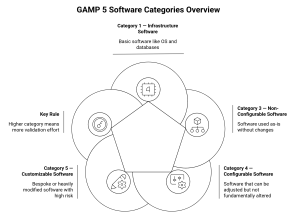
Category 1 — Infrastructure Software (operating systems, databases, middleware, etc.): This type of software is not subject to specific functional verification on its own. Its features are tested indirectly when the application running on top of it is validated. What's required here is simply documenting and verifying identity and version numbers during installation.
Category 3 — Non-configurable Software: This software is used as-is, without any configuration. Validation involves verifying the installation, conducting acceptance testing, and confirming the software is fit for its intended use, all supported by a risk assessment and supplier assessment.
Category 4 — Configurable Software: This is software that can be configured but not fundamentally altered. Validation covers correct installation and configuration, functional testing driven by risk analysis and supplier assessment, and acceptance testing against stated requirements.
Category 5 — Customizable Software: This is the highest-risk category, covering bespoke or heavily customised applications. Validation is most rigorous here and includes correct installation, functional and design specifications, risk-based functional testing, supplier assessment, and full acceptance testing against requirements.
The higher the category, the more work is needed at the specification and validation stages of the project lifecycle. This tiered approach allows manufacturers to make rational, proportionate decisions about how much validation effort to invest in each system.
Common Mistakes That Lead To Poor GAMP Implementation
Industry experts have identified the most common and costly mistakes that companies make when implementing GAMP. These are worth knowing well — and avoiding at all costs:
- No requirements documented at all
- No record of the software version being used
- Failure to archive all versions of design specifications
- Lack of records for testing inputs and outputs
- Lack of forward and backward tracing — in other words, no traceability matrix
- No defect tracking during the testing process
- No Quality Assurance Unit to independently check software trustworthiness
- No re-evaluation or retesting when hardware is added or changed
- Lack of hardware qualification, including infrastructure and application-related software
- Inadequate security controls
A Real-World Lesson: Why One SOP Is Better Than Two?
Experienced GAMP practitioners often make a seemingly small but critically important recommendation: use the same Standard Operating Procedure (SOP) for both GxP and non-GxP systems. It sounds minor, but the consequences of ignoring it can be severe.
Validation is essentially "good software engineering with documentation on steroids." The purpose is to deliberately slow things down because these systems may be responsible for critical functions like keeping someone's heart beating or helping a newborn breathe.
The reason for a unified SOP is simple: when you have different SOPs for GxP and non-GxP systems, people can and do run the wrong one by mistake. A real example illustrates this perfectly. A large company had 150 HPLC instruments and 150 Agilent systems.
During an IT upgrade, the team applied a patch but mistakenly followed the non-GxP SOP. Half of the systems crashed as a result. The organisation then had to initiate CAPAs, implement change controls, and go through multiple rounds of testing and retesting to restore compliance and functionality. All of it could have been avoided with a single, unified SOP.
Final Thoughts
GAMP 5 may not be legally binding, but in regulated industries it functions like the de facto standard for computerized systems validation. Its recommendations are closely aligned with GxP requirements set by both EU and US regulatory agencies, making it the most comprehensive and widely trusted framework available.
When applied correctly, GAMP 5 helps manufacturers work more efficiently with their suppliers, reduces the burden of testing and documentation, cuts validation and compliance maintenance costs, and leaves companies well-prepared for government audits and inspections.
And with the 2022 second edition now addressing modern realities like cloud computing, AI, blockchain, and agile development, GAMP 5 is keeping pace with how software is actually built and used today — making it just as relevant as it's ever been.
FAQs
1. What Is GAMP 5 And Why Is It Important In Regulated Industries?
GAMP 5, or Good Automated Manufacturing Practice (GAMP 5), is a widely accepted guideline that helps organizations manage and validate computerized systems in regulated environments. It provides a structured, risk-based approach to ensure systems are fit for their intended use. Although it is not a legal requirement, it is strongly recognized by regulators like the U.S. Food and Drug Administration. This makes it a trusted framework for maintaining compliance, data integrity, and product quality. Its importance lies in helping companies balance compliance with efficiency and practical implementation.
2. How Does GAMP 5 Support Computer System Validation (CSV)?
GAMP 5 supports Computer System Validation by offering a clear and scalable framework for validating systems based on their risk and complexity. It helps organizations define requirements, perform risk assessments, and carry out appropriate testing activities. Instead of applying the same level of validation to every system, it encourages focusing on critical functions that impact quality and safety. This approach reduces unnecessary work while still maintaining compliance. As a result, companies can perform validation more efficiently without compromising on regulatory expectations.
3. What Are The Key Principles Of GAMP 5 That Organizations Should Follow?
GAMP 5 is built on five key principles that guide how validation and system management should be approached. These include product and process understanding, lifecycle management, scalability, quality risk management, and leveraging supplier activities. Together, these principles ensure that validation efforts are practical, focused, and aligned with real business needs. They also encourage critical thinking instead of blindly following documentation-heavy processes. By applying these principles, organizations can build stronger, more reliable, and compliant computerized systems.
Reporting on the science, business and regulation shaping the pharmaceutical industry.
More in Regulatory Intelligence
All articles →
The Pattern Behind FDA Warning Letters: What Startups & CDMOs Often Miss

ISO 14644 Cleanroom Classes for Pharma (with EM Implications)

Discussion