470 FDA Warning Letters in 2025: The Lab Compliance Patterns You Can't Afford to Ignore
Learn the lab compliance patterns behind 470 FDA warning letters in 2025 and what every regulated lab must do differently.

In 2025, the FDA issued 470 warning letters to companies across the pharmaceutical, biotech, medical device, and dietary supplement sectors. That's nearly 470 individual instances in which a lab's internal systems failed to meet federal expectations, and the consequences ranged from costly remediation to serious reputational damage.
What's most striking about these letters is not the sheer volume. It's what they have in common. In nearly every case, the violations weren't about bad science. They were about poor documentation, weak quality systems, and processes that couldn't withstand scrutiny.
This blog breaks down what the data shows, where labs are falling short, and what steps your lab can take right now to reduce its risk heading into 2026.
By the Numbers: What the 2025 FDA Warning Letters Reveal
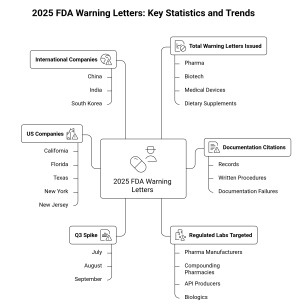
The FDA's warning letter database is publicly available, and a close look at the full set of 2025 letters tells a clear story. Here's a snapshot of the key figures:
- 470 total FDA warning letters issued in 2025
- 99% of all letters contained citations tied to documentation, records, or written procedures
- 148 letters directly targeted regulated lab environments, including pharmaceutical manufacturers, compounding pharmacies, API producers, medical device makers, and biologics facilities
- 47% of all warning letters were issued in just three months, July, August, and September
The geographic data is also worth noting. Of the 470 letters issued, 392 (85%) went to US-based companies. California topped the list with 56 letters, followed by Florida (41) and Texas (33). Internationally, China (15), India (13), and South Korea (12) received the most letters from outside the US.
The Q3 spike is important for labs to understand. If the pattern holds in 2026, the first half of the year is your window to identify gaps and fix them before FDA inspection activity peaks.
The numbers tell you how many labs failed. This tells you exactly why they did.
→ Read: 5 Most Common Reasons For FDA Warning Letters And How To Avoid Them
The Uncomfortable Truth: It's Rarely About the Science
One of the most consistent themes across the 2025 warning letters is that violations were systemic, not scientific. Labs weren't failing because their chemistry was wrong. They were failing because they couldn't prove their chemistry was right.
As one FDA warning letter put it:
"The observed lapses, including but not limited to laboratory controls, documentation practices, and data integrity controls… indicate fundamental weaknesses in the QU's oversight function.", FDA Warning Letter, SV Labs Corporation, 2025
This language is telling. The FDA is not just looking at the output of your tests. It's evaluating your ability to document, track, and audit every step of the process. When manual systems are in place, paper logs, spreadsheets, and informal workflows, that audit trail is often incomplete, inconsistent, or simply absent.
The 8 Most Common Failure Categories in Regulated Lab Warning Letters
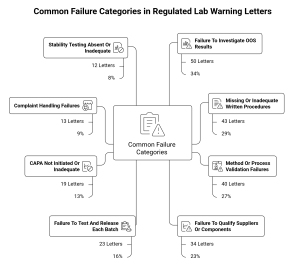
Of the 148 warning letters directed at regulated lab environments, the FDA repeatedly cited the same categories of violations. Here's how they broke down:
- Failure to investigate OOS results, 50 letters (34%)
- Missing or inadequate written procedures, 43 letters (29%)
- Method or process validation failures, 40 letters (27%)
- Failure to qualify suppliers or components, 34 letters (23%)
- Failure to test and release each batch, 23 letters (16%)
- CAPA not initiated or inadequate, 19 letters (13%)
- Complaint handling failures, 13 letters (9%)
- Stability testing absent or inadequate, 12 letters (8%)
Let's look at each of these more closely.
1. Failure to Investigate Out-of-Specification (OOS) Results
An OOS result on its own is not a compliance violation. Failing to investigate it formally is in 50 of the 148 lab-specific letters; the FDA cited a clear breakdown in how labs handled unexpected results.
The FDA's expectation follows a straightforward sequence: Was the result documented? Was an investigation opened promptly? Was it closed with a documented root cause and formal disposition? In too many labs, at least one of those steps was missing.
This kind of finding suggests that quality oversight was reactive rather than proactive, which is precisely what the FDA penalises.
2. Missing or Inadequate Written Procedures
This was among the most-cited failures across all 470 letters, not just in regulated labs. If a procedure isn't formally written, version-controlled, and accessible, the FDA treats it as though it doesn't exist, regardless of how experienced your staff might be.
Missing SOPs for equipment cleaning, absent procedures for production control, and informal and undated protocols were common findings across the letters.
3. Method or Process Validation Failures
Validation is the documented proof that your methods and processes consistently produce reliable results. In 2025, 40 lab letters cited failures here, from unvalidated analytical methods to cleaning validations that were never completed.
This category frequently connects to the issue of spreadsheet reliance. Unvalidated Excel tools used for critical calculations are a recurring target for FDA inspectors. If you can't prove your calculation tool was validated, the results it produces are considered unreliable.
4. Failure to Qualify Suppliers or Components
Every incoming material lot should be tested or verified, and every critical supplier should be formally assessed and approved. In 34 lab letters, the FDA found that labs had either never qualified their suppliers or had accepted Certificates of Analysis (CoAs) without any independent verification.
This is a compounding risk; unqualified materials create downstream problems across every product batch that uses them.
5. Failure to Test and Release Each Batch
Releasing a product without completing required testing for identity, strength, and purity is one of the most serious findings in a warning letter. In 23 letters, inspectors found that labs had either skipped or failed to complete required batch testing before distribution.
This violation has direct implications for product safety, making it one of the areas the FDA takes most seriously.
6. CAPA Not Initiated or Inadequate
A corrective and preventive action (CAPA) system that looks good on paper but fails to close real problems is a liability. In 19 letters, labs either failed to initiate CAPAs when required or submitted responses that were vague, undocumented, or failed to address root causes. The FDA expects CAPAs to be systematic, traceable, and effective, not just paperwork filed to satisfy an audit.
7. Complaint Handling Failures
Thirteen labs received citations for inadequate complaint handling, either for lacking formal procedures or for failing to investigate complaints that clearly warranted a quality event. Complaints from customers and adverse event reports are data points that the FDA expects labs to treat as quality signals.
8. Stability Testing Absent or Inadequate
Establishing shelf life and storage conditions requires an ongoing, documented stability program. In 12 letters, the FDA found that stability programs were either missing or not being conducted at the required intervals, leaving labs unable to support their own expiration claims.
Why Manual Systems Keep Appearing at the Centre of These Failures
Across all 470 letters, one pattern stands out: labs that relied on manual processes, paper records, Excel spreadsheets and informal approvals were far more vulnerable to these citations.
In several cases, the FDA specifically found that labs were using unvalidated spreadsheets as their primary tool for critical calculations, and that analysts had unrestricted access to modify or delete records. That's a data-integrity, validation, and access-control problem all at once.
Good record-keeping, audit trails, role-based access, and version-controlled documents are nearly impossible to maintain reliably in a paper-based or spreadsheet-driven environment. The scale of the problem grows as lab throughput increases.
What Labs Can Do: Building Audit-Readiness Into Everyday Operations
The labs that fare best in FDA audits are the ones that have made audit-readiness a default state, not a scramble that happens when inspectors arrive. That shift requires moving away from manual systems and toward purpose-built software.
Two types of platforms are most relevant here:
Quality Management System (QMS): A QMS is designed to help labs meet customer and regulatory requirements. It supports consistent, efficient quality control and helps ensure that products and services meet defined standards.
Laboratory Information Management System (LIMS): A LIMS is a more comprehensive platform that manages samples, tests, results, and workflows across the entire lab operation. At its core, a LIMS addresses the documentation and records management failures that drove the majority of 2025 warning letters.
Key capabilities a LIMS brings to compliance-sensitive labs include:
- Controlled, version-managed SOPs and procedures
- Automated OOS investigation workflows with audit trails
- Validated calculation tools with restricted access controls
- Supplier qualification tracking and CoA verification
- Batch release documentation and testing records
- CAPA management with documentation and closure tracking
- Stability study scheduling and data management
- Complaint logging and investigation workflows
When selecting a LIMS, look beyond the feature list. Ask vendors about configurability, implementation timelines, and whether the software team has real-world lab experience. The right LIMS should adapt to your processes, not the other way around.
Knowing the failures is step one. Building a system that prevents them is step two.
→ Read: Preventing FDA Warning Letters: Building A Compliance-First Culture
Key Takeaway for Labs Heading Into 2026
The 470 warning letters issued in 2025 point to the same conclusion: the labs that struggled were the ones still relying on systems that couldn't prove what they were doing, when they were doing it, and why. If your lab is still managing quality events in spreadsheets, SOPs in shared drives without version control, or CAPA records in email chains, the 2025 data should feel like a direct warning.
The first half of the year is the best time to close those gaps. Assess your current systems against the eight failure categories above, identify the weakest points, and start evaluating whether a purpose-built LIMS or QMS can give your lab the infrastructure it needs to stay compliant at scale.
FAQs
Q1: How many FDA warning letters were issued in 2025?
The FDA issued 470 warning letters in 2025, of which 148 were directed at regulated lab environments, including pharmaceutical manufacturers, compounding pharmacies, API producers, and medical device labs.
Q2: What are the most common reasons labs receive FDA warning letters?
The most common reasons include failure to investigate out-of-specification results, missing or inadequate written procedures, method and process validation failures, inadequate CAPA systems, and failure to test and release product batches properly.
Q3: When does the FDA issue the most warning letters?
Based on 2025 data, warning letter activity peaks in Q3. Approximately 47% of all 2025 letters were issued in July, August, and September, making the first half of the year the ideal window for labs to audit and strengthen their compliance programs.
Q4: Can a LIMS help labs avoid FDA warning letters?
Yes. A Laboratory Information Management System (LIMS) can directly address the most common citation areas, including documentation gaps, data integrity issues, unvalidated workflows, and inadequate audit trails, by centralising and automating lab quality processes.
Q5: What is the difference between a LIMS and a QMS for lab compliance?
A QMS (Quality Management System) focuses on meeting regulatory and customer quality standards. At the same time, a LIMS (Laboratory Information Management System) is a broader platform that manages the full lab workflow, including sample tracking, test records, instrument integration, and reporting. Both are valuable for compliance, but a LIMS typically offers more comprehensive coverage for regulated labs.
Reporting on the science, business and regulation shaping the pharmaceutical industry.
More in Regulatory Intelligence
All articles →
The Pattern Behind FDA Warning Letters: What Startups & CDMOs Often Miss

ISO 14644 Cleanroom Classes for Pharma (with EM Implications)
Discussion