The Great Pharma Manufacturing Shift: Why Localisation Matters More Than Ever
Pharma supply chain resilience now demands localisation, why regional manufacturing is shifting from contingency to core strategy.


For decades, pharmaceutical manufacturing followed a simple playbook: build large facilities in a few low-cost countries, then ship medicines around the world. That model is now under serious strain. Supply chain shocks, geopolitical tensions, and rising regulatory scrutiny have pushed drugmakers to rethink where and how they produce medicines. The result is a quiet but powerful shift toward Localisation, building manufacturing capacity closer to the markets that actually use the drugs.
This shift isn't just a trend. It's becoming a core part of how pharma companies manage risk, ensure supply, and meet government expectations. Here's why Localisation matters more than ever, and what it means for the industry going forward.
What Triggered the Shift
The COVID-19 pandemic exposed just how fragile global pharma supply chains really were. When borders closed and export restrictions kicked in, countries that depended heavily on imported active pharmaceutical ingredients (APIs) and finished drugs found themselves short on essential medicines.
According to the U.S. FDA, a large share of API manufacturing for drugs sold in the United States originates from facilities in India and China, leaving the supply chain concentrated in just a few regions.
This concentration created a single point of failure. A factory shutdown, a natural disaster, or a sudden export ban in one country could disrupt drug supply for dozens of others. Governments took notice, and many began pushing policies to bring manufacturing closer to home.
Knowing where your supply chain broke is only useful if you can see it in real time.
→ Read: Pharma Supply Chain Visibility Tools & Challenges
Key Forces Driving Localisation
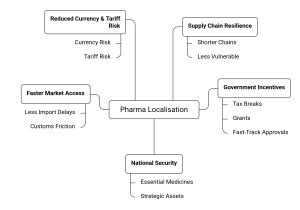
Several factors are pushing pharma companies toward regional and domestic manufacturing:
Supply chain resilience.
Companies want shorter, less vulnerable supply chains that aren't dependent on a single country or region.
Government incentives and mandates.
Many countries now offer tax breaks, grants, or fast-track approvals for companies that build local manufacturing capacity. The U.S. Inflation Reduction Act and various EU pharma strategy initiatives include provisions to strengthen domestic production.
National security concerns.
Essential medicines, including antibiotics and vaccines, are increasingly viewed as strategic assets, similar to energy or food supply.
Faster market access.
Local manufacturing can reduce the time and costs associated with importing finished products, especially in markets with strict customs and import regulations.
Reduced currency and tariff risk.
Producing locally protects margins from currency swings and import tariffs that can change with little warning.
The Regulatory Angle
Localisation isn't only a business decision; it's increasingly shaped by regulation. Many national health authorities are introducing rules that favour or require local manufacturing for certain drug categories, especially essential medicines and vaccines. For example, some countries have introduced local production quotas or preferential pricing for domestically manufactured drugs in public procurement processes.
This means companies that build local facilities aren't just managing risk. They're also positioning themselves to win government contracts and meet compliance requirements that purely import-based competitors may struggle with.
At the same time, GMP (Good Manufacturing Practice) standards remain non-negotiable regardless of where a facility is located. A local plant in any country must still meet the same quality, documentation, and validation standards as those expected by regulators such as the FDA, EMA, or WHO. Localisation does not mean lower standards; it means the same standards applied closer to home.
Challenges Companies Face
Building local manufacturing capacity isn't simple. It comes with real hurdles:
These challenges explain why Localisation is often pursued gradually, starting with finished-dose packaging or formulation, then expanding into API synthesis as capability and confidence grow.
How Companies Are Approaching Localisation
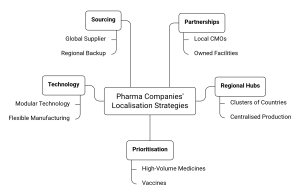
Rather than a full overhaul, most pharma companies are taking a phased, risk-based approach. Common strategies include:
- Partnering with local contract manufacturing organisations (CMOs) instead of building owned facilities from scratch
- Setting up regional hubs that serve a cluster of nearby countries rather than one-country plants everywhere. Prioritising localisation for high-volume, essential medicines first, such as generics and vaccines
- Investing in modular or flexible manufacturing technology that can scale up or down based on demand
- Building dual-sourcing strategies, keeping one global supplier while developing a regional backup
This balanced approach allows companies to reduce risk without abandoning the cost advantages of established global supply chains entirely.
Regional manufacturing only builds resilience if you can trace every unit end to end.
→ Read: End-To-End Pharma Traceability Software
A Quick Localisation Readiness Checklist
For companies evaluating a move toward local or regional manufacturing, these are useful starting questions:
- Have we identified which products are critical enough to justify local production?
- Is there a clear regulatory pathway and GMP framework in the target country?
- Do we have access to a skilled local workforce, or a plan to train one?
- Have we assessed the local infrastructure for utilities, logistics, and access to raw materials?
- Is there a technology transfer plan with proper validation and documentation?
- Have we evaluated the government incentives or local procurement advantages available?
- Do we have a contingency plan if local capacity falls short during demand spikes?
What This Means for the Industry
The shift toward Localisation doesn't mean the end of global pharma supply chains. Large-scale, centralised manufacturing will still play a major role, especially for complex products like biologics that require highly specialised facilities. But the days of relying entirely on a handful of manufacturing hubs are fading.
Going forward, expect a more distributed model: global centres of excellence for complex manufacturing, paired with regional facilities for essential, high-volume products. This hybrid approach balances cost efficiency with the resilience that recent years have shown to be critical.
For pharma companies, the message is clear. Localisation is no longer just a contingency plan; it's becoming a core part of long-term manufacturing strategy. Those who invest early in building flexible, locally compliant capacity will be better positioned to handle the next disruption, whatever its form.
FAQs
1. What does pharma manufacturing Localisation mean?
It refers to producing medicines, including APIs and finished drugs, closer to the markets where they're sold, instead of relying on a few centralised global hubs.
2. Why did COVID-19 push pharma toward Localisation?
The pandemic exposed the fragility of the supply chain when export restrictions and factory shutdowns disrupted access to essential medicines worldwide.
3. Does local manufacturing lower GMP quality standards?
No. Local facilities must still meet the same GMP and regulatory standards as any global manufacturing site, regardless of location.
4. What products are usually localised first?
Essential medicines, generics, and vaccines are typically prioritised because they pose the highest public health risk if supply is disrupted.
5. Is Localisation replacing global pharma supply chains entirely?
No. Most companies are adopting a hybrid model, combining centralised manufacturing for complex products with regional facilities for high-volume essentials.
Reporting on the science, business and regulation shaping the pharmaceutical industry.
More in Pharma Manufacturing
All articles →
Compliance In Pharma Manufacturing 2025: Key Regulations And Best Practices You Need to Know

Improving Pharmaceutical Manufacturing Flexibility: Agile Manufacturing and Rapid Scale-Up

Discussion