Sustainability in Single-Use Bioprocessing: Myth, Reality and the Path Forward
Is single-use bioprocessing sustainable? Lifecycle data on water, energy, and waste says the plastic-vs-steel debate misses the point.

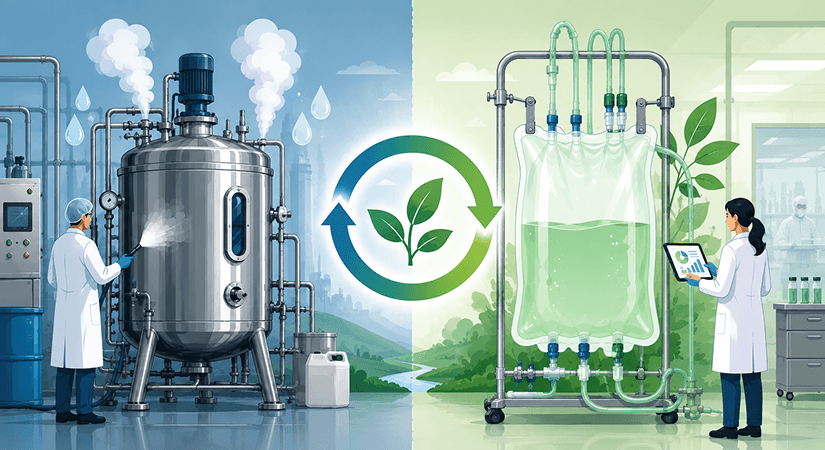
Over the past two decades, single-use systems (SUS) have transformed biopharmaceutical manufacturing. Disposable bags, tubing, connectors, filters and integrated fluid-management assemblies have enabled faster facility deployment, reduced cleaning requirements, improved operational flexibility and supported rapid scale-up of biologics, vaccines and advanced therapies. Yet their growing adoption has also intensified an important debate: can a manufacturing model built around disposable polymer components genuinely be sustainable?
The question is legitimate, but the answer is more complex than the visible accumulation of plastic waste after a production campaign. Sustainability in bioprocessing cannot be judged by one material stream in isolation. It must be assessed across the complete lifecycle of a manufacturing system—from raw material production and component manufacturing to transportation, facility operation, resource consumption and end-of-life treatment.
Viewed through this broader lens, the apparent contradiction between “single-use” and “sustainable” becomes far less straightforward.
The Sustainability Paradox
Stainless-steel systems are reusable for many years, while single-use components are intentionally discarded after one manufacturing cycle. This comparison naturally creates the perception that reusable systems must be environmentally superior. However, stainless-steel bioprocessing requires repeated cleaning-in-place (CIP) and sterilization-in-place (SIP), consuming substantial quantities of purified water, Water for Injection, steam, electricity and cleaning chemicals throughout the operating life of a facility.
Single-use systems eliminate or substantially reduce many of these recurring requirements. Their environmental burden is therefore concentrated more heavily in material production and end-of-life management, whereas conventional facilities carry significant operational burdens over decades of use.
This is why Life-Cycle Assessment (LCA) is essential. LCA evaluates environmental impacts across the complete product or process lifecycle rather than focusing on a single, highly visible metric. Studies comparing single-use and stainless-steel bioprocessing systems have frequently shown that SUS can reduce overall water consumption, cumulative energy demand, greenhouse gas emissions and chemical use, depending on process scale, facility configuration and local infrastructure.
The important lesson is that sustainability decisions must be based on lifecycle evidence—not intuition.
Water and Energy: The Less Visible Environmental Gains
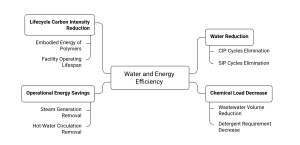
Water conservation is arguably one of the strongest sustainability advantages of single-use bioprocessing. Conventional facilities require large quantities of high-quality water for equipment cleaning, rinsing, sterilization, validation and utility operations. The environmental footprint extends beyond the water itself to the energy, infrastructure and chemicals required for its generation, storage, distribution and treatment.
By removing many cleaning and sterilization steps, single-use systems can substantially reduce water demand. Depending on process and facility design, lifecycle studies have reported reductions ranging from approximately 40% to 90%. The benefits extend further: lower water consumption means less wastewater, reduced chemical use, smaller utility systems and lower energy requirements.
This becomes particularly significant in water-stressed regions, where water availability is increasingly a strategic manufacturing risk rather than merely an environmental concern.
A similar systems perspective applies to energy. Polymer manufacturing consumes energy, but conventional facilities also require continuous steam generation, hot-water circulation, CIP and SIP cycles, extensive utility networks and supporting HVAC infrastructure. Over the operating life of a facility, these recurring energy demands can outweigh the embodied energy associated with disposable components.
For companies pursuing net-zero commitments, the relevant question is therefore not simply, “How much plastic are we using?” but, “What is the total resource and carbon intensity of the manufacturing system?”
Single-use systems are just one piece of the sustainability shift reshaping manufacturing floors. Here's the fuller picture of where pharma production is headed next.
→ Read: Latest Trends in Pharma Manufacturing Innovations
Waste Is the Challenge—But Not the Whole Story
The strongest criticism of single-use technology remains waste generation. After each production campaign, bags, tubing, filters, connectors and assemblies must be removed and treated. Unlike energy or water consumption, this waste is immediately visible.
The concern is valid. However, waste volume alone does not define environmental impact. Material composition, contamination status, transportation and end-of-life treatment all influence the final outcome. Where appropriate infrastructure exists, decontaminated polymer waste may be directed toward energy recovery or emerging material-recovery pathways rather than landfill.
The more difficult issue is recyclability. Many single-use products are sophisticated multilayer structures engineered to provide sterility assurance, barrier performance, mechanical strength, chemical compatibility and low extractables and leachables. These properties often require combinations of polymers that are difficult to separate using conventional mechanical recycling.
Pharmaceutical requirements add further complexity. Biological contamination concerns, traceability expectations and limited specialized recycling infrastructure restrict available options. Consequently, controlled incineration, including waste-to-energy where appropriate, remains an important end-of-life pathway.
The solution is not to deny this limitation, but to innovate around it. The industry is increasingly exploring mono-material constructions, design-for-recycling principles, chemical recycling, improved waste segregation and collaborative recovery models. The next generation of single-use technology must be designed not only for process performance, but increasingly for end-of-life performance.
Sustainable Polymers: The Next Frontier
Material innovation will be central to this transition. Historically, polymers for bioprocessing have been selected primarily for biocompatibility, chemical resistance, mechanical integrity, sterility assurance and extractables and leachables performance. These requirements remain non-negotiable.
Sustainability, however, is becoming an additional design criterion.
Bio-based polymers, mass-balance resins, lower-carbon materials and more recyclable polymer architectures offer promising pathways to reduce dependence on fossil-derived feedstocks and improve lifecycle performance. Yet adoption in biopharmaceutical manufacturing must remain scientifically rigorous. A material cannot be considered sustainable if it introduces unacceptable risks to product quality, process reliability or patient safety.
The objective is therefore not simply to develop “greener” polymers. It is to develop materials that combine measurable environmental improvement with uncompromising pharmaceutical-grade performance.
Material innovation isn't the only lever for greener manufacturing. See how biocatalysis and white biotech are rewriting the chemistry of pharma production itself.
→ Read: Biocatalysis & White Biotech: Greening Pharma
From Waste Management to the 5R Framework
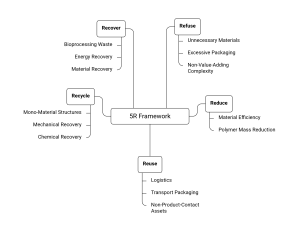
A practical sustainability strategy for single-use manufacturing can be built around five principles: Refuse, Reduce, Reuse, Recycle and Recover.
Refuse means eliminating unnecessary materials, excessive packaging and non-value-adding complexity. Reduce focuses on improving material efficiency through optimized designs, lighter components and more efficient manufacturing. Reuse has limited application for product-contact components but remains relevant for transport systems, packaging and non-product-contact assets. Recycle requires designing products and material streams with future recovery technologies in mind. Recover recognizes that some waste will remain unavoidable and seeks to extract value through energy or material recovery.
Together, these principles shift sustainability from a disposal problem to a lifecycle design philosophy.
Sustainability Is Becoming a Business Requirement
Environmental performance is no longer confined to corporate responsibility reports. Pharmaceutical companies increasingly request data on carbon emissions, energy consumption, water use, waste generation and responsible sourcing during supplier qualification and strategic procurement.
This shift is driven partly by corporate net-zero commitments and the growing importance of Scope 3 emissions. For many pharmaceutical companies, a substantial proportion of their environmental footprint lies within the supply chain. Suppliers must therefore provide credible data if customers are to measure and reduce their own indirect impacts.
As a result, sustainability is emerging as a fourth dimension of supplier competitiveness alongside quality, cost and delivery.
Organizations capable of demonstrating robust ESG performance, transparent reporting and measurable environmental improvement are increasingly viewed as more resilient strategic partners. Sustainability is also becoming an innovation driver: efforts to reduce materials, energy, water and waste frequently improve operational efficiency and lower costs.
Sustainability Is a Supply-Chain Challenge
No single company can make single-use bioprocessing sustainable in isolation. The environmental footprint of an assembly reflects the combined activities of resin manufacturers, film producers, component manufacturers, assembly facilities, logistics providers, biopharmaceutical companies and waste-management organizations.
Progress therefore requires collaboration.
Shared lifecycle data, harmonized sustainability metrics, responsible sourcing, joint material-development programs and circular-economy partnerships can achieve improvements that individual organizations cannot deliver alone. Alignment with recognized frameworks—including the UN Sustainable Development Goals, Science Based Targets initiative, Global Reporting Initiative, CDP and emerging international sustainability disclosure standards—can further strengthen transparency and comparability.
The future of sustainable bioprocessing will depend on ecosystems, not isolated initiatives.
The Path Forward
The sustainability debate around single-use bioprocessing should move beyond the simplistic question of plastic versus stainless steel. Single-use systems generate waste, and the challenges of recyclability and material circularity are real. But conventional manufacturing also carries substantial environmental burdens through water consumption, energy demand, cleaning chemicals and utility infrastructure.
The scientifically credible approach is to evaluate the complete lifecycle.
The path forward is not a choice between sustainability and single-use technology. It is the continued evolution of single-use systems through better materials, smarter design, rigorous lifecycle assessment, improved waste recovery, transparent ESG reporting and deeper collaboration across the supply chain.
Sustainability should not be viewed as a constraint on bioprocessing innovation. Properly integrated, it can become a catalyst for more efficient facilities, more resilient supply chains and better manufacturing technologies.
The organizations that lead the next era of bioprocessing will not be defined solely by the quality of the products they manufacture. They will be distinguished by their ability to combine scientific excellence, patient safety, operational performance and environmental responsibility. The real opportunity is not simply to make single-use bioprocessing less unsustainable, but to redesign its entire lifecycle so that quality, innovation and sustainability advance together.
Reporting on the science, business and regulation shaping the pharmaceutical industry.
More in Pharma Manufacturing
All articles →
Compliance In Pharma Manufacturing 2025: Key Regulations And Best Practices You Need to Know

Improving Pharmaceutical Manufacturing Flexibility: Agile Manufacturing and Rapid Scale-Up

Discussion