by Simantini Singh Deo
9 minutes
DPDPA Act Compliance For Pharma Companies: Key Requirements & Practical Insights
DPDPA compliance for pharma: consent, data protection, clinical trials, pharmacovigilance, patient rights & digital health requirements.
The Digital Personal Data Protection Act (DPDPA) has become one of the most important regulatory developments affecting the pharmaceutical industry in India. As the sector increasingly adopts digital tools for research, manufacturing, clinical trials, patient engagement, and supply chain operations, the amount of personal and sensitive health data being collected has grown rapidly.
The DPDPA brings a structured framework to ensure that all this data is handled responsibly. For the pharmaceutical industry, where patient trust, regulatory compliance, and data accuracy are crucial, the Act marks a major shift toward stronger data governance.
Pharmaceutical companies engage with a wide range of stakeholders, including patients, doctors, clinical researchers, distributors, and regulators. Many of these interactions involve personal data, and in some cases, highly sensitive health-related information.
With the introduction of the DPDPA, the responsibility to protect this information becomes even more critical. The Act not only safeguards individuals’ privacy rights but also provides clarity to the industry on how personal data must be collected, processed, stored, and shared.
As a result, pharma companies are now re-evaluating their data processes, compliance strategies, and technological infrastructures to meet the new obligations.
Understanding The DPDPA Act Across The Pharmaceutical Value Chain
The DPDPA Act focuses on protecting personal data of individuals (referred to as Data Principals) and places compliance responsibilities on organisations (referred to as Data Fiduciaries). In the pharmaceutical industry, a Data Fiduciary can be a manufacturing company, research organisation, clinical trial sponsor, hospital unit involved in studies, or even a digital health platform.
Any entity that collects or processes personal data, including patient identity, medical records, prescription history, diagnostic results, genomic information, or clinical trial data, is legally required to follow the rules set by the Act. This becomes particularly relevant because pharmaceutical processes inherently require extensive data collection.
For example, during clinical trials, companies collect detailed health information to track drug efficacy and safety. Pharmacovigilance activities depend on personal data to monitor adverse drug reactions. Even supply chain operations often require identity verification, especially for controlled substances. The DPDPA ensures that all this data flow happens with proper consent, lawful purpose, and transparent practices.
Why Does The Act Matters To The Pharmaceutical Industry?
The pharmaceutical sector deals with some of the most sensitive categories of data, making it a high-stakes environment. Any misuse, breach, or unauthorized access can have serious consequences for both patients and companies.
With increasing digital adoption, right from electronic medical records and AI-driven research to cloud-based manufacturing systems, the industry needed a strong regulatory foundation to manage privacy and security risks.
The DPDPA Holds Particular Importance Because It Brings:
- A uniform national standard for personal data management
- Defined rights for patients over their data
- Clear responsibilities for companies that collect and process information
- Stronger accountability and transparency requirements
- Higher penalties for misuse or negligence
By introducing this structure, the Act helps build greater trust between patients and pharmaceutical organisations, which is essential for the success of research, digital health programs, and real-world evidence generation.
Key Provisions Of The DPDPA Act For The Pharmaceutical Sector
The DPDPA includes several clauses that directly impact day-to-day operations in pharmaceutical companies. Though the Act covers broad sectors, the following provisions hold special significance for pharma because of the nature of their data handling activities.
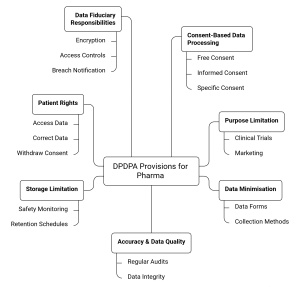
1) Consent-Based Data Processing — Pharma companies must obtain free, informed, and specific consent from individuals before collecting their personal data. This is especially critical in clinical trials, patient support programs, and digital health platforms, where participants must be fully aware of how their information will be used.
2) Purpose Limitation — Data can only be used for the purpose for which it was collected. For example, clinical trial data gathered for safety monitoring cannot be used for unrelated marketing activities without additional consent.
3) Data Minimisation — Only the necessary amount of personal data should be collected. This pushes pharma organisations to review their data forms, collection methods, and internal processes more carefully.
4) Accuracy & Data Quality — Pharma companies must ensure that data stored in their systems is accurate and updated. This plays a major role in ensuring reliable research results and regulatory submissions.
5) Storage Limitation — Data cannot be stored indefinitely. Once the purpose is fulfilled such as completion of a safety monitoring period, data should be deleted unless required by law.
6) Rights Of Patients (Data Principals) — Individuals have the right to access, correct, and request deletion of their data. They can also withdraw consent at any point, which makes documentation management even more important for pharma companies.
7) Responsibility Of Data Fiduciaries — The Act requires pharma companies to implement strong technical and organisational measures to protect data, including:
- Encryption
- Access controls
- Data breach notification mechanisms
- Cybersecurity audits
- Vendor management and compliance checks
These measures ensure that data is protected throughout the entire lifecycle.
Impact On Major Pharma Operations
Since the DPDPA affects multiple functional areas, pharmaceutical companies must evaluate its impact across all departments. Different processes use and generate personal data in unique ways, so the Act influences day-to-day decisions across research, manufacturing, marketing, and distribution.
a) Clinical Trials & Research: Clinical trials involve extensive data related to patient identity, medical history, genetic information, and treatment responses. Under DPDPA, trial sponsors must ensure:
- Transparent consent forms
- Secure data handling from start to finish
- Strict role-based access
- Secure data sharing with global partners
- Documentation of data flows and retention periods
b) Pharmacovigilance: Pharmacovigilance data often includes personal details and medical histories of patients reporting adverse events. To comply with the Act, companies must manage:
- Proper consent for post-market data
- Secure storage of adverse event reports
- Controlled access for regulatory authorities
c) Digital Health & Patient Support Programs: As pharma companies adopt telemedicine tools, mobile apps, wearable integration, and AI-based patient support systems, they must now:
- Embed privacy features into all digital platforms
- Ensure that vendors follow DPDPA requirements
- Provide clear communication about data usage
d) Sales, Marketing, & Field Activities: Sales teams and marketing units often store doctor information, clinic details, and patient program lists. Under the Act, companies must:
- Ensure that data is collected with consent
- Avoid using clinical trial or prescription data for promotional purposes
- Protect field force digital tools with strict security controls
Compliance Requirements For Pharmaceutical Companies
Compliance with the Act requires thoughtful planning and integrated data governance. Many companies are now strengthening their privacy frameworks to align with legal expectations.
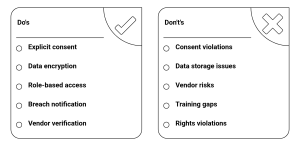
Key Compliance Steps Include:
- Establishing internal privacy policies and data management frameworks
- Designing consent forms aligned with DPDPA
- Mapping all data flows across departments
- Conducting Data Protection Impact Assessments (DPIAs) for high-risk activities
- Implementing strong cybersecurity systems
- Training employees on data protection responsibilities
- Ensuring third-party vendors follow the same standards
This creates a structured system where data is managed ethically, transparently, and securely.
Encryption protocols and access controls are only as strong as your cybersecurity defense strategy.
Know the pharma industry's top 5 security threats before they compromise your DPDPA compliance.
→ Read: Cybersecurity in Pharma: 5 Threats You Can't Ignore in 2025
Challenges For The Pharmaceutical Industry
While the Act brings clarity and structure, the transition toward compliance is not without challenges. Pharmaceutical companies, especially those with complex data ecosystems and global collaborations, may face hurdles such as:
- Integrating privacy controls into legacy systems
- Managing cross-border data transfers
- Standardizing documentation for consent and retention
- Upgrading IT infrastructure to meet security requirements
- Training employees across manufacturing, R&D, field operations, and corporate offices
- Ensuring vendor compliance across supply chains
However, companies that proactively adopt strong privacy frameworks will gain long-term benefits through improved efficiency and trust.
Opportunities Created By The DPDPA
Rather than seeing compliance only as a regulatory burden, the Act can be an opportunity for the pharmaceutical sector to modernise its operations. Strong data governance helps:
- Improve accuracy in clinical research
- Boost reliability in pharmacovigilance reporting
- Strengthen digital health initiatives
- Increase patient participation in studies
- Reduce data breaches and cyber risks
- Build better relationships with healthcare professionals
- Prepare companies for global regulatory alignment
Better data management ultimately improves product quality, research outcomes, and public confidence.
DPDPA mandates training, but compliance culture comes from informed teams.
Role-based regulatory preparedness transforms employees into your first line of data protection defense.
→ Read: Pharma Compliance Training: Plan & Stay Ahead of Laws
In Conclusion
The DPDPA Act represents a major milestone for the Indian pharmaceutical industry, bringing much-needed structure to personal data protection. As pharma companies increasingly rely on digital tools, analytics, and interconnected systems, the Act ensures that the privacy and security of individuals remain a priority.
It holds companies accountable for responsible data handling and gives patients more control over their personal information. For the pharmaceutical sector, compliance is not just a legal requirement, it is a foundation for trust, innovation, and long-term growth.
By adopting strong privacy practices, improving technological systems, and ensuring transparent communication, companies can create a more secure and ethical environment for research, manufacturing, and patient engagement. With the DPDPA guiding the way, the industry is moving toward a future where data protection, scientific progress, and patient well-being coexist seamlessly.
FAQs
1) What Does The DPDPA Act Mean For Pharmaceutical Companies?
The Digital Personal Data Protection Act requires pharma companies to handle all personal and health-related data responsibly. This includes data collected during clinical trials, patient programs, digital health platforms, sales interactions, and pharmacovigilance processes. Companies must take consent before collecting data, use it only for the stated purpose, protect it with strong security systems, and delete it once the purpose is fulfilled. This ensures that every stage of data use is governed by transparency and accountability.
2) How Does The DPDPA Affect Clinical Trials And Patient Programs?
Clinical trials and patient support programs rely heavily on sensitive patient information. Under the DPDPA, companies must provide clear and transparent consent forms, explain how data will be used, ensure safe data storage, and restrict access only to authorized personnel. Patients also have the right to access, correct, or request deletion of their data at any time. This helps build greater trust and encourages more informed participation in research and support initiatives.
3) What Steps Should Pharma Companies Take To Comply With The DPDPA?
To meet compliance requirements, companies should update their privacy policies, redesign consent processes, map all data flows, conduct risk assessments, strengthen cybersecurity, train employees, and ensure third-party vendors follow the same standards. These steps help build a secure and trustworthy data environment across the pharmaceutical value chain. By taking these actions proactively, companies can reduce risks and stay prepared for future regulatory expectations.