by Mrudula Kulkarni
10 minutes
The 2026 Respiratory Revolution: Ensifentrine and the Future of COPD
First dual PDE3/PDE4 COPD inhaler in 20 years: ENHANCE efficacy, FDA/GOLD 2025 backed, Merck $10B buy.

A molecule two decades in the making is reshaping how pharma leaders must think about chronic obstructive pulmonary disease — its science, its market, and the strategic imperative it creates.
KEY STATISTICS AT A GLANCE
$3.89 Trillion
GLOBAL COPD DIRECT COSTS IN 2025 (CHEST/PUBMED, APRIL 2025)
20+ Years
SINCE THE LAST NOVEL INHALED MECHANISM FOR COPD MAINTENANCE THERAPY
42%
REDUCTION IN COPD EXACERBATIONS VS. PLACEBO IN ENHANCE PHASE III TRIALS
$10 Billion
MERCK'S ACQUISITION OF VERONA PHARMA (OCTOBER 2025)
1,553
PATIENTS ENROLLED ACROSS THE ENHANCE-1 AND ENHANCE-2 CLINICAL TRIALS
The Weight of a Disease We Stopped Solving
Chronic obstructive pulmonary disease (COPD) is the third leading cause of death worldwide. It is not a silent epidemic — it is a loud, data-saturated crisis that has, paradoxically, seen almost no truly novel pharmacological innovation for two decades. That stasis ends with ensifentrine (Ohtuvayre™).
A landmark economic modelling study published in CHEST and PubMed (April 2025) forecasted that global direct costs attributable to COPD will reach $3.89 trillion in 2025 alone, climbing to a cumulative $24.35 trillion by 2050. Indirect costs add another $2.50 trillion annually. These are not projections that can be addressed by incremental adjustments to existing treatment pathways.
Meanwhile, patients on maximum standard therapy — triple combinations of long-acting beta agonists (LABAs), long-acting muscarinic antagonists (LAMAs), and inhaled corticosteroids (ICS) — continue to experience persistent dyspnea and recurrent exacerbations. The unmet need is quantifiable and urgent.
TABLE 1 — GLOBAL COPD BURDEN SNAPSHOT (2025)
METRIC | 2025 ESTIMATE | SOURCE | TREND |
|---|---|---|---|
Global Direct Costs | $3.89 trillion | CHEST/PubMed (Apr 2025) | Rising |
Global Indirect Costs | $2.50 trillion | CHEST/PubMed (Apr 2025) | Rising |
Annual Exacerbations | 2.28 billion | Global Burden of Disease | Rising |
COPD Drugs Market (2033) | $36.88 billion | DataM Intelligence (2026) | Rising |
Cumulative Direct (to 2050) | $24.35 trillion | CHEST/PubMed (Apr 2025) | Accelerating |
Triple therapy transformed COPD maintenance care — but persistent symptoms and exacerbations continue to expose the limitations of current escalation models.
Read More → Breztri Dosing in COPD and Asthma: The Clinical and Commercial Strategy Behind Triple Therapy
One Molecule, Two Targets: The Science of Dual PDE3/PDE4 Inhibition
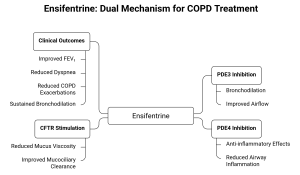
The story of ensifentrine begins with a fundamental insight into airway pathophysiology. Two enzyme families — phosphodiesterase 3 (PDE3) and phosphodiesterase 4 (PDE4) — play distinct but complementary roles in COPD pathology. PDE3 governs smooth muscle relaxation by regulating cyclic AMP (cAMP) and cGMP in the airway. PDE4 governs inflammatory cell activation and migration, and also stimulates the cystic fibrosis transmembrane conductance regulator (CFTR) in bronchial epithelial cells.
Inhibiting PDE3 produces bronchodilation. Inhibiting PDE4 produces anti-inflammatory effects and may reduce mucous viscosity. Ensifentrine does both — in a single inhaled molecule. As published in the American Journal of Respiratory and Critical Care Medicine (AJRCCM, 2023), this dual mechanism distinguishes it from every therapy currently in clinical use.
Mechanism of Action: Step-by-Step
- Step 1: Inhaled via standard jet nebulizer (3 mg, twice daily)
- PDE3 Inhibition: Increases cAMP in airway smooth muscle → Bronchodilation
- PDE4 Inhibition: Decreases inflammatory cell activation → Anti-inflammatory effect
- CFTR Activation: Reduces mucus viscosity, improves mucociliary clearance
- Clinical Outcomes: Improved FEV₁, reduced dyspnea, reduced exacerbation frequency
Critically, unlike oral roflumilast — the selective PDE4 inhibitor approved in 2011 — ensifentrine is delivered directly to the lung. This localised delivery may explain why ensifentrine demonstrated a safety profile similar to placebo in the ENHANCE Phase III trials, confirmed across multiple meta-analyses published in Respiratory Medicine (November 2024).
The ENHANCE Trials: Building the Evidence Fortress
Between September 2020 and December 2022, ensifentrine was evaluated in 1,553 patients aged 40 to 80 with moderate to severe symptomatic COPD across 250 research centers in 17 countries. The ENHANCE program comprised two replicate, randomised, double-blind, placebo-controlled Phase III trials: ENHANCE-1 (NCT04535986) and ENHANCE-2 (NCT04778397).
Key Efficacy Outcomes
- FEV₁ AUC (0–12h): +87 mL (ENHANCE-1) and +94 mL (ENHANCE-2) vs. placebo (both P < 0.001)
- Peak FEV₁ (0–4h): +146 mL vs. placebo in ENHANCE-2 (P < 0.0001)
- Exacerbations: 42% reduction vs. placebo over 24 weeks (P = 0.0109)
- Effect onset: Bronchodilatory effects evident on Day 1 and sustained across 24 weeks (CHEST Pulmonary, September 2025)
- Quality of Life: Clinically significant improvement on SGRQ-C vs. placebo
- Safety: Adverse event profile similar to placebo
TABLE 2 — ENHANCE PHASE III TRIAL RESULTS SUMMARY
ENDPOINTENDPOINT | ENHANCE-1ENHANCE-1 | ENHANCE-2ENHANCE-2 | CLINICAL SIGNIFICANCECLINICAL SIGNIFICANCE |
|---|---|---|---|
FEV1 AUC (0-12h) vs placeboFEV1 AUC (0-12h) vs placebo | +87 mL (P<.001)+87 mL (P<.001) | +94 mL (P<.001)+94 mL (P<.001) | SignificantSignificant |
Peak FEV1 (0-4h)Peak FEV1 (0-4h) | —— | +146 mL (P<.0001)+146 mL (P<.0001) | SignificantSignificant |
Exacerbation ReductionExacerbation Reduction | 42% vs placebo42% vs placebo | (P=.0109)(P=.0109) | SignificantSignificant |
Quality of Life (SGRQ-C)Quality of Life (SGRQ-C) | ImprovedImproved | ImprovedImproved | SignificantSignificant |
Safety vs placeboSafety vs placebo | Similar AEsSimilar AEs | Similar AEsSimilar AEs | FavorableFavorable |
Effect OnsetEffect Onset | Day 1Day 1 | Sustained 24 wksSustained 24 wks | Rapid & DurableRapid & Durable |
"This is the first inhaled product with a novel mechanism of action available for maintenance COPD treatment in over 20 years."
— Tara Rheault, PhD, MPH, Verona Pharma | American Journal of Managed Care (AJMC), 2024
Regulatory Validation and the GOLD 2025 Endorsement
On June 26, 2024, the U.S. FDA approved ensifentrine (Ohtuvayre™) for the maintenance treatment of moderate to severe COPD in adult patients. It is administered as a 3 mg/2.5 mL ampule, twice daily via oral inhalation using a standard jet nebulizer.
The regulatory endorsement was followed by inclusion in the GOLD 2025 Report (Global Initiative for Chronic Obstructive Lung Disease), alongside dupilumab, as one of only two new treatment options added that year. GOLD classified ensifentrine under the shortness-of-breath (dyspnea) pathway as an add-on therapy for patients experiencing dyspnea despite dual long-acting bronchodilator therapy.
As Dr. MeiLan Han noted in Patient Care Online (April 2026), most ENHANCE trial participants were not on triple inhaled therapy — the current standard of care — making definitive exacerbation interpretation in triple-therapy patients a next-generation research question.
TABLE 3 — ENSIFENTRINE VS. KEY COPD PHARMACOTHERAPY COMPARATORS
AGENT | CLASS | ROUTE | MECHANISM | DIFFERENTIATOR |
|---|---|---|---|---|
Ensifentrine (Ohtuvayre) | Dual PDE3/4 Inhibitor | Inhaled (nebulizer) | Bronchodilation + anti-inflammatory | First-in-class, dual action |
Roflumilast | PDE4 Inhibitor | Oral | Anti-inflammatory only | Systemic; weight loss risk |
LABA (salmeterol) | Beta-2 Agonist | Inhaled | Bronchodilation only | No anti-inflammatory |
LAMA (tiotropium) | Muscarinic Antagonist | Inhaled | Bronchodilation only | No anti-inflammatory |
ICS (fluticasone) | Corticosteroid | Inhaled | Anti-inflammatory | No bronchodilation; pneumonia risk |
Dupilumab | IL-4/IL-13 Antagonist | Subcutaneous | Type 2 inflammation only | Biologic; eosinophilic COPD |
The $10 Billion Strategic Signal: Merck's Acquisition of Verona Pharma
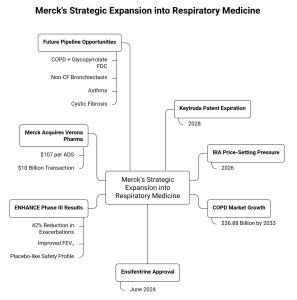
On October 7, 2025, Merck & Co., Inc. completed its acquisition of Verona Pharma at $107 per ADS — a total transaction value of approximately $10 billion. The deal was announced July 8, 2025, and cleared all regulatory and shareholder requirements in under three months.
For pharma strategists, this acquisition is rich with signal. Merck's blockbuster oncology drug Keytruda faces U.S. patent expiration in 2028 and IRA price-setting from 2026. Acquiring a first-in-class COPD asset — targeting a $36.88 billion market by 2033 — is textbook portfolio diversification.
UBS analyst Trung Huynh highlighted a key commercial advantage: Ohtuvayre can be used with any background COPD medication, making it uniquely versatile as a maintenance add-on. This flexibility — the absence of class-specific contraindications with existing bronchodilators — significantly expands the eligible patient population.
"The Verona Pharma acquisition reflects our commitment to delivering innovative treatments and our ability to execute on our science-led and value-driven business development strategy."
— Robert M. Davis, Chairman & CEO, Merck & Co., Inc. | Business Wire, October 2025
TABLE 4 — ENSIFENTRINE PIPELINE UNDER MERCK (POST-ACQUISITION)
INDICATION | STAGE | FORMULATION | STATUS |
|---|---|---|---|
COPD Maintenance (Mono / Add-on) | Approved FDA June 2024 | Nebulized 3 mg BID | Commercially Active |
COPD + Glycopyrrolate FDC | In Development | FDC inhaled | Active Pipeline |
Non-CF Bronchiectasis (NCFBE) | Phase II (Active Trials) | Nebulized | Active Trials |
Cystic Fibrosis | Exploratory | Nebulized | Exploratory |
Asthma | Exploratory | Nebulized | Exploratory |
The Verona deal was not an isolated respiratory bet — it reflected a much larger industry shift toward late-stage specialty assets with durable commercial runway.
Read More→ How 2025 Changed Pharma: The Mergers & Acquisitions That Truly Mattered
Safety Profile: The Critical Differentiator for Formulary Teams
For pharma leaders engaged in formulary decision-making and payer negotiation, the safety profile of ensifentrine is as important as its efficacy data. A meta-analysis in Respiratory Medicine (November 2024) confirmed that ensifentrine had fewer adverse events compared to placebo — a finding that is pharmacologically unusual and clinically compelling.
Unlike oral roflumilast, ensifentrine carries no documented risk of weight loss. Both agents, however, share precautionary language regarding psychiatric adverse effects — including insomnia, anxiety, depression, and suicidal ideation — necessitating careful patient selection and monitoring protocols.
Ensifentrine should NOT be used as rescue therapy for acute bronchospasm. Paradoxical bronchospasm, while possible as with all inhaled therapies, requires immediate discontinuation and management with a short-acting bronchodilator.
The Road Ahead: Precision Medicine and the Next Frontier
The approval of ensifentrine is not the end of the COPD innovation story — it is the beginning of a new chapter. With Merck's global commercial infrastructure now behind Ohtuvayre, international market access efforts in Europe and Asia-Pacific will accelerate. The ensifentrine + glycopyrrolate fixed-dose combination is in active development, targeting simplified nebulized regimens that could dramatically improve real-world adherence.
Beyond COPD, the PDE3/PDE4 platform shows promise in non-cystic fibrosis bronchiectasis (NCFBE) — a condition with even fewer approved therapies and a growing diagnosed population. Phase II trial data from this programme will represent a pivotal strategic inflection point for respiratory franchise leaders.
The broader lesson: dual phosphodiesterase inhibition delivered via inhalation has survived Phase II attrition, replicate Phase III scrutiny, FDA review, GOLD committee evaluation, and a $10 billion market validation. That is not coincidence — it is a scientific signal that deserves sustained strategic attention.
FAQs
01: What exactly makes ensifentrine 'first-in-class'?
Ensifentrine is the first inhaled therapy approved for COPD maintenance that combines both bronchodilator and non-steroidal anti-inflammatory activities in a single molecule. No prior approved COPD therapy has inhibited both PDE3 and PDE4 via the inhaled route. Oral roflumilast targets PDE4 only, and existing bronchodilators (LABAs, LAMAs) do not address the inflammatory component of COPD.
02: How does ensifentrine fit into current treatment algorithms?
The GOLD 2025 guidelines position ensifentrine as a follow-up or add-on therapy for patients experiencing persistent dyspnea despite dual long-acting bronchodilator use. It is classified in the shortness-of-breath symptom pathway and can be layered onto any existing LABA, LAMA, or ICS regimen without pharmacodynamic class conflict — a key market access advantage.
03: What are the key commercial risks pharma leaders should monitor?
Primary risks include: (1) adherence challenges inherent to nebulizer-based BID administration in real-world settings, where DPIs are dominant; (2) limited post-marketing exacerbation data in patients already on triple therapy (LABA + LAMA + ICS); (3) psychiatric adverse effect precautions that may limit use in certain patient subgroups; and (4) payer pressure on pricing.
04: What is the significance of Merck's $10 billion acquisition?
The deal validates ensifentrine as a long-cycle asset — Merck described it as 'expected to grow into the next decade.' With Keytruda facing patent expiry in 2028, Merck needed a durable, non-oncology revenue driver. The $107-per-ADS price reflected a substantial premium and validates the COPD drugs market's projected trajectory to $36.88 billion by 2033.
05: What should pharma R&D leaders learn from ensifentrine's development?
Ensifentrine's journey demonstrates the power of mechanistic precision: PDE3/PDE4 as a dual target was well-understood for years, but the challenge was delivering it inhaled with acceptable safety. Ensifentrine solved that through formulation science. The lesson for R&D leaders: revisiting established enzyme-pathway biology with new delivery modalities can unearth first-in-class opportunities even in seemingly mature therapeutic areas.
References & Citations
- Anzueto A, Barjaktarevic IZ, Siler TM, et al. Ensifentrine, a novel PDE3 and PDE4 inhibitor for the treatment of COPD: the ENHANCE trials. Am J Respir Crit Care Med. 2023;208(4):406-416. doi:10.1164/rccm.202306-0944OC
- FDA Approves Ensifentrine (Ohtuvayre) for Maintenance Treatment of COPD. AJMC. June 26, 2024. ajmc.com
- Verona Pharma. U.S. FDA Approval of Ohtuvayre (ensifentrine). Press Release. June 26, 2024. veronapharma.com
- Merck Completes Acquisition of Verona Pharma. Business Wire / Yahoo Finance. October 7, 2025.
- Merck to Acquire Verona Pharma: ~$10B Transaction. Globe and Mail / Business Wire. July 9, 2025.
- Forecasting the Global Economic and Health Burden of COPD From 2025 Through 2050. CHEST / PubMed / ScienceDirect. April 2025. doi:10.1016/j.chest.2025.04.350
- GOLD 2025 Report: Ensifentrine, a New Treatment in COPD. HCPLive. March 2026. hcplive.com
- Han ML. 2025 GOLD Report for COPD: Dupilumab, Ensifentrine. Patient Care Online. April 2026.
- Ensifentrine: A Novel Option for Maintenance of COPD. PMC/PubMed Central. PMC12187689. 2025.
- Safety and efficacy of ensifentrine in COPD: A systemic review and meta-analysis. Respiratory Medicine. November 2024. S0954-6111(24)00338-X.
- Lung Function and Safety Outcomes in COPD Treated With Ensifentrine. CHEST Pulmonary. September 2025. S2949-7892(25)00077-7.
- Ensifentrine: a novel approach to redefining COPD management. Expert Opinion on Pharmacotherapy. Taylor & Francis. May 2025. doi:10.1080/14656566.2025.2491515
- Advancing Obstructive Airway Disease Treatment: Dual PDE3/4 Inhibition. PMC12071989. 2025.
- COPD Drugs Market Set to Reach US$ 36.88 Billion by 2033. DataM Intelligence / OpenPR. May 2026.
- Global, Regional, and National Burden of COPD: GBD Study 2021. Frontiers in Medicine. March 2025. doi:10.3389/fmed.2025.1564878
DISCLAIMER: This report is for educational and strategic information purposes for pharma industry professionals. Based on peer-reviewed literature, regulatory announcements, and publicly available clinical data. Not medical advice, prescribing guidance, or investment recommendation. © 2026 Pharma Intelligence.