Understanding FDA 21 CFR Part 210: What It Means For Drug Manufacturing And How To Stay Compliant?
Understand what FDA 21 CFR Part 210 means for drug manufacturing, who must comply, and how to stay compliant.

Most people pick up a prescription from the pharmacy without giving it a second thought. They trust that the medicine inside the bottle contains exactly what it says on the label, in the right amount, with no harmful contaminants. That trust did not appear out of thin air. It was built through decades of regulation and oversight.
Before 1962, that trust was far less warranted. A string of dangerous drugs reached patients and caused widespread, sometimes fatal harm. The public outcry that followed made one thing very clear: the pharmaceutical industry needed a strong, enforceable set of rules to protect patients from unsafe or substandard medicines.
The response to that crisis was Current Good Manufacturing Practice, more commonly known as cGMP. These regulations were codified in the United States under Title 21 of the Code of Federal Regulations, specifically in Part 210 and Part 211.
Together, they created the foundation for how drugs are manufactured, processed, stored, and distributed in the US. This article focuses specifically on 21 CFR Part 210. We will explain what it covers, why it matters, how organizations can stay compliant, and what mistakes to avoid along the way.
What Are 21 CFR Part 210 And Part 211?
The Food and Drug Administration (FDA) enforces two closely related sets of cGMP regulations for pharmaceutical manufacturers. These are 21 CFR Part 210 and 21 CFR Part 211.
Think of Part 210 as the foundation. It is relatively brief but essential. It sets out the overall purpose, scope, and legal standing of cGMP regulations. It defines key terms, explains which products are covered, and makes clear what happens when a manufacturer fails to comply.
Part 211 builds on that foundation. It is much more detailed and covers the specific requirements for facilities, equipment, personnel, laboratory controls, production processes, packaging, labeling, and quality control.
If Part 210 draws the map, Part 211 fills in the streets. For any quality team working in the pharmaceutical industry, understanding both parts is critical. You cannot comply with Part 211 without first understanding what Part 210 establishes as the overarching framework.
The Three Core Sections Of 21 CFR Part 210
Part 210 is organized around three main areas: the status of cGMP, the applicability of cGMP, and definitions of key terms. Each one plays a specific role!
1. The Status of cGMP (21 CFR 210.1)
This section answers three important questions: What is the purpose of cGMP? What does it cover? And what happens if a manufacturer does not follow it?
- Purpose: The core purpose of cGMP is straightforward: to make sure that drugs are safe and that they actually are what they claim to be. The FDA's own language puts it plainly. A drug must meet safety requirements and must have the identity, strength, quality, and purity that it claims or is represented to have.
In plain terms, this means a drug cannot simply claim to contain 500mg of a particular active ingredient. It must actually contain that amount, at the stated purity, free from contamination, and manufactured under conditions that make consistent quality possible. Every batch must meet these standards, not just the occasional one.
- Scope: The scope of cGMP is deliberately broad. It covers every stage of a drug's journey from raw material to finished product. This includes the manufacturing methods being used, the physical facilities where production takes place, the quality control processes in place, as well as packaging, storage, and holding conditions.
This wide scope ensures there are no gaps. A drug could be formulated perfectly but still fail patients if it is stored improperly or packed in contaminated containers. Part 210 makes clear that the entire chain must meet minimum standards.
- Staying Current: The "c" in cGMP stands for "current," and this distinction is deliberate and meaningful. It separates cGMP from older, less rigorous GMP standards. GMP represents minimum manufacturing practices, but they do not necessarily reflect the latest available technologies, methods, or knowledge.
cGMP, by contrast, requires manufacturers to stay up to date. As science advances and new manufacturing technologies become available, the regulations evolve to reflect those advancements. A company that was fully compliant five years ago may need to update its systems and practices today. This is not a burden so much as a built-in mechanism for continuous improvement.
- Consequences Of Noncompliance: Failing to follow cGMP regulations under Part 210 or Part 211 has serious consequences. In legal terms, any drug produced in violation of these regulations is considered "adulterated." This is not just a technical classification. It has real, immediate implications. An adulterated drug can be recalled from the market.
The company responsible may face significant fines. In serious cases, operations can be suspended or shut down entirely. The reputational damage alone can be severe and long-lasting. And it is worth noting that both the product and the individual or organization responsible for the violation are subject to regulatory action.
2. The Applicability of cGMP (21 CFR 210.2)
This section clarifies exactly who and what the regulations apply to!
- Who Must Comply: The short answer is: nearly every organization involved in making or distributing drugs in the United States. This includes manufacturers of both prescription and over-the-counter drugs.
It also applies to active pharmaceutical ingredients, not just the finished dosage forms that end up in a patient's hands. Whether a company manufactures tablets, injectables, topical creams, or liquid medicines, if they are doing so for the US market, they must comply with cGMP.
- Biological Products And HCT/P Products: Some products fall under additional layers of regulation. Biological products and human cell, tissue, or cellular- and tissue-based products (commonly referred to as HCT/P) are subject to their own specific regulatory requirements on top of cGMP.
When multiple sets of regulations apply to the same product, they are meant to work alongside each other rather than cancel each other out. If there is ever a direct conflict between regulations, the rule that is most specific to the product in question takes precedence. But cGMP requirements are never simply set aside.
- Drugs Still In Development: Products that are still in clinical development are generally not treated the same as finished commercial drugs. However, once an Investigational New Drug (IND) reaches Phase 2 clinical trials or beyond, it must begin to comply with Part 211, which governs finished pharmaceuticals. This is a critical compliance milestone for companies developing new drugs and should be built into project timelines from early stages of development.
3. Definitions (21 CFR 210.3)
One of the most practical elements of Part 210 is its list of defined terms. In regulatory compliance, precise language matters enormously. If a term can be interpreted in multiple ways, enforcement becomes inconsistent and confusion becomes inevitable.
Part 210 addresses this by providing clear definitions for terms that appear throughout the cGMP regulations. A few important examples include:
- A batch refers to a specific quantity of a drug that is intended to have uniform character and quality, produced according to a single manufacturing order during the same production cycle. This definition is fundamental to how production records, testing, and traceability work.
- A quality control unit refers to the person or organizational element within a company that is designated to carry out quality control duties. This unit has authority and responsibility that cannot be casually delegated or ignored.
- A representative sample is a sample drawn using rational criteria, such as random sampling, in a way that accurately reflects the larger batch or material being evaluated. This definition matters for laboratory testing because a poorly drawn sample can lead to false conclusions about product quality.
These definitions create a shared vocabulary that every manufacturer, inspector, and quality professional can use with confidence.
Best Practices For Staying Compliant With 21 CFR Part 210
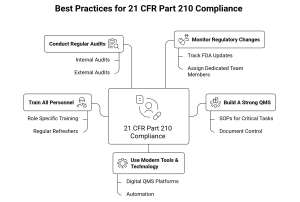
Understanding the regulations is only half the challenge. Applying them consistently in a real manufacturing environment requires active effort, proper systems, and a culture that takes quality seriously.
1) Monitor Regulatory Changes Actively
cGMP regulations are not static. The FDA updates guidance and expectations as science evolves. Organizations need to monitor regulatory publications and updates regularly. This is not a once-a-year task. Designating specific team members to track and communicate regulatory changes is a practical and effective approach.
2) Build A Strong Quality Management System
A Quality Management System (QMS) is the backbone of cGMP compliance. A well-designed QMS provides structure for all manufacturing and quality activities. It covers standard operating procedures (SOPs) for critical tasks, document control processes that ensure the right version of every procedure is in use, change management protocols, supplier qualifications, and ongoing quality monitoring.
A QMS should be treated as a living system. It needs to be reviewed, updated, and tested regularly to make sure it reflects actual practices and meets current regulatory expectations.
3) Use Modern Tools & Technology
Manufacturing equipment must meet current standards, but so must the systems used to manage quality data and documentation. Digital QMS platforms, for example, can replace paper-based systems that are prone to errors, difficult to audit, and slow to update.
Automation reduces the risk of human error in documentation and helps ensure consistency across processes. Adopting the right tools is not just about efficiency. It is about building a compliance infrastructure that is reliable and sustainable.
4) Train All Personnel Thoroughly & Continuously
People are at the center of every manufacturing process. A well-written SOP only works if the person following it understands it correctly and applies it consistently. All personnel who are involved in manufacturing, processing, packing, or holding drugs should receive role-specific training that is comprehensive, documented, and regularly refreshed.
Organizations should begin by assessing where knowledge gaps currently exist. Training programs should then be designed to close those gaps and be revisited regularly to reflect process changes and regulatory updates. Periodic evaluations help confirm that training has been absorbed and is being applied.
5) Conduct Regular Internal & External Audits
Audits are one of the most effective tools for identifying compliance gaps before they become regulatory problems. Internal audits allow teams to look critically at their own processes, catch issues early, and implement corrective actions proactively.
External or third-party audits add an independent perspective. Outside auditors often spot problems that internal teams have become blind to simply through familiarity. Audits should be well-documented, conducted objectively, and supported with adequate resources to ensure they are thorough and meaningful.
5 Common Compliance Pitfalls To Avoid
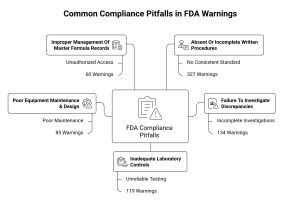
Despite the clear requirements of cGMP, many pharmaceutical companies still fall short. According to FDA data, the number of compliance warnings issued following inspections more than doubled in a recent three-year period. In 2024 alone, 561 compliance warnings were issued.
Here Is Where Companies Most Commonly Went Wrong!
a) Absent Or Incomplete Written Procedures — The single largest category of violations in 2024 was the absence of written procedures or failure to follow existing ones. This accounted for 327 out of 561 warnings, which is 58% of all warnings issued. This is a foundational problem. Without written procedures, there is no consistent standard for employees to follow. Without compliance with those procedures, documentation is meaningless.
b) Failure To Investigate Discrepancies — The second most common issue was failing to properly investigate discrepancies or failures. When something goes wrong in manufacturing or quality testing, the quality control unit must investigate thoroughly and take appropriate follow-up action. Incomplete or inadequate investigations accounted for 134 warnings, or 24% of the total.
c) Inadequate Laboratory Controls — Reliable laboratory controls are essential for generating accurate, trustworthy data. Without scientifically sound testing methods and controls, manufacturers cannot be confident in the quality of their products. Failures in this area accounted for 119 warnings, representing 21% of the total.
d) Poor Equipment Maintenance & Design — Equipment that is poorly maintained, incorrectly sized, inappropriately located, or inadequately cleaned poses serious risks to product quality. This category accounted for 85 warnings, or 15% of the total.
e) Improper Management Of Master Formula Records — Sixty warnings, also representing 15% of the total, were linked to inappropriate computer control of master formula records. This typically arises when sensitive documents are stored in systems that allow unauthorized access, creating risks for both data integrity and product safety.
The Bottom Line
21 CFR Part 210 may be short compared to Part 211, but it carries enormous weight. It sets the legal and conceptual foundation for everything that follows in pharmaceutical manufacturing compliance. It defines the purpose and scope of cGMP, identifies who must comply, and establishes the precise language that the entire regulatory system depends on.
For quality professionals, the message is clear. Compliance is not optional, and it is not a one-time achievement. It requires an active, ongoing commitment to monitoring regulations, maintaining strong systems, training people well, and auditing honestly.
As regulatory scrutiny continues to increase, the organizations that thrive will be those that treat quality not as a checkbox exercise but as a genuine operational priority. That mindset, supported by the right tools and processes, is what separates companies that consistently meet cGMP standards from those that appear in FDA warning letter databases.
FAQs
1) What Is FDA 21 CFR Part 210?
FDA 21 CFR Part 210 outlines the fundamental Current Good Manufacturing Practice (cGMP) requirements governing the methods, facilities, and controls used in drug manufacturing. It serves as the foundation of pharmaceutical quality regulations, ensuring every product is produced consistently and safely. The regulation establishes the minimum standards needed to ensure drugs meet identity, strength, quality, and purity requirements. It also provides the terminology and structure that guide all other cGMP expectations under the FDA framework.
2) Why Is 21 CFR Part 210 Important For Drug Manufacturers?
It provides the core legal and operational framework manufacturers must follow to prevent contamination, mix-ups, and quality defects throughout production. Compliance is essential not only for protecting patients but also for avoiding regulatory actions such as inspection findings, warning letters, and product recalls. It sets a uniform baseline that ensures manufacturing processes remain scientifically sound and properly controlled. Adhering to these standards also strengthens overall product reliability and patient confidence in the final drug.
3) Who Must Comply With FDA 21 CFR Part 210?
All companies involved in manufacturing, processing, packing, or holding drugs intended for distribution in the United States must meet these requirements. This applies to prescription drugs, OTC products, contract manufacturers, and API producers, ensuring uniform quality standards across the entire supply chain. Even companies operating outside the US must comply if they export medicines to the American market. These requirements ensure that every product reaching patients meets the same level of quality, regardless of where it was manufactured.
Reporting on the science, business and regulation shaping the pharmaceutical industry.
More in Regulatory Intelligence
All articles →
The Pattern Behind FDA Warning Letters: What Startups & CDMOs Often Miss

ISO 14644 Cleanroom Classes for Pharma (with EM Implications)

Discussion