by Simantini Singh Deo
7 minutes
How The PDCA Cycle Strengthens Quality Management In Life Sciences?
PDCA cycle strengthens pharma QMS through structured quality management. Explore GMP compliance, CAPA, eQMS integration, and continuous improvement.
Quality is the foundation of every life sciences organization. Whether it is pharmaceuticals, biotechnology, or medical devices, the expectation is always the same: products must be safe, effective, and consistently reliable. Because of this, companies rely on a Quality Management System (QMS) to bring structure and control to all quality-related activities.
A QMS is essentially a coordinated system that connects processes, documentation, responsibilities, and decision-making into one unified framework. In modern organizations, this is often managed through a digital platform known as an electronic QMS (eQMS). These systems go far beyond storing documents, they help teams collaborate, track compliance, and maintain visibility across the entire product lifecycle.
However, having a QMS alone is not enough. Organizations also need a structured way to continuously improve it. This is where the PDCA cycle becomes essential.
Understanding PDCA As A Continuous Improvement Approach
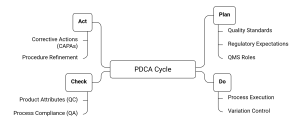
The Plan–Do–Check–Act (PDCA) cycle, also known as the Deming Cycle, is a simple yet powerful method used to improve processes systematically. Instead of relying on trial and error, PDCA encourages organizations to move step-by-step, ensuring that every improvement is planned, tested, evaluated, and refined.
The strength of PDCA lies in its repetition. It is not a one-time process but a continuous loop that helps organizations learn and improve over time, which is especially important in highly regulated industries like life sciences.
Step 1: Plan – Building A Strong Foundation For Quality
The “Plan” stage is where everything begins. It focuses on understanding what quality means for the organization and how it can be achieved in a controlled and measurable way. Without proper planning, even the best execution can fail to deliver consistent results.
In this phase, organizations clearly define their expectations and structure their approach to quality. This typically involves:
- Defining quality from both customer expectations and regulatory requirements
- Establishing clear policies, procedures, and quality standards
- Mapping roles and responsibilities across departments
- Designing the overall structure of the QMS
This stage is critical because it ensures alignment across the organization. Every employee understands what is expected, how their work contributes to quality, and what standards must be followed. In many ways, the planning stage acts as the blueprint for the entire quality system.
Step 2: Do – Executing And Building Quality into Processes
Once planning is complete, the organization moves into execution, where ideas and designs are turned into real processes and products. The “Do” stage is where quality is actively built into operations rather than inspected afterward.
A key principle guiding this stage is:
“Quality must be designed into the process, not inspected into the product.”
In practice, this means that organizations focus heavily on controlling variation and ensuring consistency. Scientific tools, statistical methods, and controlled experimentation are used to maintain product stability.
Key activities in this stage include:
- Implementing defined processes and procedures
- Conducting controlled manufacturing or development activities
- Using statistical tools to reduce process variation
- Ensuring repeatability across batches and production cycles
By carefully managing these activities, organizations ensure that products consistently meet the specifications defined in the planning stage.
Step 3: Check – Evaluating Performance And Ensuring Compliance
After execution, it is important to verify whether the results match expectations. The “Check” stage focuses on measurement, evaluation, and compliance confirmation. It ensures that processes are working as intended and that products meet required standards.
This stage typically involves two key functions:
- Quality Control (QC): Quality Control focuses on the direct testing and measurement of product attributes. QC teams generate detailed reports based on laboratory analysis and inspection results. Their role is to confirm whether the product meets defined specifications.
- Quality Assurance (QA): Quality Assurance takes a broader view. It ensures that the entire process was followed correctly and that documentation is complete, accurate, and compliant. QA acts as a safeguard before products are released.
A modern eQMS plays a major role in strengthening this stage by enabling:
- Automated generation of QC reports
- Digital review and approval workflows
- Secure electronic signatures
- Real-time monitoring of quality KPIs through dashboards
- Full traceability of data and actions
Together, QC and QA ensure that both product quality and process integrity are maintained at a high standard.
Step 4: Act – Driving Improvement And Corrective Actions
The final stage of PDCA focuses on learning from results and making necessary improvements. If the “Check” phase reveals deviations or issues, organizations must take corrective actions to resolve them and prevent recurrence.
This stage is not limited to fixing problems. It also supports continuous improvement, meaning even successful processes are reviewed for possible enhancement.
Typical actions in this stage include:
- Conducting root cause analysis of deviations or failures
- Implementing corrective and preventive actions (CAPAs)
- Updating standard operating procedures (SOPs)
- Providing additional employee training where needed
- Adjusting process parameters for better consistency
In addition to resolving issues, organizations also document whether the actions taken were effective. This documentation is important because it builds organizational knowledge and supports future decision-making.
CAPAs only work when people understand why they exist.
Here's why quality systems fail without capability behind them.
→ Read: Why Pharmaceutical Quality Systems Fail Without Capability Building
How PDCA Integrates With A Modern Quality Management System?
The PDCA cycle works most effectively when embedded within a strong Quality Management System (QMS). While the QMS provides structure and governance, PDCA ensures that the system is continuously improved rather than remaining static.
Modern digital eQMS platforms enhance this relationship by centralizing all quality activities into a single system. These platforms offer several advantages:
- Cloud-based access to documents and processes from anywhere
- Integrated modules for CAPA, training, audits, and change control
- Automated workflows that reduce manual effort and delays
- Complete digital traceability for compliance and audits
- Improved collaboration across global teams
In addition, regulatory frameworks such as ISO 9001:2015 emphasize structured quality systems and continuous improvement, making PDCA a natural fit within compliant organizations.
PDCA gives the cycle.
QMS gives it a home. Here's how a complete quality management system is actually built and run.
→ Read: What Is QMS | Quality Management System Explained
Why A Strong eQMS Is Essential For Quality Excellence?
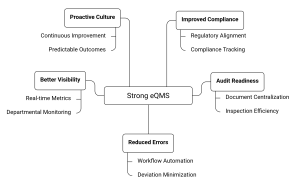
A well-implemented eQMS is not just a digital tool, it becomes the backbone of quality culture within an organization. It ensures that processes are not only defined but also consistently followed and improved.
The key benefits of a strong eQMS include:
- Improved compliance with regulatory requirements
- Faster and more efficient audit readiness
- Reduced operational errors and deviations
- Lower cost associated with poor quality
- Enhanced training and onboarding processes
- Better visibility into performance metrics
- Stronger collaboration across departments and locations
Most importantly, a strong eQMS helps organizations shift from reactive problem-solving to proactive quality management.
Final Thoughts
The PDCA cycle remains one of the most practical and effective tools for improving quality management in life sciences. Its structured yet flexible approach allows organizations to continuously refine their processes while maintaining strict compliance with regulatory standards.
When combined with a modern digital QMS, PDCA becomes even more powerful. It transforms quality management from a static system into a dynamic cycle of learning and improvement.
Ultimately, quality in life sciences is not a one-time achievement—it is an ongoing responsibility. The PDCA cycle ensures that organizations stay committed to that responsibility, continuously improving products, processes, and ultimately patient outcomes.
FAQs
1. How Does The PDCA Cycle Improve Quality Management In Life Sciences?
The PDCA cycle provides a structured, step-by-step method for improving processes, ensuring that quality enhancements are planned, tested, evaluated, and refined rather than implemented through trial and error. In a regulated environment like life sciences, this creates consistency and reduces the risk of compliance failures. By repeating the cycle continuously, organisations build a culture of steady, predictable improvement that strengthens overall quality performance. This structured cadence also helps teams identify inefficiencies early, reducing the cost and complexity of corrective actions.
2. Why Is PDCA More Effective When Combined With A Modern eQMS?
An eQMS brings all quality processes, documents, approvals, and data into a single digital platform, reducing manual effort and ensuring visibility across the product lifecycle. When PDCA is integrated into this system, improvements become easier to track, implement, and verify. This combination creates a closed-loop quality ecosystem where issues are quickly identified, corrected, and prevented from recurring. It also ensures that every improvement is documented, auditable, and aligned with regulatory expectations.
3. What Makes The “Check” And “Act” Stages So Critical In Life Sciences Quality Systems?
These stages ensure that processes are performing as expected and that every deviation, trend, or risk is addressed before it affects product quality or patient safety. They also formalise the evaluation of QC results, QA oversight, and effectiveness of corrective actions. Strong execution of Check and Act not only protects compliance but also accelerates learning, helping organisations continuously optimise their operations. This discipline ensures that corrective actions evolve into preventive actions, strengthening long-term operational resilience.