by Mrudula Kulkarni
10 minutes
When Data Integrity Meets the Right to Be Forgotten: Resolving the 21 CFR Part 11 and GDPR Conflict
A practical pharma guide to handling the 21 CFR Part 11 and GDPR conflict with retention, audit trails, and data privacy.
A comprehensive guide for life sciences leaders on navigating the structural compliance tension between FDA electronic records obligations and European data privacy rights.
Data Integrity or Data Privacy? Why Pharma Cannot Easily Choose
Imagine this: a senior validation scientist resigns from your EU-based pharmaceutical manufacturing facility. Three months later, a formal request arrives from their legal representative. Under the General Data Protection Regulation (GDPR), they are invoking their right to erasure under Article 17. They want every record bearing their name, signature, and professional history purged from your systems.
Your legal team flags the request as legitimate. Your quality assurance team flags a different problem. Under 21 CFR Part 11, the US FDA requires that electronic records remain accurate, complete, retrievable, and unaltered for the full statutory retention period. The batch records this scientist signed may still be within their retention window. The audit trail entries carrying their electronic signatures cannot simply be deleted without compromising data integrity.
This is not a hypothetical edge case. It is a structural compliance tension that every EU-based life sciences company exporting to the US must have a documented position on. Yet fewer than a third of organizations have a formal data retention plan that addresses it.
~60% Of FDA Warning Letters from 2021-2024 cited data integrity deficiencies, of which Part 11 lapses are a primary subset Source: FDA CDER / IntuitionLabs, 2026 | 47 Warning letters to device companies in FY 2024 alone — more than double the prior year — frequently citing missing audit trails and inadequate access controls Source: Qualityze / ECA Academy, 2026 | <30% Of organizations have a formal data retention plan in place despite operating under dual regulatory obligations for electronic records Source: i4cp / Seramount Research |
|---|
The conflict sits at the intersection of two equally legitimate regulatory objectives. 21 CFR Part 11 compliance exists to protect the integrity and traceability of records that underpin product quality and patient safety. GDPR data protection exists to protect individuals from having their personal information retained beyond its necessary purpose. Both are binding. Neither is optional.
What Counts as Personal Data Inside a Pharma QMS?
Before resolving the conflict, leaders must understand its scope. The definition of personal data under GDPR is deliberately broad. Any data associated with an identifiable living person qualifies. Inside a typical pharmaceutical Quality Management System (QMS), this encompasses far more than employee names and contact details.
Data Type in QMS | Personal Data? | 21 CFR Part 11? | Conflict Risk |
|---|---|---|---|
Electronic signatures on batch records | Yes — name, unique ID, timestamp | Yes — § 11.10(b), § 11.10(c) | High |
Audit trail entries (who changed what, when) | Yes — individually identifiable actions | Yes — mandatory, tamper-evident | High |
Employee competence records and CVs | Yes — professional and personal history | Yes — 21 CFR 211.25 qualification evidence | High |
Training completion records | Yes — associated with named individual | Yes — GMP training traceability | Medium |
CAPA and deviation sign-offs | Yes — if named approver | Yes — traceability requirement | Medium |
Patient adverse event records in QMS | Yes — sensitive health data | Indirectly (complaint handling records) | High |
Premises entry/exit logs for GMP areas | Yes — movement data of identified persons | Rarely, unless linked to access controls | Lower |
Understanding this matrix is the first step in risk stratification. The sharpest conflicts arise where the same data element is simultaneously required for regulatory traceability and subject to a legitimate erasure request under GDPR Article 17.
Data integrity obligations don't stop at electronic signatures and audit trails.
Digital EM systems, LIMS, and eQMS platforms each carry their own 21 CFR Part 11 compliance footprint.
→ Read: Digital EM: Transforming Pharma Cleanrooms
Record Retention Under 21 CFR Part 11: What the Regulation Actually Requires

The retention obligations under 21 CFR Part 11 are not standalone. They derive their authority from what the FDA calls "predicate rules" — the underlying regulations that require the record to exist in the first place. Part 11 then layers on requirements for how those records must be maintained in electronic form.
§ 11.10(b) — Accuracy and Completeness of Electronic Records |
|---|
The ability to generate accurate and complete copies of records in both human readable and electronic form suitable for inspection, review, and copying by the agency. 21 CFR Part 11, Section 11.10(b) — U.S. FDA |
§ 11.10(c) — Record Retrieval Throughout Retention Period |
|---|
Protection of records to enable their accurate and ready retrieval throughout the records retention period. 21 CFR Part 11, Section 11.10(c) — U.S. FDA |
The predicate rule most relevant to manufacturing is 21 CFR 211.180, which establishes that batch record retention runs until one year after the expiration date of the batch, or three years after distribution of the last lot of applicable OTC drug products. For products in active regulatory dossiers, record retention can extend significantly further.
The FDA's position is unambiguous: wherever a predicate rule requires a record, that record must be maintained with the same integrity regardless of whether the employee who created it is still employed. The record does not belong to the individual. It belongs to the product's regulatory history.
"Strong data integrity is the foundation of regulatory trust. Continuous, real-time compliance monitoring enables organizations to maintain audit-ready electronic records while reducing operational risk."
— Instem Compliance Research, 2026
GDPR's Right to Erasure: More Limited Than It Appears
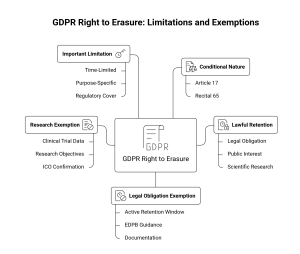
The right to be forgotten under GDPR Article 17 is one of the regulation's most cited provisions. It is also one of its most misunderstood. The right is conditional and carries explicit exceptions that are directly relevant to pharmaceutical record-keeping obligations.
GDPR Recital 65 — Right of Rectification and Erasure |
|---|
The further retention of personal data should be lawful where it is necessary for compliance with a legal obligation, for the performance of a task carried out in the public interest, on the grounds of public interest in the area of public health, for archiving purposes in the public interest, or for scientific or historical research purposes. GDPR Recital 65 — Official Journal of the European Union |
This is a structural recognition that data protection must coexist with other legitimate societal interests, including regulatory compliance and patient safety. The European Data Protection Board (EDPB) guidance has consistently upheld that where a legal obligation requires retention, erasure requests may be refused during the active retention window.
Importantly, GDPR also exempts clinical trial data from the full force of the right to erasure where deletion would "render impossible or seriously impair the achievement of the research objectives." The ICO (UK Information Commissioner's Office) has confirmed that where deletion would undermine the integrity of a trial dataset, refusal is justified.
However, the exemption is time-limited and purpose-specific. Once the legal retention obligation expires, the exemption falls away. Organizations cannot invoke regulatory requirements indefinitely as a basis for retaining personal data beyond what those requirements actually demand.
Three Conflict Scenarios and How to Navigate Them
Industry experts consistently identify three distinct scenario types where the 21 CFR Part 11 and GDPR tension becomes operational. Each requires a differentiated approach.
Scenario 1: QA Actions in the eQMS | Scenario 2: Patient Data in QMS | Scenario 3: Competence Records and CVs |
|---|---|---|
Example: Former employee's name appears in electronic signatures on batch releases, CAPA approvals, and event investigations. Quality assurance actions fall under the employer-employee contractual and regulatory framework, not under GDPR as a primary basis. The audit trail entry documenting that a named individual changed a document status serves a regulatory function, not a personal data processing function. The data retention obligation overrides the erasure request during the active retention period. Defensible: Retain with documented justification. Log the erasure request and its regulatory basis for refusal in the audit trail. | Example: Complaint records or adverse event reports contain identifiable patient information stored within the quality system. This scenario carries the highest GDPR compliance risk. Patient data is classified as sensitive under GDPR Article 9. If a patient invokes their right to erasure, the organization must apply a careful risk-based assessment. Where the data supports an active regulatory submission, retention is defensible. Pseudonymization should be considered as an interim measure. High Risk: Apply risk-based analysis for each request. Document the legal basis for retention or deletion explicitly. | Example: Former employee's training history, CV, and competence assessments remain in the HR or training module of the QMS. Under 21 CFR 211.25, organizations must document that personnel performing regulated functions were appropriately qualified. An erasure request creates a gap in the regulatory qualification record. The approach is to distinguish between qualification evidence required for the product record and personal profile data that serves no ongoing regulatory function. Recommended: Retain minimum qualification evidence required by predicate rule. Delete all non-essential personal profile data. Document reasoning in audit trail with explicit GDPR reference. |
A Risk-Based Framework for Dual Compliance
The path to sustainable 21 CFR Part 11 and GDPR dual compliance runs through policy architecture, not case-by-case firefighting. Organizations that have resolved this conflict successfully treat it as a data governance problem requiring systemic solutions.
Step 1: Build a Data and Record Inventory
Map every category of electronic record held in your eQMS, LIMS, and related systems. For each category, document the predicate rule that requires it, the applicable retention period, and whether it contains personally identifiable information. The inventory should capture: the purpose of collection, the method of collection, the applicable retention period, security and access controls, whether the data is shared with third parties, and the legal basis for retention.
Step 2: Establish a Dual-Purpose Retention Policy
A single retention policy covering both 21 CFR data integrity requirements and GDPR data minimization principles is achievable but requires deliberate drafting. The policy must distinguish between records retained for regulatory purposes (where the GDPR exemption applies) and personal data retained for operational convenience (where it does not). Regulatory retention is the floor, not a blanket permission to retain everything indefinitely.
Step 3: Define the Technical Response to Erasure Requests
When an erasure request arrives, the organization needs a documented workflow: initial assessment against the data inventory, determination of whether any retention exemption applies, a defined escalation path if legal opinion is required, a standardized response to the data subject, and an audit trail entry documenting the decision and its regulatory basis, regardless of whether the request is granted or refused.
Step 4: Implement Pseudonymization Where Technically Feasible
In some record categories, it may be technically possible to satisfy the spirit of a GDPR erasure request without deleting the regulatory record. Pseudonymization replaces direct identifiers with a code that cannot be reversed without a separately held key, reducing the personal data processing risk while preserving the integrity of the underlying record. This approach should be evaluated on a record-category basis and is not universally applicable to all audit trail or electronic signature contexts.
Building a dual-compliance framework requires more than policy, it requires a quality system where capability matches obligation.
Why pharma quality systems fail when people understand procedures but not the principles behind them.
→ Read: Why Pharmaceutical Quality Systems Fail Without Capability Building
FAQs
Can a former employee legally force deletion of their electronic signatures from batch records?
Not during the active regulatory retention period. Electronic signatures embedded in batch records are protected under 21 CFR Part 11 and the applicable predicate rule (e.g., 21 CFR 211.180) for the duration of that record's retention window. GDPR's right to erasure does not override a legal retention obligation. Once the retention period expires, the data should be reviewed for deletion of any personal identifiers that no longer serve a regulatory purpose.
Does GDPR's research exemption cover all pharmaceutical data, including manufacturing records?
No. GDPR's research exemption (Article 17(3)(d)) applies most clearly to clinical trial data where deletion would seriously impair research objectives. Manufacturing, QA, and commercial batch records derive their retention protection from the legal obligation exemption under Article 17(3)(b). The distinction matters because the legal basis must be correctly documented in your data inventory and in any response to a data subject request.
What should an audit trail entry look like when we refuse a GDPR erasure request?
Best practice is to log the refusal in the audit trail with explicit reference to the legal basis. For example: 'Data subject erasure request received [date]. Retention required under 21 CFR 211.180 predicate rule; regulatory retention period expires [date]. GDPR Article 17(3)(b) exemption applied. Request refused. Response provided to data subject [date].' This audit trail entry creates a compliance record reviewable during both FDA and GDPR supervisory authority inspections.
Is pseudonymization an acceptable alternative to deletion under GDPR?
Pseudonymization reduces personal data risk and may in some record categories satisfy the practical intent of an erasure request. However, it does not constitute deletion under GDPR. The approach is most defensible when combined with a documented retention justification and where re-identification through retained key data is technically controlled. Always obtain a legal opinion before treating pseudonymization as a substitute for a formal erasure decision.
What is the risk of getting this wrong from a regulatory enforcement perspective?
Enforcement risks run in both directions. Deleting records to comply with a GDPR request when a Part 11 retention obligation applies exposes the organization to FDA warning letters. The FDA issued over 47 warning letters to device companies in FY 2024 alone, many citing data integrity lapses consistent with improper record alteration. Conversely, refusing a legitimate GDPR erasure request without documented legal justification exposes the organization to GDPR supervisory authority enforcement, which can reach fines of up to EUR 20 million or 4% of global annual turnover under GDPR Article 83.
References and Citations
1. U.S. Food and Drug Administration. 21 CFR Part 11: Electronic Records; Electronic Signatures - Scope and Application. FDA Guidance. Updated January 2024. https://www.fda.gov
2. European Parliament and Council. General Data Protection Regulation (GDPR) - Regulation (EU) 2016/679. Articles 17, 83; Recitals 65, 66. https://gdpr-info.eu
3. U.S. Code of Federal Regulations. 21 CFR § 211.180: Records and Reports - General Requirements. https://www.accessdata.fda.gov
4. U.S. Code of Federal Regulations. 21 CFR § 211.25: Personnel Qualifications. Electronic Code of Federal Regulations.
5. IntuitionLabs AI. 21 CFR Part 11 Compliance: Requirements and Data Integrity. 2026. https://intuitionlabs.ai
6. Instem Life Science Software. How to Strengthen Data Integrity and Ensure 21 CFR Part 11 Compliance. January 2026. https://www.instem.com
7. Qualityze. What is FDA 21 CFR Part 11? A Complete Guide. April 2026. https://www.qualityze.com
8. SimplerQMS. FDA 21 CFR Part 11 Audit Trails: Definition, Requirements, and Compliance. March 2026. https://simplerqms.com
9. GDPR Info. Article 17 GDPR - Right to Erasure (Right to Be Forgotten). https://gdpr-info.eu/art-17-gdpr/
10. Information Commissioner's Office (ICO). Research Exemptions under UK GDPR - Right to Erasure. https://ico.org.uk
11. Vivenics. Can Clinical Trial Participants Request to Delete Their Personal Data? December 2023. https://vivenics.com
12. Norton Rose Fulbright. The Impact of the GDPR on Clinical Trial Research. https://www.nortonrosefulbright.com
13. PharmaTimes. A Need to Know Basis: GDPR and Clinical Trials. March 2019. https://pharmatimes.com
14. NCBI Bookshelf. The EU's General Data Protection Regulation (GDPR) in a Research Context. 2018. https://www.ncbi.nlm.nih.gov/books/NBK543521/
15. SOCRA. Overview of GDPR for Clinical Research Organizations. 2020. https://www.socra.org
16. Scilife. How to Handle Conflict Between 21 CFR Part 11 and GDPR (Expert consultation: Yves Dene, Neeru Bakshi). Updated February 2026. https://www.scilife.io/blog/conflict-between-21-cfr-part-11-gdpr
17. GDPR Info EU. GDPR Article 17 Explained: Understanding the Right to Erasure. December 2025. https://gdprinfo.eu
DISCLAIMER: This article is for educational and informational purposes only. It does not constitute legal advice. Organizations should obtain qualified legal counsel before making compliance decisions.