by Mrudula Kulkarni
12 minutes
PATIENT CENTRICITY: DECODING ONCOLOGY & CHEMO TOXICITY MANAGEMENT
CIPN, CINV, digital toxicity, logistic toxicity, decoded for pharma leaders building patient-centric oncology and chemo toxicity strategies.

EXECUTIVE SUMMARY: THE IMPERATIVE OF LISTENING TO THE PATIENT
Chemotherapy remains the backbone of systemic cancer treatment, yet its toxicities continue to erode patient quality of life, drive treatment discontinuation, and generate enormous healthcare costs. The shift toward patient centricity in oncology is not merely an ethical mandate; it is a clinical, commercial, and regulatory necessity.
The International Agency for Research on Cancer (IARC) projects a 77% increase in new cancer cases between 2022 and 2050, placing unprecedented pressure on healthcare systems globally. As of mid-2025, over 5,700 oncology drugs are in active clinical development or have an IND filed. In 2024 alone, approximately one in four clinical trials initiated worldwide focused on oncology.
Yet, despite this scientific momentum, the burden of chemotherapy-induced toxicities — from nausea and neutropenia to peripheral neuropathy and cognitive impairment — remains grossly underreported, insufficiently managed, and largely invisible to the clinical team until severity escalates.
This report provides pharma leaders with a rigorous, evidence-based framework to decode the current landscape and lead the transition to truly patient-centric oncology care.
SECTION 01 — BURDEN OF TOXICITY: THE HIDDEN CRISIS WITHIN THE CURE
When a patient hears the word "chemotherapy," they understand it will be difficult. What they may not fully anticipate is the multidimensional burden of chemo-induced toxicities — a constellation of physical, psychological, and economic harms that extend months, sometimes years, beyond the last infusion cycle.
A landmark 2025 systematic review and meta-analysis published in Regional Anesthesia & Pain Medicine by D'Souza et al. (Mayo Clinic), drawing on 76 studies from 29 countries and more than 10,962 patients, revealed that nearly half of all patients who develop chemotherapy-induced peripheral neuropathy (CIPN) suffer persistent, clinically significant symptoms lasting three months or longer. Among women, this prevalence climbs to nearly 60%.
KEY STATISTICS
• ~49% — patients with CIPN experience chronic moderate-to-severe symptoms (≥3 months)
• ~83% — prevalence of CIPN with cisplatin-based regimens (Ezzi et al., 2019)
• ~1.6 million — estimated incident chemo-induced anemia cases annually across 7MM countries
• $1.5 billion — CIPN market size in 7MM, 2022; projected CAGR of 3.1% through 2032
PREVALENCE OF KEY CHEMOTHERAPY-INDUCED TOXICITIES
Toxicity | Estimated Prevalance |
|---|---|
Nausea/Vomiting (CINV) | 70–80% |
Fatigue | ~75% |
Peripheral Neuropathy | 17–83%* (drug-dependent) |
Alopecia | ~60% |
Neutropenia | ~50% |
Mucositis / Stomatitis | 20–40% |
Cognitive Impairment | ~20–30% |
*Range reflects drug-specific variation: platinum-based agents and taxanes carry the highest CIPN risk.
Source: Wiranata et al. 2024 (PLOS ONE); D'Souza et al. 2025 (Reg Anesth Pain Med); Maqdasawi et al. 2025 (BMC Cancer); DelveInsight 2023.
A 2024 study published in PLOS ONE (Wiranata et al., Universitas Gadjah Mada) evaluated 46 patient-reported toxicities across 142 breast cancer patients receiving neoadjuvant/adjuvant chemotherapy using CTCAE v4.0. The research identified distinct toxicity symptom clusters in both the first (T1) and second (T2) halves of the planned chemotherapy cycle, with clusters evolving and correlating across treatment timeframes.
Note: The toxicity burden is not uniform. Patients receiving platinum-based agents (cisplatin, oxaliplatin) and taxanes (paclitaxel, docetaxel) bear the highest CIPN risk. Pharmacogenetic profiling — including polymorphisms in CYP2C8, CYP3A5, and DPYD — is rapidly becoming a cornerstone of individualized risk stratification before initiating neurotoxic and fluoropyrimidine-based regimens.
SECTION 02 — DEFINING THE PARADIGM: WHAT DOES TRUE PATIENT CENTRICITY MEAN IN ONCOLOGY?
Patient centricity in oncology is a systemic commitment to placing the patient's lived experience, values, and preferences at the center of every clinical and operational decision — from trial design to post-market surveillance. It is operationalized through tools, workflows, and cultural change, not just mission statements.
"Emerging data indicate that patient-centric approaches can improve outcomes. Supportive care clinical trials involving partnerships between leading academic centers and community health centers have reduced early deaths in acute promyelocytic leukemia by ensuring access to therapy."
— AACR Cancer Progress Report, 2025
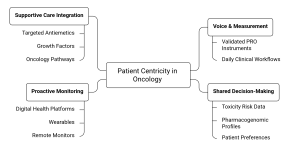
THE FOUR DIMENSIONS OF PATIENT CENTRICITY IN CHEMO TOXICITY MANAGEMENT
Dimension 1 — Voice & Measurement
Systematically capturing what patients feel through validated patient-reported outcome (PRO) instruments integrated into the clinical workflow, not just as research endpoints.
Dimension 2 — Shared Decision-Making
Using toxicity risk data, pharmacogenomic profiles, and patient preferences to co-develop treatment plans that balance efficacy against the patient's unique tolerance threshold.
Dimension 3 — Proactive Monitoring
Deploying digital health tools, wearables, and remote monitoring platforms to detect adverse events early — before clinical severity forces dose reductions or treatment discontinuation.
Dimension 4 — Supportive Care Integration
Embedding evidence-based supportive care — antiemetics, growth factors, neuroprotective strategies — into every oncology treatment pathway as a standard of care, not an afterthought.
A 2024 paper published in JCO Clinical Cancer Informatics (Gibbons, Baas, Chung) introduced the concept of "digital toxicity" — the unintended burden created by poorly designed digital health tools themselves, highlighting that patient-centric design must also protect patients from digital overload and tool fragmentation.
SECTION 03 — MEASURING WHAT MATTERS: PATIENT-REPORTED OUTCOMES AND THE PRO-CTCAE FRAMEWORK
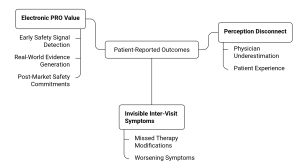
The systematic documentation of chemotoxicities in outpatient oncology settings has historically been fragmented, reactive, and clinician-subjective. Studies demonstrate a significant disconnect between physician-graded toxicity and patient experience: a key finding from Zagreb (University Hospital for Tumors) in early breast cancer showed that physicians consistently underestimate the severity and frequency of side effects as perceived by patients.
The PRO-CTCAE (Patient-Reported Outcomes version of the Common Terminology Criteria for Adverse Events) tool, developed by the National Cancer Institute, offers a validated, standardized framework to capture patient-experienced symptoms across 124 symptomatic adverse events in 78 items. Research demonstrates that incorporating PRO-CTCAE into ambulatory oncology workflows is feasible, acceptable, and clinically meaningful.
THE PHYSICIAN-PATIENT PERCEPTION GAP
A striking pattern emerges from the literature: physicians systematically grade toxicities as less severe than patients rate them. This discrepancy has real consequences. Treatment decisions — dose modifications, supportive agent additions, cycle delays — that would be clinically appropriate based on patient experience are never triggered because the clinical team does not know what the patient is experiencing between visits.
For pharma leaders, this gap represents both a patient safety risk and an opportunity: integrating electronic PRO (ePRO) collection into clinical operations and real-world evidence (RWE) programs can fundamentally improve safety signal detection, label updates, and post-market commitments.
SECTION 04 — DIGITAL TRANSFORMATION: DIGITAL HEALTH AS A FORCE MULTIPLIER
The oncology digital health ecosystem has matured significantly since 2020. From remote patient monitoring platforms and AI-powered symptom triage to digital therapeutics (DTx) that address treatment-related side effects, technology is reshaping how toxicity is detected, reported, and managed in real time.
AI-POWERED PREDICTIVE MONITORING
In 2024, AI-powered radiomics achieved 89% accuracy in predicting immunotherapy response, compared to 60% for conventional methods. Platforms from RadNet, Siemens Healthineers, and RaySearch Laboratories are transforming routine imaging into predictive tools. Several major pharmaceutical companies are already integrating real-time molecular monitoring and wearable sensor data into Phase II/III oncology trials.
DIGITAL THERAPEUTICS FOR ONCOLOGY SIDE EFFECTS
Digital therapeutics (DTx) are emerging as a validated complement to pharmacological treatment in managing oncology side effects including pain, nausea, fatigue, anxiety, and depression. The DTx Alliance's 2024 Refresh report highlights that these tools can detect adverse events earlier — enabling management before severity escalates to permanent treatment discontinuation.
Wearables flag the symptom.
AI decides if it's a signal worth acting on.
Here's how AI is already reshaping pharmacovigilance — and what that means for oncology drug safety.
→ Read: AI in Pharmacovigilance: Drug Safety
SECTION 05 — PRECISION PREVENTION: PHARMACOGENOMICS AND TOXICITY PREDICTION
The most effective chemo toxicity management strategy is prevention. Pharmacogenomics — the study of how genetic variation influences drug response — is rapidly transitioning from research curiosity to clinical standard. The 2025 NCCN Clinical Practice Guidelines now recommend discussing DPYD genetic variant testing prior to fluoropyrimidine therapy (5-FU, capecitabine), given that DPYD polymorphisms alter dihydropyrimidine dehydrogenase activity and dramatically increase toxicity risk.
A 2024 JCO Global Oncology study on predictive factors of CIPN in breast cancer generated a decision tree model identifying marital status, BMI, C-reactive protein (CRP), and neutrophil-to-lymphocyte ratio (NLR) as key pre-treatment predictors — with a CIPN prevalence of 64.7% in the highest-risk group.
STRATEGIC IMPLICATION: Embedding pharmacogenomic testing recommendations and companion diagnostics into drug labels and clinical development programs is no longer optional. It is the evidence-based pathway to reducing serious adverse event rates, avoiding treatment discontinuation, and demonstrating genuine commitment to patient-centric oncology.
SECTION 06 — TRIAL INNOVATION: PATIENT-CENTRIC CLINICAL TRIAL DESIGN
The conventional oncology clinical trial model — frequent site visits, complex protocols, intravenous administration — creates a significant participation barrier and exacerbates what researchers now term "logistic toxicity": the cascade of scheduling conflicts, travel burdens, lost wages, and caregiver strain that clinical trial participation imposes on patients and families.
Data from GlobalData's Clinical Trials database shows that new cancer trials increased 92% between 2010 and 2024. The proportion of cancer trials incorporating at least one element of decentralization has doubled from 2015 to 2024, with telemedicine as the leading element.
KEY CONTEXT: Of 5,700+ oncology drugs in development, over two-thirds are injectables with 67% as IV infusions — creating inherent site-visit dependencies that limit decentralization options. Oral dosage forms account for 30% of pipeline therapies.
SECTION 07 — STANDARDS OF SUPPORTIVE CARE: THE EVIDENCE BASE
CHEMOTHERAPY-INDUCED NAUSEA AND VOMITING (CINV)
Chemotherapy-induced nausea and vomiting (CINV) affects 70–80% of patients and remains one of the most feared treatment-related toxicities. Modern antiemetic regimens — combining 5-HT3 receptor antagonists (ondansetron, palonosetron), NK1 receptor antagonists (aprepitant, fosaprepitant), and dexamethasone — have significantly improved complete response rates. NCCN guidelines mandate risk-stratified antiemetic prophylaxis.
CHEMOTHERAPY-INDUCED PERIPHERAL NEUROPATHY (CIPN)
CIPN remains one of the most burdensome and poorly managed long-term toxicities. Unlike CINV, there is currently no FDA-approved neuroprotective agent. Duloxetine (an SNRI) holds the strongest evidence for treatment of established CIPN pain. Dose reduction or discontinuation is often required — highlighting the critical importance of early detection through PRO monitoring.
FEBRILE NEUTROPENIA (FN)
Febrile neutropenia is a medical emergency associated with significant morbidity and mortality. Primary prophylaxis with G-CSF (filgrastim, pegfilgrastim) is recommended by ASCO, NCCN, and EORTC guidelines for regimens carrying >20% FN risk.
SECTION 08 — REGULATORY & COMMERCIAL LANDSCAPE
From July 1, 2024, to June 30, 2025, the US FDA approved 20 new therapeutics for various cancer types — all under frameworks increasingly incorporating patient-focused drug development (PFDD) guidance. The FDA's four PFDD guidance documents (2018–2022) formally established that drug developers must collect, analyze, and incorporate patient experience data, including PROs, into regulatory submissions.
REGULATORY NOTE: The NCCN's new recommendation for DPYD testing before fluoropyrimidine therapy mirrors a broader regulatory movement: agencies expect sponsors to proactively characterize pharmacogenomic risk in label language. Building genetic testing into clinical development programs is now a best-practice expectation.
MARKET ACCESS IMPLICATIONS
Payers are increasingly scrutinizing oncology supportive care costs. Drug manufacturers who can demonstrate that their therapies produce fewer severe toxicities — through rigorous PRO data, lower hospitalization rates, and higher treatment adherence — carry a compelling pharmacoeconomic narrative in HTA submissions and payer negotiations.
CIPN market size: ~$1.5B in 7MM (2022) | Projected CAGR: 3.1% through 2032 (DelveInsight, 2023)
PRO data catching toxicity signals is only half the equation.
The other half is building a pharmacovigilance system that turns safety intelligence into commercial advantage.
→ Read: Good Pharmacovigilance Practices: From Compliance to Growth Strategy in Pharma
FAQs
Q1. What is the single highest-impact step pharma companies can take to improve patient centricity in oncology drug development?
Integrate validated patient-reported outcome (PRO) instruments as key secondary or co-primary endpoints from Phase I onwards. Most early-phase oncology trials still rely exclusively on physician-graded CTCAE data, which systematically underestimates patient-experienced toxicity. Embedding PRO-CTCAE or disease-specific HRQoL instruments captures the patient voice structurally, generates regulatory-grade evidence, and enables commercially differentiated labeling in a crowded therapeutic landscape.
Q2. How significant is CIPN as a clinical and commercial burden?
CIPN affects between 17% and 83% of patients depending on the neurotoxic agent used (highest with platinum agents and taxanes). A 2025 Mayo Clinic meta-analysis (D'Souza et al., Regional Anesthesia & Pain Medicine) drawing on 76 studies from 29 countries found that nearly half (49%) of patients with CIPN experience chronic moderate-to-severe symptoms lasting three months or longer. With no FDA-approved neuroprotective agent currently available, the unmet need is enormous — and the CIPN treatment market is projected to grow significantly through 2032.
Q3. What does "digital toxicity" mean and why should pharma leaders care?
"Digital toxicity" — a concept formally introduced in JCO Clinical Cancer Informatics (Gibbons et al., 2024) — refers to the unintended burden imposed on patients and clinicians by poorly designed or fragmented digital health tools. This includes alert fatigue, cognitive overload from multiple disconnected apps, and data privacy concerns. Pharma leaders investing in digital health oncology platforms must mandate user-centered design principles, HCP workflow integration, and formal digital toxicity impact assessments.
Q4. Is pharmacogenomic testing for chemotherapy toxicity now a regulatory expectation?
Yes, increasingly so. The 2025 NCCN Guidelines now formally recommend discussing DPYD genetic variant testing before fluoropyrimidine therapy. The FDA has already incorporated UGT1A1 guidance into the irinotecan label. Expect this trajectory to continue: sponsors who proactively characterize pharmacogenomic risk factors will be better positioned for regulatory and market access success.
Q5. What is the strategic value of decentralized oncology trials from a patient-centricity perspective?
Decentralized clinical trials (DCTs) in oncology directly address the "logistic toxicity" burden — the cascade of travel, scheduling, and financial stressors that clinical trial participation imposes. With DCT adoption doubling from 2015 to 2024 (telemedicine as the leading element), decentralization improves trial diversity and representativeness, reduces attrition, and generates data that better reflects real-world patient populations. For pharma sponsors, this translates to more robust evidence, faster enrollment, and a credible patient-centricity narrative for regulatory, HTA, and payer audiences.
REFERENCES & CITATIONS
1. D'Souza RS, Saini C, Hussain N, et al. Global estimates of prevalence of chronic painful neuropathy and moderate-to-severe neuropathy among patients with chemotherapy-induced peripheral neuropathy: a systematic review and meta-analysis of data from 29 countries between 2000 and 2024. Regional Anesthesia & Pain Medicine. Published online December 4, 2025. doi:10.1136/rapm-2024-106229
2. Wiranata JA, Hutajulu SH, Astari YK, et al. Patient-reported outcomes and symptom clusters pattern of chemotherapy-induced toxicity in patients with early breast cancer. PLOS ONE. 2024;19(2):e0298928. doi:10.1371/journal.pone.0298928
3. Gibbons C, Baas C, Chung C. Emergence of Digital Toxicity and the Need for an Integrated, Patient-Centric Approach to the Development, Evaluation, and Use of Digital Health Tools for Oncology. JCO Clinical Cancer Informatics. 2024;8:e2300105.
4. AACR Cancer Progress Report 2025. Unifying Cancer Science and Medicine: A Continuum of Innovation for Impact. American Association for Cancer Research; 2025. cancerprogressreport.aacr.org
5. NCCN Clinical Practice Guidelines in Oncology 2025 Updates — Colorectal Cancer, Small Cell Lung Cancer. ASCO Post summary, May 2025.
6. Maqdasawi A, Ghanayiem R, Khalaf M, et al. Chemotherapy-induced side effects burden in Palestinian hospitals: a cross-sectional study. BMC Cancer. 2025;25:1149.
7. Basch E, Reeve BB, Mitchell SA, et al. Routine Surveillance of Chemotherapy Toxicities Using PRO-CTCAE. PMID: 32700029. 2020.
8. DelveInsight. A Comprehensive Analysis of the Chemotherapy-induced Complications Market Outlook by 2032. October 2023.
9. Flora DB. The Top 10 AI in Precision Oncology Stories of 2024. AI in Precision Oncology. 2025. doi:10.1089/aipo.2025.ed
10. Alcimed. Patient-centered cancer care: emerging trends in oncology. December 2025. alcimed.com
11. Clinical Trials Arena. Community-based research in oncology: Balancing patient centricity with complexity in cancer trials. October 2025.
12. IDEA Pharma. A Review of Four Promising Digital Health Solutions in Oncology. DTx Alliance, 2024 Refresh.
13. D'Souza RS et al. (Mayo Clinic). Global estimates of CIPN prevalence. Reg Anesth Pain Med. 2025. PMID 39880412.
14. NRG Oncology/NSABP B-30. Toxicity Index, patient-reported outcomes, and persistence of breast cancer chemotherapy-associated side effects. npj Breast Cancer. November 2022. doi:10.1038/s41523-022-00489-9
15. University Hospital for Tumors, Zagreb. Difference in Estimation of Side Effects of Chemotherapy between Physicians and Patients. PMC. 2021. PMC8657299.
16. JCO Global Oncology. Predictive Factors of Chemotherapy-Induced Peripheral Neuropathy in Breast Cancer: A Decision Tree Model Approach. 2024. doi:10.1200/GO.24.00160
© 2026 Managing Editor Intelligence. All rights reserved.
This report is intended for pharmaceutical and healthcare leadership audiences. Clinical decisions must be made in consultation with qualified oncology professionals.