by Mrudula Kulkarni
11 minutes
Quantifying the ROI: Do AI Chemistry Platforms Actually Reduce Pharma R&D Costs?
AI drug discovery raised billions in deals. Deloitte's 2026 report found the ROI "hasn't been realized at scale" yet. Here's why.
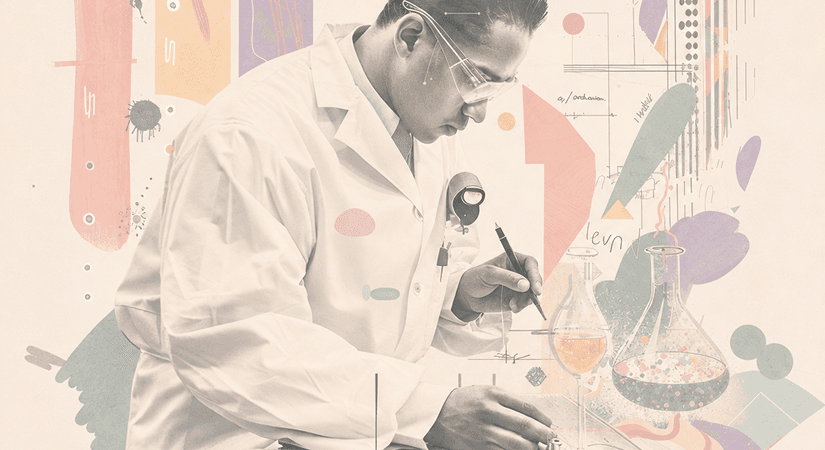
Imagine spending over two and a half billion dollars and a decade of human effort — only to watch your candidate fail in Phase III. This is not a hypothetical. It is the baseline reality of modern pharmaceutical R&D.
According to Deloitte's 16th Annual Pharmaceutical Innovation Report (published May 2026), the average cost of developing a single drug asset among the top 20 global biopharmaceutical companies reached $2.671 billion in 2025 — a significant 20% jump from $2.229 billion the previous year. The industry spent $7.7 billion in 2024 alone on clinical trials for assets that were ultimately terminated.
Phase III clinical trial cycle times increased by 12% between 2023 and 2024. Total development time now exceeds 100 months from Phase I to regulatory filing. The Phase I drug success rate has plummeted to just 6.7% in 2024, compared to 10% a decade ago.
Against this backdrop, AI chemistry platforms are positioned as the most transformative force in pharmaceutical R&D since combinatorial chemistry. But pharma leaders are right to ask the hard question: Does the ROI hold up under scientific scrutiny — or is it still a promise on paper?
A Critical Caveat from Deloitte Before We Go Further
The Deloitte 16th Annual Report (May 2026) includes a finding that every pharma leader must read before evaluating AI drug discovery ROI: AI's promise to significantly reduce development time and costs "has not yet been realized at scale, largely due to a pilot-driven, function-by-function approach."
This is not a dismissal of AI. It is a structural diagnosis. Organizations that have deployed AI in isolated pockets — one tool for virtual screening here, one model for ADMET prediction there — are not capturing systemic ROI. The value lies in end-to-end integration. With this lens in place, the rest of this analysis makes more sense.
Setting the Stage: What Are AI Chemistry Platforms?
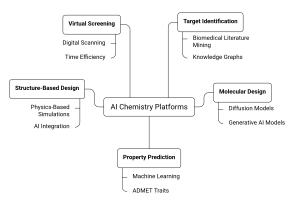
AI chemistry platforms are integrated computational systems that combine machine learning, deep learning, physics-based molecular simulation, and generative models to accelerate the drug discovery and optimization pipeline. They operate across several interconnected functions:
- Target identification using knowledge graphs and biomedical literature mining
- Molecular design and generation via generative adversarial networks, variational autoencoders, and diffusion models
- Property prediction for ADMET (absorption, distribution, metabolism, excretion, toxicity)
- Structure-based drug design combining AI with molecular dynamics and free-energy perturbation calculations
- Virtual screening of billions of chemical compounds without physical synthesis
The leading platforms in 2025–2026 span a spectrum of approaches, as reviewed in Pharmacological Reviews (Volume 78, Issue 1, January 2026), which critically compared five paradigms: generative chemistry, phenomics-first systems, integrated target-to-design pipelines, knowledge-graph repurposing, and physics-plus-machine learning design.
The ROI Numbers: What the Data Actually Shows
Table 1: AI vs. Traditional Drug Discovery — Key Performance Metrics (2025–2026)
Metric | Traditional R&D | AI-Assisted R&D | Improvement |
|---|---|---|---|
Average Time to IND Filing | 10–15 years | 3–6 years | 40–60% faster |
Preclinical Cost Reduction | Baseline | 30–70% lower | Significant |
Overall Cost Reduction | Baseline | 25–40% lower | Meaningful |
Phase I Success Rate (AI programs) | 40–65% | 80–90% | +20–30 points |
Phase II Success Rate (AI programs) | 30–45% | 65–75% | +20–30 points |
Clinical Trial Cost Savings | Baseline | Up to 70% per trial | High |
Trial Timeline Reduction | Baseline | Up to 80% | High |
AI R&D Market Size (2025) | — | $1.94 billion | CAGR 27% to 2034 |
Sources: Axis Intelligence AI Drug Discovery 2026; Scilife 2024; Nature Biotechnology 2025; Pharmacological Reviews 2026
Important note: The Phase I success rate improvements reflect early-stage evidence from platforms with rigorous candidate selection — not yet a population-level benchmark. The clinical dataset of AI-originated molecules remains limited (173 programs in clinical development globally as of 2026), and these projections should be interpreted accordingly.
Platform-by-Platform ROI Evidence
1. Insilico Medicine — The First AI-to-Clinic Molecule
Insilico Medicine's rentosertib (ISM001-055), developed for idiopathic pulmonary fibrosis, became one of the most cited proofs of concept in AI-driven drug discovery. Developed using the company's proprietary Pharma.AI platform, the molecule progressed from target identification to Phase IIa clinical trials with published efficacy data in Nature Medicine (2025) — a milestone that would have taken conventional methods significantly longer.
The cumulative commercial validation arrived when Eli Lilly signed a partnership with Insilico including $115 million upfront and up to $2.75 billion in total milestone payments (March 2026). Earlier, in January 2026, Qilu Pharmaceutical entered a strategic collaboration valued at nearly $120 million to develop small molecule inhibitors for cardiometabolic diseases using Insilico's Pharma.AI platform. These deal structures signal that large pharma is not merely experimenting — they are paying for proven AI chemistry infrastructure.
2. Recursion Pharmaceuticals + Exscientia — A $688M Bet on Integration
In November 2024, Recursion Pharmaceuticals completed its $688 million all-stock acquisition of Exscientia, creating one of the most vertically integrated AI drug discovery platforms in the world. The merger combined Exscientia's precision generative chemistry with Recursion's automated cell-imaging phenomics and deep learning validation system.
The strategic thesis: by combining molecular design AI with high-throughput biological validation, the platform compresses the traditional design-make-test-analyze (DMTA) cycle from months to weeks. This integration is precisely the architecture required for genuine pharma R&D cost reduction at scale — the kind of end-to-end deployment that Deloitte's 2026 report identifies as the prerequisite for realizing AI's ROI.
3. Schrödinger — Physics-Based AI for Binding Precision
Schrödinger exemplifies the physics-plus-ML approach to computational chemistry platforms. Founded in 1990, the company has built a suite of tools — including Glide (molecular docking), FEP+ (free-energy calculations), LiveDesign (collaborative design), and BioLuminate (biologics) — and has progressively integrated machine learning to enhance their predictive accuracy.
The result is a platform capable of predicting binding affinity with high precision when target structures are available — directly reducing the number of compounds that must be synthesized and tested. Schrödinger serves all top 20 pharmaceutical companies by revenue, with several having standardized on the platform as a core component of their preclinical research. This translates to measurable reductions in wet lab expenditure, though published per-program ROI figures remain proprietary.
4. AlphaFold 3 and Isomorphic Labs — Structure Unlocks Discovery
DeepMind's AlphaFold 3 (published in Nature, May 2024) dramatically expanded the AI molecular design landscape by extending predictions beyond protein folding to protein-ligand, protein-DNA, and protein-RNA interactions. AlphaFold 3 demonstrated 50% greater accuracy than the best traditional molecular docking methods on the PoseBusters benchmark for predicting drug-binding poses — without requiring input structural information.
By 2026, AlphaFold 3 has been integrated into virtually every major AI drug discovery pipeline, enabling binding site prediction, off-target risk assessment, and the targeting of previously "undruggable" protein-protein interactions. Isomorphic Labs — DeepMind's commercial spinoff — signed a multi-target research collaboration with Johnson & Johnson on January 20, 2026, marking its transition from open-science tool to commercial ROI generator.
5. NVIDIA BioNeMo — Infrastructure for Generative Chemistry at Scale
NVIDIA's BioNeMo platform represents the computational infrastructure layer underpinning generative chemistry AI. Released as an open-source framework in late 2024, BioNeMo provides domain-specific data loaders, training recipes, and NIM (NVIDIA Inference Microservices) containers for tasks spanning protein structure prediction, molecular design, and virtual screening.
Drug discovery teams can train foundation models on DNA, RNA, protein, and small-molecule data, then deploy them via BioNeMo Blueprints and NIM containers — dramatically reducing the time and infrastructure cost required to operationalize machine learning drug discovery capabilities internally. This is the infrastructure layer that makes end-to-end AI integration economically feasible for mid-sized biotechs.
Five major platforms, one fraction of the field. Here are 19 more startups shaping AI-driven drug discovery right now.
→ 19 Pharma Startups Shaping AI-Driven Drug Discovery
Where the Savings Actually Come From: A Stage-by-Stage Analysis
Table 2: AI Cost Impact Across the Drug Development Pipeline
R&D Stage | Traditional Cost Driver | AI Intervention | Reported Savings |
|---|---|---|---|
Target Identification | Literature review, genetic studies | Knowledge graphs, NLP | 40–60% time reduction |
Hit Generation | HTS screening of large compound libraries | Virtual screening, generative design | Up to 70% compound synthesis reduction |
Lead Optimization | Iterative synthesis cycles | ADMET prediction, free-energy calculations | 30–50% cycle compression |
Preclinical ADMET | In vivo/in vitro testing panels | Predictive toxicology models | 25–40% cost reduction |
Clinical Trial Design | Manual patient recruitment | AI-powered biomarker stratification | 20–50% recruitment time reduction |
Phase I–III | High attrition at each gate | Better candidate selection | +20–30% success rate improvement |
Sources: McKinsey 2024; Deloitte 2023; Scilife 2024; AllAboutAI Drug Development Statistics 2026
The most significant savings concentrate in two areas: early-stage molecule generation (where AI can explore chemical space without synthesis cost) and clinical trial optimization (where better patient selection reduces attrition and wasteful expenditure).
McKinsey's 2024 report confirmed that over 70% of pharmaceutical executives say their organizations have made significant investments in AI applications, particularly in drug discovery and clinical trial optimization. Deloitte's analysis found that AI-powered patient recruitment platforms reduced trial startup times by 20 to 50% — a meaningful lever given that recruitment delays are among the most expensive variables in Phase II and III programs.
The Hidden Costs: What ROI Frameworks Must Account For
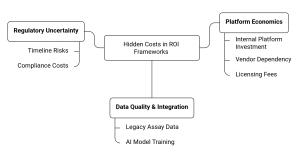
No responsible analysis of AI chemistry platform ROI can omit the cost side of the ledger. Pharma leaders must stress-test vendor claims against three categories of hidden cost.
1. Platform Build vs. Buy vs. Partner Economics
According to Axis Intelligence's 2026 drug discovery analysis, the decision framework maps to program volume:
- Build internally (20+ programs/year): Investment of $50–200 million; ROI positive in 12–24 months
- License platforms (5–20 programs/year): $500K–$5M/year; lower upfront, vendor dependency risk
- Partnership deals (1–5 programs/year): $5–50M deals; IP complications must be managed contractually
2. Data Quality and Integration Costs
AI models are only as good as their training data. Organizations without structured, high-quality proprietary assay data face substantial investment in data curation before platform deployment generates ROI. This cost is rarely quantified in vendor case studies — and is a primary reason Deloitte's 2026 report found that AI ROI has not been realized at scale.
3. Regulatory Uncertainty
While FDA guidance on AI submissions is evolving positively — with 500+ AI submissions now on record — regulatory uncertainty still represents a risk multiplier that affects timeline projections. An AI-designed molecule must pass the same regulatory standards as any other candidate.
Market Trajectory: The Investment Case for AI Drug Discovery
The macroeconomic context is compelling. The AI drug discovery market reached $1.94 billion in 2025 and is projected to grow to $16.49 billion by 2034, at a compound annual growth rate of 27%. Pharma AI spend broadly is expected to grow from $4 billion in 2025 to $25 billion by 2030.
Critically, only 10.7% of companies have fully implemented AI across clinical activities as of 2026 — leaving substantial first-mover advantage for organizations that move decisively. Over 173 AI-discovered drug programs are currently in clinical development, with 15–20 expected to enter pivotal trials in 2026. Partnerships between traditional pharma and AI technology firms increased approximately 30% from 2022 to 2024, signaling that the industry has moved past proof-of-concept into systematic integration.
Case Study: The Real-World ROI Calculation
Consider a mid-sized pharmaceutical company running eight programs per year. Using conservative published benchmarks:
Table 3: Illustrative ROI Model — AI Chemistry Platform Adoption (Mid-Pharma)
Cost Category | Without AI | With AI Platform | Annual Delta |
|---|---|---|---|
Hit-to-lead synthesis cost | $4.8M | $2.9M | -$1.9M |
ADMET testing panels | $3.2M | $2.0M | -$1.2M |
Failed Phase I write-offs | $45M | $31.5M (30% attrition reduction) | -$13.5M |
Clinical recruitment delays | $12M | $7.2M | -$4.8M |
Platform license cost | — | $3.5M | +$3.5M |
Net Annual Savings | ~$17.9M | ||
5-Year ROI (conservative) | ~3–5x |
Model based on published benchmarks from Axis Intelligence 2026, McKinsey 2024, and Deloitte 2023. Results will vary by therapeutic area, data quality, and program complexity. This model assumes integrated — not siloed — AI deployment.
For large pharma with program volumes exceeding 20 per year, Axis Intelligence estimates 5–10x ROI over five years — primarily driven by attrition reduction and timeline compression at the preclinical-to-IND transition.
The Attrition Imperative: Why AI ROI Is Primarily an Attrition Story
The single most important insight for pharma leaders is this: the ROI of AI chemistry platforms is primarily an attrition story, not a synthesis cost story.
The Deloitte 2025 report (15th annual) identified attrition as a primary driver of cost escalation. In 2024, the industry's top 20 companies spent $7.7 billion on trials for candidates that were terminated. The Phase I success rate of 6.7% means that for every 15 molecules entering the clinic, roughly 14 will fail — each carrying years of accumulated investment.
AI platforms that improve candidate selection quality — by predicting off-target toxicity, metabolic instability, and mechanism-based failures before clinical entry — generate outsized ROI not by making individual experiments cheaper, but by increasing the probability that the candidates reaching the clinic are the right ones.
Published data from AI-assisted programs shows Phase I success rates of 80–90% versus the industry baseline of 40–65%. This differential, compounded across a portfolio, has the potential to transform the economics of drug development — though pharma leaders should note this is still early-stage evidence.
Better candidate selection isn't a theory — it's already happening. Here are 5 real-world case studies proving it.
→ How AI Improves Predictability in Drug Development
Regulatory Tailwinds Strengthening the ROI Case
The FDA's evolving framework for AI submissions is a critical enabler. With over 500 AI-related submissions now on record, the agency is developing standardized requirements that reduce regulatory uncertainty — one of the most significant hidden costs in AI-assisted programs.
This regulatory maturation is allowing AI-designed molecules to follow expedited development pathways in some cases, further compressing the timeline from discovery to IND.
The Verdict for Pharma Leaders
The evidence base for AI chemistry platform ROI has matured considerably from 2022 to 2026. What was once theoretical modeling is now backed by clinical data, billion-dollar partnership deals, and independent academic reviews. But the Deloitte 16th Annual Report delivers a sobering structural finding: AI's promise "has not yet been realized at scale" across the industry — and rising per-asset drug costs to $2.671 billion in 2025 confirm that macroeconomic pressure is intensifying, not easing.
The ROI is real — but it is not automatic. It is highest for organizations that deploy AI end-to-end across the pipeline, have structured proprietary data assets, sufficient program volume, and the computational talent to validate model outputs. It is lowest for organizations treating AI as a plug-and-play cost cutter without the foundational infrastructure it requires.
The strategic conclusion is clear: the 89.3% of pharma organizations that have not yet fully implemented AI-driven R&D across clinical activities are leaving measurable competitive advantage on the table. In a landscape where the average drug now costs $2.671 billion to develop and the Phase I success rate is 6.7%, the question is no longer whether to invest in AI chemistry platforms — it is how to build the integrated infrastructure that makes that investment pay off.
Frequently Asked Questions
Q1: Can small and mid-size biotech firms achieve positive ROI from AI chemistry platforms, or is this only for large pharma?
The ROI calculus depends heavily on program volume and data assets. Mid-sized firms running 5–10 programs per year can achieve positive ROI through platform licensing ($500K–$5M/year) within 18–36 months, particularly in hit generation and ADMET prediction where generic models can substitute for proprietary training data. Partnership structures with platforms like Insilico, Recursion, or Schrödinger can provide access without requiring internal AI infrastructure investment.
Q2: How long does it realistically take to see cost savings after implementing an AI chemistry platform?
For platform licensing with existing vendor models, cost savings in virtual screening and hit prioritization can be realized within 6–12 months. For internally built platforms requiring proprietary model training, the timeline extends to 18–36 months before meaningful ROI materializes. Deloitte's 2026 report cautions that siloed, function-by-function AI adoption delays this timeline considerably.
Q3: Are the success rate improvements for AI-originated molecules in clinical trials scientifically validated, or based on limited data?
This is the most important caveat for pharma leaders. Published Phase IIa data from molecules like Insilico's rentosertib (ISM001-055) demonstrates efficacy — but the overall AI drug discovery clinical dataset remains small (173 programs globally as of 2026). Success rate projections of 80–90% in Phase I reflect early-stage evidence from platforms with rigorous candidate selection. Larger datasets will be required before these figures can be treated as population-level benchmarks.
Q4: What is the risk of vendor dependency when licensing AI chemistry platforms?
Vendor dependency is a real and quantifiable risk. The 2024 acquisition of Exscientia by Recursion demonstrates the consolidation dynamics in this sector. Organizations licensing AI platforms should negotiate data portability, IP ownership of generated molecules, and transition provisions into their contracts. Running parallel internal capability development alongside vendor licensing mitigates single-point-of-failure risk.
Q5: How should pharma boards evaluate AI chemistry platform investments differently from traditional R&D capital allocation?
AI chemistry platforms should be evaluated as infrastructure investments with portfolio-level returns, not as individual project expenditures. The relevant ROI metric is not cost savings on a single molecule but the improvement in portfolio-wide probability of technical success (PTS). Boards should require vendors to demonstrate molecules in clinical stages — not just preclinical — and should benchmark claimed success rates against the published literature from Pharmacological Reviews, Nature Biotechnology, and the Journal of Chemical Information and Modeling.
References and Citations
- Deloitte Centre for Health Solutions. Measuring the Return from Pharmaceutical Innovation 2024 (15th Annual Report). Published March 2025.
- Deloitte Centre for Health Solutions. Navigating the GLP-1 Boom: Measuring the Return from Pharmaceutical Innovation 2025 (16th Annual Report). Published May 2026.
- Pharmacological Reviews, Volume 78, Issue 1, January 2026. "Leading Artificial Intelligence–Driven Drug Discovery Platforms: 2025 Landscape and Global Outlook."
- Nature Biotechnology, 2025. AI-Assisted Drug Development Timeline Analysis.
- Nature Medicine, 2025. Rentosertib (ISM001-055) Phase IIa Clinical Efficacy Data.
- Axis Intelligence. AI Drug Discovery 2026: Complete Analysis — 173 Programs, FDA Framework & Market. December 2025.
- IntuitionLabs. Measuring AI ROI in Drug Discovery: Key Metrics and Outcomes. April 2026.
- McKinsey & Company. AI Adoption in Pharmaceutical Industry Report, 2024.
- Scilife. "Using AI in Clinical Trials: Cost Savings and Timeline Reductions." 2024.
- AllAboutAI Resources. AI in Drug Development Statistics 2026: The $60 Billion Reality vs. Hype Analysis. January 2026.
- PRNewswire / Insilico Medicine. "Insilico Medicine and Qilu Pharmaceutical Reach Near $120 Million Drug Development Collaboration." January 27, 2026.
- EurekAlert. "Insilico Medicine and Qilu Pharmaceutical Sign Cardiometabolic Drug Discovery Deal." January 27, 2026.
- ScienceDirect. "Leading Artificial Intelligence–Driven Drug Discovery Platforms: 2025 Landscape and Global Outlook." November 2025.
- Journal of Chemical Information and Modeling, 2025. "Generative AI for the Design of Molecules: Advances and Challenges." J. Chem. Inf. Model. 2025, 65, 23, 12668–12690.
- IntuitionLabs. NVIDIA BioNeMo Explained: Generative AI in Drug Discovery. March 2026.
- Springer Nature Link. "AI-Enabled Drug and Molecular Discovery: Computational Methods, Platforms, and Translational Horizons." Discover Molecules, December 2025.
- FierceBiotech. "Drug Development Cost Pharma $2.2B per Asset in 2024." March 2025.
- DrugDiscoveryTrends. "Deloitte Report: R&D Returns Rising to 7%; GLP-1s Did Most of the Work." May 2026.
- DrugDiscoveryTrends. "From 1.5% to 5.9%: Deloitte Explores What's Fueling Big Pharma's R&D IRR Climb." May 2025.
- ClinicalLeader. "Biopharma R&D Faces Productivity and Attrition Challenges in 2025." January 2025.
- PharmExec. "$25B Potential in Accelerating AI's Impact and Value in Pharma." November 2025.
- Sapio Sciences. "AI-Powered Molecular Docking: From DiffDock and BioNeMo to the Next Generation of Drug Discovery." October 2025.
- Isomorphic Labs / Johnson & Johnson. Multi-Target Research Collaboration Announcement. January 20, 2026.
- Schrödinger, Inc. Platform Overview: Glide, FEP+, LiveDesign, BioLuminate. schrodinger.com, 2026.
- Nature, May 2024. "Accurate Structure Prediction of Biomolecular Interactions with AlphaFold 3." (AlphaFold 3 / PoseBusters benchmark.)