The Patent Problem: Who Really Owns What AI Discovers in Science?
AI is discovering drugs but cannot own a patent. Explore who holds IP rights in AI-assisted pharma discovery and what your team must do.

Science has always moved forward on the shoulders of human curiosity. Researchers spend years designing experiments, forming hypotheses, running trials, and interpreting results. But today, AI systems are doing a growing share of that work, and in some cases, doing it faster than any human team ever could.
AlphaFold predicted the 3D structures of over 200 million proteins. AI drug discovery platforms like Insilico Medicine and Exscientia have advanced molecules from target identification to clinical trials in a fraction of the time it typically takes. These are not small feats. These are discoveries that could change medicine.
And yet, a critical question has gone largely unanswered: Who owns them?
This is not a theoretical debate. It sits at the intersection of patent law, intellectual property rights, scientific ethics, and the future of pharmaceutical and biotech innovation. The answer will shape how companies invest in AI, how universities protect their research, and how discoveries get commercialised.
The Core Legal Problem
Most intellectual property law around the world was written with one assumption built in: that inventors are human.
In the United States, the Patent Act requires that a patent application name a natural person as the inventor. The same principle holds in Europe under the European Patent Convention (EPC), and in most other jurisdictions globally. An AI system, however sophisticated, cannot be named an inventor because it lacks legal personhood.
This was tested directly in the DABUS cases (2019–2023), where inventor Stephen Thaler attempted to list an AI called DABUS as the sole inventor on patent applications filed in multiple countries. Courts and patent offices in the US, UK, EU, and Australia all rejected the applications. The UK Supreme Court's 2023 ruling made clear: under current law, inventors must be human.
So, where does that leave discoveries made primarily by AI?
Four Possible Ownership Scenarios
When an AI system contributes to a scientific discovery, ownership typically falls into one of four categories depending on how the discovery was made and who deployed the system.
The critical distinction courts and patent examiners are increasingly focusing on is the level of human intellectual contribution. If a researcher simply pressed "run" on an AI model and accepted the output without meaningful scientific judgment, that may not qualify as inventorship. If, however, a scientist designed the experiment, interpreted the AI's output, and made meaningful decisions about how to apply it, they likely qualify as an inventor.
What the Pharma and Biotech Industry Is Doing Right Now
Pharmaceutical and biotech companies are not waiting for legislatures to catch up. They are already navigating this problem through a combination of legal strategy, internal policy, and contractual frameworks.
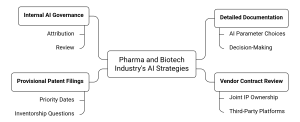
Key industry practices currently in use:
- Detailed documentation of human contribution: Companies using AI in drug discovery are training scientists to keep meticulous records of every decision point, which parameters they chose, why they selected certain outputs, and how they validated results. This paper trail supports inventorship claims.
- Vendor contract review: Organisations using third-party AI platforms are scrutinising the IP clauses in licensing agreements, since some platforms claim joint ownership or license-back rights on discoveries made using their tools.
- Provisional patent filings as early anchors: Companies are filing provisional applications quickly to establish priority dates, even before full inventorship questions are resolved.
- Internal AI governance policies: Large pharma companies, including AstraZeneca, Pfizer, and Novartis, have developed internal guidelines that define how AI-assisted discoveries are documented, reviewed, and attributed.
The Inventorship Test: Checklist for AI-Assisted Discoveries
If your organisation is involved in AI-assisted research, the following checklist can help assess whether a human inventorship claim is defensible.
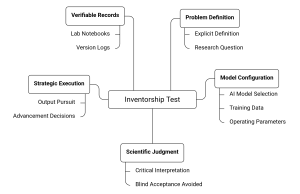
Inventorship Defensibility Checklist
- Did a human define the scientific problem or research question?
- Did a human select or configure the AI model, training data, or parameters?
- Did a human evaluate and interpret the AI's output with scientific judgment?
- Did a human make a decision about which outputs to pursue and why?
- Are contemporaneous lab notebooks, electronic records, or version logs available to document this?
- Has legal counsel reviewed the terms of service of any third-party AI platform used?
- Is the human contributor's role specific and documented, not just supervisory?
- Has the organisation's IP team been involved before any public disclosure?
Passing most of these checkpoints substantially strengthens a patent application naming human inventors.
Copyright vs. Patent: Two Different Problems
Ownership of AI-generated scientific content falls under two distinct legal frameworks that are often conflated.
Patents protect inventions — a new molecule, a new synthesis process, a new drug formulation. For a patent to be valid, there must be a qualifying human inventor.
Copyright protects creative expression — a written research paper, a software algorithm, a graphical data visualisation. In 2023, the US Copyright Office confirmed that works produced entirely by AI without human creative input are not eligible for copyright protection. However, works in which a human makes meaningful creative choices about how AI output is selected, arranged, or expressed may qualify for copyright, with the human listed as the author.
This distinction matters enormously for pharma companies publishing AI-generated research, filing regulatory documents that include AI-generated analyses, or developing AI-written clinical study protocols.
Emerging Regulatory and Legislative Signals
Lawmakers are beginning to respond, though slowly.
In the United States, the USPTO published guidance in February 2024 clarifying that AI-assisted inventions are patentable, but only where a natural person has made a "significant contribution" to the conception of the invention. This is a meaningful shift it acknowledges that AI can be a contributor, but not the inventor.
In the European Union, the European Patent Office (EPO) has similarly confirmed that AI cannot be listed as an inventor, but has signalled openness to developing new frameworks as the technology evolves.
In the United Kingdom, the Law Commission launched a 2024 review examining whether UK patent law needs amendment to address AI-generated inventions, potentially through a new, lower-level IP right for AI outputs that lack a human inventor.
India, China, and Australia are each at different stages of policy development, creating a patchwork of international rules that companies operating globally must navigate carefully.
Ethical Dimensions: Beyond Ownership
The legal question of ownership is important, but it sits alongside a deeper ethical debate that the scientific community is only beginning to have.
If an AI discovers a life-saving drug candidate, should that discovery be patented at all, or should it enter the public domain to ensure broader access? If pharmaceutical companies hold exclusive rights over AI-generated discoveries made using publicly funded datasets (like genomic databases funded by taxpayers), is that fair?
There is also the question of credit and accountability. In academic science, authorship carries responsibility for the accuracy of data, for the integrity of methods, and for responding to corrections. If AI generates findings that turn out to be wrong, and no human exercises genuine oversight, who answers for it?
These questions are not abstract. They will define how regulators, funding agencies, and the public trust AI-generated science, and how quickly these discoveries can move from algorithm to approved therapy.
Owning the discovery means nothing if you can't defend the science behind it. Here's the epistemic contract AI in GxP pharma actually demands.
→ Read: The New Epistemic Contract For Artificial Intelligence In GxP Environment: Stepping Beyond Compliance Theatre
Practical Takeaways for Pharma and Biotech Teams
Whether you work in IP, regulatory affairs, research, or business development, AI ownership is now a practical operational issue. Here is where to focus:
- Involve IP counsel early — before AI tools are deployed in any research workflow, not after a discovery is made
- Audit your AI tool agreements — understand what rights you are granting or waiving when you use commercial AI platforms
- Train your scientists on documentation — human contribution must be recorded in real time, not reconstructed after the fact
- Monitor USPTO and EPO guidance — policy is evolving rapidly; last year's standard may not be this year's
- Prepare for jurisdiction-specific strategy — a patent filing approach that works in the US may need modification for Europe, China, or India
IP strategy in biopharma isn't just legal housekeeping, it's survival.
Here's the full playbook where medicine, business, and IPR law collide.
→ Read: The Intersection of Medicine, Business & IPR Law: A New Age Playbook for Biopharma Strategy
Final Thoughts
The law has not caught up with the science. That gap is real, and it creates genuine risk for companies, researchers, and institutions investing in AI-driven discovery.
What is clear today is that human contribution still matters — not just symbolically, but legally and strategically. The organisations that document it carefully, structure their AI use thoughtfully, and stay ahead of regulatory guidance will be best placed to protect what they find.
AI may be writing the next chapter of drug discovery. But for now, a human still needs to hold the pen.
Frequently Asked Questions
1. Can an AI be listed as an inventor on a patent?
No. As of today, patent laws in the US, UK, EU, and most other countries require that inventors be human. AI systems cannot hold legal rights or be named as inventors.
2. Who owns a drug discovered by AI?
Ownership generally belongs to the company or individual who deployed the AI and can demonstrate meaningful human intellectual contribution to the discovery process.
3. Does using an AI tool affect my patent rights?
It can, especially if you use a third-party AI platform. Some platform agreements include IP clauses that may affect who owns discoveries made using their tools. Always review terms of service with legal counsel.
4. Are AI-generated research papers protected by copyright?
Content generated entirely by AI without meaningful human creative input is not eligible for copyright in the US and many other jurisdictions, as confirmed by the US Copyright Office in 2023.
5. Is there any country that allows AI inventorship?
No country currently recognises AI as a legal inventor. However, several jurisdictions, including the UK, are actively reviewing whether new IP categories for AI-generated inventions should be created.
Reporting on the science, business and regulation shaping the pharmaceutical industry.
Discussion