5 Examples Of Medical Affairs Intelligence Using AI
Discover how AI is transforming Medical Affairs through 5 real-world examples from Elsevier, Clarivate, Veeva, IQVIA, and Microsoft.


Medical Affairs has always played a vital role in connecting science, healthcare professionals, and patients. But in recent years, the landscape has become far more complex. Scientific knowledge is growing at an unprecedented rate, treatment guidelines shift faster than before, and healthcare professionals need timely, reliable insights to make informed decisions.
Traditional Medical Affairs processes were never designed to absorb this volume of information. This is where artificial intelligence is reshaping the function. Rather than replacing scientific expertise, AI enhances it by helping teams analyze evidence quickly, identify trends early, and deliver scientific value with more precision.
Today, AI-supported Medical Affairs is not a future concept, it is already here, strengthening scientific communication and decision-making across the industry.
Why AI Has Become Essential In Medical Affairs Today?
The modern healthcare ecosystem moves faster than ever. New studies are published daily, real-world datasets continue expanding, treatment practices evolve quickly, and physicians expect instant scientific clarity.
Medical Affairs teams can no longer rely solely on manual review, static KOL lists, or traditional insights channels. AI has become essential because it eliminates delays, surfaces patterns hidden in data, and supports teams with a level of speed and depth no human could achieve alone.
It helps identify unmet scientific needs in real time, keeps track of emerging therapies, and ensures that medical insights are based on robust evidence rather than fragmented inputs. AI also brings consistency, every insight, every trend, and every dataset is analyzed uniformly, reducing bias and strengthening scientific accuracy.
Most importantly, AI frees Medical Affairs professionals to focus on higher-value tasks such as scientific interpretation, strategic planning, and meaningful engagement with healthcare professionals. With this broader context, here are five examples that show how AI is driving Medical Affairs intelligence today.
Here Are The 5 Examples Of Medical Affairs Intelligence Using Artificial Intelligence!
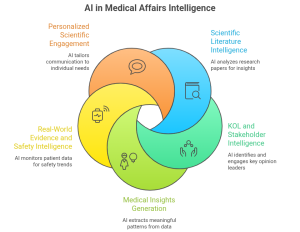
1) AI For Scientific Literature Intelligence – Example: Elsevier
Scientific literature grows too fast for manual review, and AI fills this gap by scanning, categorizing, and interpreting research at scale. Elsevier uses AI to analyze thousands of new publications, clinical trial updates, and preprints to identify patterns in emerging science.
Its systems highlight mechanism-of-action discoveries, new biomarkers, real-world data findings, and early evidence that may influence therapeutic strategies. Instead of teams spending hours reading through dense scientific papers, AI summarizes key points, flags high-impact research, and identifies contradictions that require deeper evaluation.
This makes literature monitoring faster, smarter, and more accurate. Medical Affairs teams can then invest their time in translating these findings into scientific narratives and educational materials that support physicians and improve clinical practice.
2) AI for KOL And Stakeholder Intelligence – Example: Clarivate
Understanding scientific influence has become more complex, and AI helps Medical Affairs identify both established leaders and emerging voices. Clarivate uses AI models to map expert networks by analyzing publications, citations, congress participation, research collaborations, and digital engagement.
The platform identifies not only global leaders but also rising specialists whose research impact is growing. AI helps Medical Affairs understand each stakeholder’s scientific footprint, preferred topics, collaboration networks, and thought leadership patterns.
This level of intelligence allows Medical Affairs teams to build more targeted engagement plans, organize more relevant advisory boards, and collaborate with the right experts on scientific initiatives. It replaces guesswork with evidence-backed insights, ensuring that scientific engagement is both strategic and meaningful.
3) AI For Medical Insights Generation – Example: Veeva Systems
Medical insights often arrive from multiple sources such as MSL conversations, congress sessions, digital interactions, and competitive observations. But these insights are scattered and inconsistent.
AI transforms this by organizing, prioritizing, and detecting patterns in the insights Medical Affairs teams collect. Veeva Systems uses AI-driven platforms that categorize insights automatically, detect recurring scientific questions, identify unmet education needs, and highlight emerging concerns from healthcare professionals.
The system groups thousands of insights and presents them in clear themes, allowing Medical Affairs teams to respond faster and more strategically. Instead of spending days interpreting raw notes, teams can quickly identify what matters most like unaddressed physician questions, shifts in treatment behavior, and early signs of scientific misunderstanding.
This improves decision-making and accelerates the development of educational content, field strategies, and support materials.
4) AI for Real-World Evidence and Safety Intelligence – Example: IQVIA
Real-world evidence has become a central pillar of Medical Affairs, but analyzing large datasets manually is impossible. IQVIA applies AI to millions of anonymized patient records to identify treatment patterns, safety trends, adherence challenges, and therapy outcomes.
AI models can detect signals that may not emerge in clinical trials, such as how specific patient subgroups respond differently or how comorbidities influence real-world treatment success. These insights help Medical Affairs refine benefit-risk communication and shape new scientific narratives that resonate with physicians.
AI-supported RWE analysis also strengthens safety vigilance by identifying associations that require deeper scientific investigation. The result is a Medical Affairs team that understands patient experiences more clearly and supports healthcare professionals with insights grounded in real-world data rather than assumptions.
5) AI for Personalized Scientific Engagement – Example: Microsoft In Life Sciences
Healthcare professionals want scientific information tailored to their specialty, their practice, and their patient population. AI makes this possible by analyzing past interactions, scientific preferences, prescribing patterns, and expressed educational needs.
Microsoft has partnered with life sciences organizations to build AI engines that personalize scientific content delivery. These systems predict which studies, updates, or materials a physician will find most useful and recommend them at the right time. AI also prepares Medical Affairs teams for field interactions by highlighting the topics most relevant to each stakeholder.
This shifts engagement from generic to truly personalized. Instead of presenting broad, one-size-fits-all medical decks, teams can share targeted information that supports real clinical decisions. This approach strengthens trust, improves scientific dialogue, and ensures that healthcare professionals receive high-quality information that aligns with their needs.

How AI Strengthens The Scientific Impact Of Medical Affairs?
These five examples show how deeply AI is transforming Medical Affairs. It improves scientific rigour, accelerates evidence gathering, sharpens insights, and enhances medical engagement.
Instead of drowning in data, teams can focus on scientific interpretation, strategic planning, and improving patient outcomes. AI is not replacing Medical Affairs, it is elevating it, giving professionals the tools to operate with greater clarity, speed, and impact.
Summing It Up!
AI is becoming an essential partner in Medical Affairs. From literature intelligence and KOL mapping to insight generation, RWE analysis, and personalized scientific engagement, AI is reshaping how medical teams work and how they deliver scientific value.
The five examples above illustrate how AI helps Medical Affairs stay ahead of scientific complexity and support healthcare professionals more effectively. As AI continues to evolve, Medical Affairs will become even more strategic, more informed, and more deeply connected to the real scientific needs of healthcare systems.
FAQs
1) What Does “Medical Affairs Intelligence Using AI” Mean?
Medical Affairs intelligence using AI refers to the use of artificial intelligence tools to analyze scientific data, track emerging research, understand healthcare professional needs, and support evidence-based decision-making. Instead of relying only on manual review, AI helps teams process information faster, detect patterns, and deliver more accurate scientific insights.
2) Why Has AI Become Important For Modern Medical Affairs Teams?
AI has become essential because scientific data is now too vast and fast-moving to monitor manually. New studies, real-world datasets, and treatment updates appear daily, and AI helps organize and interpret this information instantly. This ensures Medical Affairs teams stay current, identify unmet needs quickly, and engage healthcare professionals with stronger scientific clarity and consistency.
3) How Is AI Used To Improve Medical Affairs Intelligence Today?
AI improves Medical Affairs intelligence by supporting literature monitoring, mapping KOL networks, generating structured insights, analyzing real-world evidence, and enabling personalized scientific engagement. These capabilities help teams understand scientific trends, prepare better educational materials, respond faster to physician questions, and strengthen the accuracy and relevance of scientific communication.
Reporting on the science, business and regulation shaping the pharmaceutical industry.


Discussion