by Vaibhavi M.
12 minutes
How AI-Native Biotech Companies Are Rewriting The Rules Of Drug Discovery
How AI-native biotech rewrites drug discovery | AlphaFold, platform models, generative molecule design, and partnerships reshaping pharma economics.
Introduction: A New Kind of Biotech Is Emerging
For decades, drug discovery followed a familiar path: years of lab experiments, billions of dollars in investment, and a high chance of failure. The average time to bring a new drug to market has traditionally been 10 to 15 years, with costs often exceeding $2 billion per approved molecule. Most of that time and money is spent failing, testing hypotheses that do not pan out in humans.
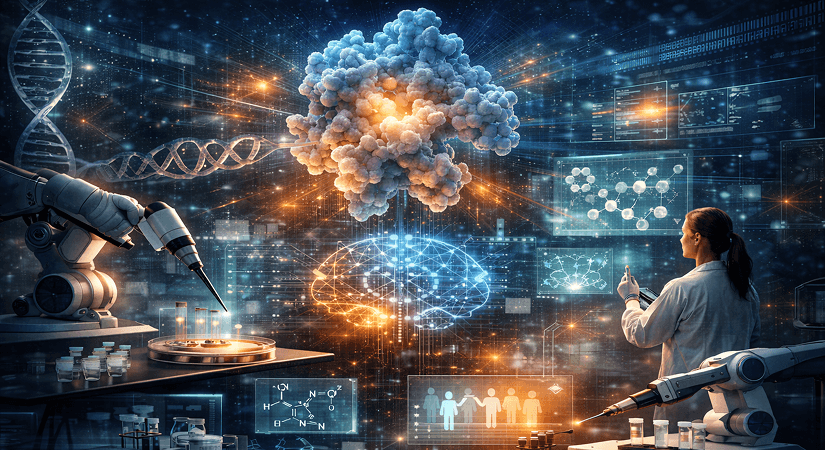
Now, a new wave of companies is changing that equation. These are AI-native biotech companies, organisations that were built from day one around artificial intelligence, not ones that simply adopted AI tools later. They are not using AI as a feature; AI is their foundation.
This shift is more significant than it sounds. It is not just about speed. It is about how biology itself is being understood, modelled, and acted upon. And it is reshaping the entire pharmaceutical value chain.
What Makes a Company "AI-Native"?
The term AI-native is not a marketing label. It describes a specific way of building and operating a biotech company. Traditional biotechs were built around wet labs, where scientists run physical experiments to test one hypothesis at a time. AI-native biotechs flip this model. They build computational infrastructure first, then use wet lab work to validate what the algorithms have already predicted.
Key characteristics of AI-native biotech companies include:
- Data as a core asset: These companies invest heavily in generating proprietary biological datasets because the quality of AI predictions is only as good as the data it learns from.
- Integrated biology and machine learning teams: Biologists and data scientists work in the same loop, not in siloed departments.
- Iterative design-build-test cycles: Instead of linear R&D, they run rapid computational cycles that generate thousands of hypotheses, then select the most promising ones for physical testing.
- Platform-first business models: Many AI-native biotechs are built around a core platform, a general-purpose engine that can be applied across multiple disease areas and drug modalities.
Companies like Recursion Pharmaceuticals, Isomorphic Labs, Insilico Medicine, and Absci have become examples of this model. Each of them has built differentiated platforms that go beyond what traditional computational chemistry or bioinformatics tools could offer.
The Technology Stack Behind AI-Native Biotech
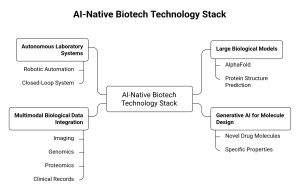
Understanding what makes these companies work requires examining the underlying technologies they rely on.
Large biological models: Just as large language models (LLMs) like GPT were trained on text, companies are now training foundation models on biological sequences, proteins, DNA, RNA, and small molecules. These models learn the underlying grammar of biology. AlphaFold, developed by DeepMind (now part of Isomorphic Labs), is the most prominent example. It can predict the 3D structure of virtually any protein from its amino acid sequence, a problem that had stumped scientists for 50 years.
Generative AI for molecule design: Generative models are now being used to design novel drug molecules from scratch. Rather than screening a library of existing compounds, companies can ask a model to generate a molecule that fits a specific biological target with desired properties, solubility, toxicity profile and binding affinity, all built into the specification.
Multimodal biological data integration: AI-native companies are combining imaging data, genomics, proteomics, and clinical records into unified computational models. Recursion Pharmaceuticals, for instance, has built a system that captures cellular imaging data at a massive scale, billions of images, and uses deep learning to identify disease-relevant patterns that no human eye could detect.
Autonomous laboratory systems: Some companies are coupling AI predictions with robotic lab automation. This creates a closed loop where AI suggests an experiment, a robot runs it, and the result feeds back into the model, with minimal human intervention at each cycle.
Where AI Is Making the Biggest Difference
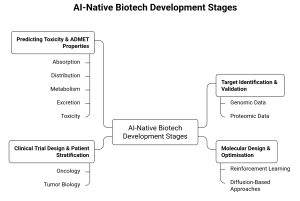
AI-native biotech companies are making an impact across the drug development process, but the gains are not equal across all stages.
Target identification and validation is where AI has arguably made the most progress. Identifying which biological target, a protein, receptor, or gene, is responsible for a disease is the first and often most consequential decision in drug development. AI models trained on genomic and proteomic data can now surface targets that were previously invisible to researchers.
Molecular design and optimisation is the second area of rapid advancement. Designing a molecule that binds to a target effectively, is stable in the body, and does not cause toxicity is a multi-constraint optimisation problem. AI models, particularly those using reinforcement learning and diffusion-based generative approaches, are well-suited to this kind of multi-objective search.
Clinical trial design and patient stratification are an emerging frontier. AI is beginning to help companies identify which patients are most likely to respond to a treatment, making trials smaller, faster, and more likely to succeed. This is particularly relevant in oncology, where tumour biology varies widely between patients.
Predicting toxicity and ADMET properties, absorption, distribution, metabolism, excretion, and toxicity, earlier in the process is also a major gain. Historically, many drug candidates failed in late-stage trials because of safety issues that were not caught until expensive human studies. AI models can now flag these risks at the design stage.
The Business Model Shift
AI-native biotech companies are also changing how the industry thinks about value creation.
Many of these companies operate a dual model: they develop their own drug pipeline internally, while also licensing their platform to large pharmaceutical companies as a service. This creates two revenue streams, milestone payments and royalties from partnerships, and eventual drug sales from their own portfolio.
Pharmaceutical giants, including Pfizer, Merck, Sanofi, and AstraZeneca, have all signed significant partnerships with AI-native biotech companies in recent years. These deals are often structured around a co-development arrangement, in which the AI company provides target identification or molecular design, and the pharma company funds clinical development and commercialisation.
This partnership model is also accelerating access to real-world clinical data, which is one of the most valuable and scarce resources for training biological AI models. Large pharma companies have decades of clinical data that AI-native startups cannot easily replicate.
AI-native biotech accelerates discovery, but molecules still must navigate complex regulatory pathways from IND to approval.
Understanding the process helps.
→ Read: Exploring Biopharmaceuticals Regulatory Pathways
Challenges That Still Remain
Despite the momentum, AI-native biotech faces real and serious challenges.
Data quality and biological noise: Biology is inherently noisy. Experimental results vary across labs, cell lines, and conditions. Training AI models on low-quality or inconsistently generated data can lead to overconfident predictions that fail in the clinic.
Generalisation to human biology: Most training data comes from cell lines or animal models. Translating predictions into human biology remains one of the hardest problems in all of medicine, and AI has not solved it.
Regulatory uncertainty: Regulatory agencies like the FDA and EMA are still developing frameworks for evaluating AI-generated evidence in drug submissions. Questions around model interpretability, data provenance, and algorithmic bias are unresolved.
Talent and infrastructure costs: Building and running these platforms requires specialised talent at the intersection of machine learning, biology, and chemistry, a small pool globally. The computing infrastructure required for training large biological models is also expensive.
AI-native platforms represent one frontier of digital transformation.
Learn how pharma companies are embedding AI across operations, not just discovery.
→ Read: Digital Transformation in Pharma: Use Cases
What the Future Looks Like
The most important development in this space may still be ahead: the convergence of AI-native drug discovery with AI-native clinical development. If AI can compress not just the discovery phase but also the design and execution of clinical trials, the traditional 10-to-15-year timeline could shrink dramatically.
Several companies are already experimenting with adaptive trial designs powered by AI, using real-time patient data to modify trial parameters without compromising statistical integrity. Others are developing digital biomarkers and AI-powered diagnostics that could enable continuous patient monitoring outside traditional clinical settings.
There is also growing interest in what some researchers call "programmable biology", the idea that cells themselves could eventually be designed and tuned using AI-guided genetic tools like CRISPR, enabling treatments that are highly specific to an individual patient's biology.
Conclusion
AI-native biotech companies are not a trend. They represent a structural shift in how medicines are discovered and developed. By treating biology as a data problem and embedding AI at every layer of their operations, these companies are achieving results that were not possible just five years ago. They are finding targets that were overlooked, designing molecules that fit biology more precisely, and moving faster through early development than any previous generation of drug companies.
The road ahead still has major obstacles, regulatory, scientific, and commercial. But the direction is clear. The next generation of breakthrough medicines is increasingly likely to have an algorithm at its origin.
FAQs
1. What is an AI-native biotech company?
An AI-native biotech company is one built from the ground up around artificial intelligence , meaning AI drives target discovery, molecule design, and research workflows, rather than being added on top of traditional lab processes.
2. How does AI speed up drug discovery?
AI can analyse vast biological datasets, predict protein structures, design drug molecules computationally, and identify toxicity risks early , cutting the time and cost of early-stage R&D significantly compared to conventional experimental approaches.
3. Which AI-native biotech companies are leading the space?
Notable companies include Recursion Pharmaceuticals, Isomorphic Labs, Insilico Medicine, Absci, and Exscientia, each with differentiated AI platforms targeting different parts of the drug development process.
4. What is AlphaFold and why does it matter for biotech?
AlphaFold is a deep learning model developed by DeepMind that predicts the 3D structure of proteins from their amino acid sequences. Accurate protein structure prediction is foundational to drug design, and AlphaFold made this widely accessible for the first time.
5. Are there regulatory frameworks for AI-discovered drugs?
Regulatory agencies like the FDA and EMA are actively developing guidance on AI in drug development. Currently, AI-discovered drugs go through the same clinical trial and approval processes as conventionally developed ones, but model transparency and data quality are under increasing scrutiny.