How AI Is Changing Drug Safety Monitoring - And What the Future Looks Like
How AI transforms drug safety | signal detection, adverse event automation, real-world evidence integration, and pharmacovigilance team augmentation.


Every medicine that reaches patients comes with a promise that its benefits outweigh its risks. Pharmacovigilance (PV) is the science that keeps that promise alive. It involves collecting, detecting, assessing, and preventing adverse drug reactions (ADRs) throughout a drug's life on the market.
But here's the challenge: the volume of safety data the pharmaceutical industry deals with today is staggering. Millions of individual case safety reports (ICSRs), spontaneous reports from patients and healthcare professionals, electronic health records, social media posts, scientific literature, it never stops. Traditional manual methods of processing this data are slow, expensive, and prone to error.
This is where artificial intelligence (AI) steps in, not as a futuristic concept, but as a practical tool already reshaping how drug safety teams operate. This blog takes a close look at how AI is being applied in pharmacovigilance today, where it is headed, and what it means for patient safety globally.
What Is AI-Assisted Pharmacovigilance?
AI-assisted pharmacovigilance refers to the use of machine learning (ML), natural language processing (NLP), and related technologies to automate and improve drug safety processes. These tools are designed to handle large amounts of unstructured and structured data faster and more accurately than human reviewers can do alone.
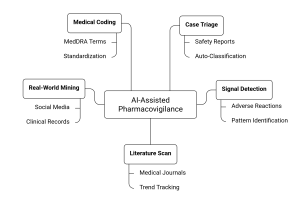
The core areas where AI is currently applied include:
- Case processing and triage: automatically classifying incoming ICSRs by seriousness, expectedness, and causality
- Signal detection: Identifying new or changing safety signals from aggregate data
- Literature monitoring: Scanning published medical literature for relevant ADR information
- Social media and real-world data mining: Extracting patient-reported safety information from non-traditional sources
- Medical coding: assigning MedDRA (Medical Dictionary for Regulatory Activities) terms to adverse event descriptions
Each of these tasks has traditionally required trained pharmacovigilance professionals working long hours. AI doesn't replace their judgment; it amplifies their capacity.
The Current State of AI in Drug Safety
Regulatory agencies have already begun acknowledging AI's role in pharmacovigilance. The European Medicines Agency (EMA) and the U.S. Food and Drug Administration (FDA) have both published discussion papers and pilot programs exploring AI's use in safety surveillance.
The FDA's Sentinel System, which links data from over 100 million patients across U.S. healthcare networks, uses automated analytics to detect drug safety signals in near real time. The EMA's EudraVigilance database, which contains over 20 million adverse event reports, is increasingly being paired with AI tools to improve signal detection efficiency.
One of the biggest practical applications today is NLP for case intake. When a patient or doctor submits an adverse event report, the language is often informal, incomplete, or written in different languages. NLP models can extract the key elements, the suspect drug, the adverse event, the patient demographics, and the outcome, and structure them automatically. This reduces the time to process each case from hours to minutes.
Similarly, machine learning models are now being trained on historical ICSR data to predict the seriousness of incoming cases. Instead of every report going into the same manual queue, high-priority cases can be flagged automatically, ensuring safety teams focus first on what matters most.
Key Benefits of AI in Pharmacovigilance
The advantages are not just about speed. The deeper value lies in how AI improves decision-making quality and regulatory compliance.
1. Better Signal Detection
Traditional signal detection methods, such as the Proportional Reporting Ratio (PRR) and the Bayesian Confidence Propagation Neural Network (BCPNN), are statistical tools that compare reporting frequencies. They work well, but they can miss signals buried in complex, multi-source datasets.
AI models, especially deep learning networks, can analyse patterns across multiple variables simultaneously, drug combinations, patient demographics, comorbidities, time-to-onset, and identify signals that traditional methods might overlook. This leads to earlier warnings and faster regulatory action.
2. Reduced Case Processing Backlog
Many pharmaceutical companies and contract research organisations (CROs) struggle with case processing backlogs, especially after product launches or during pandemic-related surges in reporting. AI-assisted tools can automatically process and pre-fill case data, cutting manual effort by 40–70% in validated implementations.
3. Improved Data Quality
Inconsistent coding, missing fields, and duplicate reports are persistent problems in PV databases. AI tools trained on MedDRA hierarchies can suggest the most appropriate coding terms and flag potential duplicates before they enter the system, improving the integrity of aggregate safety data used in Periodic Benefit-Risk Evaluation Reports (PBRERs) and Development Safety Update Reports (DSURs).
4. Real-World Evidence Integration
Electronic health records (EHRs), insurance claims data, wearable device outputs, and patient registries all contain valuable safety signals. AI can integrate and analyse this real-world evidence (RWE) at a scale no human team could manage manually, giving a more complete picture of a drug's safety profile in everyday use.
AI-powered signal detection and case processing must operate within validated quality systems.
Understanding QMS frameworks ensures pharmacovigilance AI integrates with compliance infrastructure.
→ Read: ISO 13485 Quality Management System | A Pharma Leaders Guide
Challenges That Still Need to Be Solved
Despite the promise, AI in pharmacovigilance is not without its limitations. Being honest about these challenges is important for setting realistic expectations.
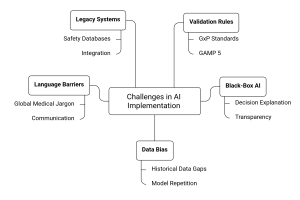
- Regulatory validation requirements: AI tools used in GxP-regulated environments must be validated according to standards such as GAMP 5. This process is time-consuming and requires extensive documentation. Regulators have not yet issued clear, harmonised guidelines on how AI models should be validated for PV use.
- Black-box problem: Many deep learning models cannot easily explain why they flagged a particular signal or classified a case in a particular way. In a regulatory environment where auditability is critical, this lack of explainability is a major concern.
- Data bias: AI models are only as good as the data they are trained on. If historical ICSR data reflect reporting biases (e.g., under-reporting in certain patient populations or geographies), the AI will replicate and potentially amplify those biases.
- Language and cultural nuances: Global PV operations deal with reports in dozens of languages. While NLP has improved significantly, subtle linguistic nuances and regional medical terminology still challenge automated systems.
- Integration with legacy systems: Most pharmaceutical companies run PV on established safety databases. Integrating AI tools with older systems like Argus Safety or ArisGlobal is not always straightforward and often requires significant IT investment.
AI validation and governance challenges in pharmacovigilance mirror broader pharma struggles.
Organizations adopting AI must build governance frameworks before scaling deployment.
→ Read: How AI Is Rapidly Changing Pharma HR And Why Most Companies Aren't Ready
What the Future Looks Like
Looking ahead, the trajectory is clear. AI will not be an optional add-on in pharmacovigilance; it will become a standard part of how drug safety is managed. Here is what that future is likely to involve.
Proactive Safety Monitoring
Today's pharmacovigilance is largely reactive; a report comes in, and the system responds. Future AI systems will enable truly proactive monitoring, where models continuously scan all available data sources and alert safety teams to emerging risks before they show up in formal reports.
Continuous Signal Assessment
Rather than periodic signal detection reviews, AI will enable continuous, real-time assessment of the entire post-market safety landscape. This aligns with the concept of ICH E2C's benefit-risk framework, in which safety conclusions are updated dynamically as new data arrive.
Personalised Risk Profiles
As pharmacogenomics and precision medicine advance, AI will help link specific adverse events to patient subgroups based on genetic, demographic, or clinical factors. This will allow regulators and companies to develop more targeted risk management strategies, not just for the general population but also for individual patient profiles.
Smarter Regulatory Submissions
Periodic safety reports, PBRERs, DSURs and Risk Management Plans require extensive data analysis and narrative writing. AI tools are already being developed to assist with compiling these documents, extracting structured data from safety databases, and generating draft narratives that human writers review and refine. This accelerates submission timelines and reduces the risk of data errors.
Greater Collaboration Between Regulators and Industry
The FDA, EMA, and ICH are actively working to develop frameworks that allow AI-generated outputs to be used reliably in regulatory submissions. The goal is to create a shared understanding of how AI models should be developed, validated, and monitored, a kind of pharmacovigilance equivalent of ICH E6 R3 for clinical trials. This collaborative approach will be key to building confidence in AI-based safety systems.
The Human Element Remains Central
It is worth emphasising: AI will not replace pharmacovigilance professionals. What it will do is free them from repetitive, high-volume tasks so they can focus on complex clinical judgment, regulatory strategy, and benefit-risk communication, work that genuinely requires human expertise.
The most effective pharmacovigilance systems of the future will be human-AI partnerships. Trained safety scientists will work alongside intelligent tools, reviewing AI-flagged signals, making causality assessments, and ensuring that regulatory submissions reflect a genuine, balanced evaluation of a medicine's safety profile.
Conclusion
Pharmacovigilance has always been about one thing: protecting patients. AI offers an unprecedented opportunity to do that better, by processing more data, detecting signals earlier, and improving the quality of safety decisions made every day.
The transition will not happen overnight, and it will require careful validation, regulatory guidance, and investment in people and systems. But the direction is set. Drug safety in the age of AI will be faster, smarter, and more connected, and ultimately, patients around the world will be safer because of it.
FAQs
Q1. What is AI-assisted pharmacovigilance?
AI-assisted pharmacovigilance uses machine learning and natural language processing to automate and enhance drug safety monitoring tasks, such as adverse event processing, signal detection, and medical literature review.
Q2. How does AI help in detecting drug safety signals?
AI models analyse large, multi-source datasets, including spontaneous reports, EHRs, and real-world data, to identify patterns and emerging safety signals that traditional statistical methods might miss, often at an earlier stage.
Q3. Is the use of AI in pharmacovigilance approved by regulators?
Regulatory agencies such as the FDA and EMA are actively exploring and piloting AI for safety surveillance. However, harmonised guidelines for validating AI tools in GxP-regulated PV environments are still being developed.
Q4. What are the biggest challenges of using AI in drug safety?
The main challenges include model explainability (the "black box" issue), regulatory validation requirements, data bias in training datasets, language barriers in global reporting, and integration with legacy safety database systems.
Q5. Will AI replace pharmacovigilance professionals?
No. AI is designed to support, not replace, trained safety scientists. It handles high-volume, repetitive tasks so that professionals can focus on clinical judgment, benefit-risk assessment, and regulatory strategy, roles that require human expertise.
Reporting on the science, business and regulation shaping the pharmaceutical industry.


Discussion