by Simantini Singh Deo
7 minutes
AI Governance In Pharma: Is It Becoming The New GMP?
GMP built trust in physical manufacturing. Now algorithms need the same guardrails, here's why AI governance is following its playbook.
Table Of Contents
- What Is AI Governance, Really?
- Why GMP Became The Gold Standard In The First Place?
- The Parallels Between AI Governance And GMP
- Where AI Governance Is Still Catching Up?
- What Regulators Are Already Doing?
- Building An AI Governance Framework: A Practical Starting Point
- A Real-World Scenario: When Governance Would Have Helped?
- What Does This Means for Pharma's Competitive Outlook?
- Wrapping It Up!
- FAQs
For decades, Good Manufacturing Practice, or GMP, has been the backbone of trust in pharma. It's the reason a tablet made in one country works exactly the same as one made in another, and the reason regulators, doctors, and patients can trust a drug without personally verifying every batch themselves.
Now, as AI quietly takes over decisions once made by humans, a new question is emerging: does AI need its own version of GMP? Let's break down what AI governance actually means, why it's gaining urgency, and whether it deserves a seat next to GMP as a core pillar of pharma quality.
What Is AI Governance, Really?
AI governance is simply the set of rules, checks, and responsibilities a company puts in place to make sure its AI systems behave safely, fairly, and predictably. Think of it as the rulebook that decides how much trust an algorithm is allowed to earn before a human has to step in.
In pharma, this shows up in places like:
- Drug discovery algorithms that suggest which molecules are worth testing.
- Clinical trial models that predict patient outcomes or flag safety signals.
- Manufacturing systems that adjust production parameters in real time.
- Regulatory submission tools that help draft documents for health authorities.
Each of these uses carries real consequences if the AI gets something wrong, which is exactly why governance matters so much here.
Why GMP Became The Gold Standard In The First Place?
To understand why AI governance is being compared to GMP, it helps to remember what GMP actually solved. Before it existed, drug quality varied wildly between manufacturers, and there was no consistent way to guarantee safety. GMP fixed that by requiring:
- Documented processes for every step of manufacturing.
- Consistent quality checks at defined points in production.
- Traceability, so any problem could be traced back to its source.
- Accountability, with named people responsible for each stage.
AI governance is starting to follow the exact same logic, just applied to algorithms instead of assembly lines.
The Parallels Between AI Governance And GMP
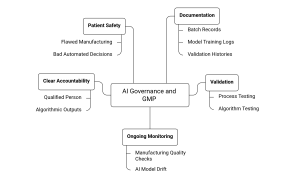
The comparison isn't just a catchy headline, it holds up surprisingly well when you look closely:
a) Both Demand Documentation: GMP requires batch records; AI governance requires model documentation showing how a system was trained and validated.
b) Both Require Validation Before Use: A manufacturing process must be validated before it runs at scale, and increasingly, so must an AI model before it influences a real decision.
c) Both Need Ongoing Monitoring: GMP includes continuous quality checks; AI systems need continuous performance monitoring to catch drift or errors over time.
d) Both Assign Clear Accountability: Just as a Qualified Person signs off on a drug batch, someone now needs to sign off on an AI system's outputs.
e) Both Exist To Protect Patients: At the core, GMP prevents bad batches from reaching people, and AI governance aims to prevent bad algorithmic decisions from doing the same.
Where AI Governance Is Still Catching Up?
Despite the parallels, AI governance isn't as mature as GMP, and a few gaps are worth noting:
- No universal standard yet GMP has decades of globally recognized guidelines; AI governance frameworks are still being written and vary by region.
- It is harder to audit because the manufacturing process can be physically inspected, but an AI model's internal logic is often difficult to fully explain, even to its own developers.
- Faster pace of change as AI models get updated far more often than manufacturing equipment, which makes static, one-time validation less useful.
- Talent shortage as few auditors or inspectors currently have the technical skills to evaluate AI systems the way they evaluate manufacturing lines.
These gaps aren't reasons to dismiss AI governance. They're reasons it needs to mature quickly.
The EU isn't waiting for a universal standard; Annex 22 is already spelling out what AI-GMP looks like for manufacturers.
Here's what it requires.
→ Read: EU Annex 22: The AI-GMP Guide for Pharma Manufacturers
What Regulators Are Already Doing?
Regulatory bodies haven't ignored this shift. Several efforts are already shaping how AI governance will look in pharma:
1) Guidance documents from major health authorities are starting to address AI and machine learning use in drug development and manufacturing.
2) Risk-based frameworks are being proposed, where higher-risk AI applications, like those affecting patient safety, face stricter oversight than lower-risk ones, like scheduling tools.
3) Change control expectations are being extended to cover AI models that get retrained or updated after initial approval.
4) Cross-industry collaboration is increasing, with regulators, companies, and technology providers working together to define shared standards before problems force reactive rules instead.
This mirrors how GMP itself evolved over time: through a mix of industry practice and regulatory response, not a single sweeping rule written all at once.
Building An AI Governance Framework: A Practical Starting Point
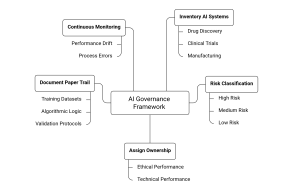
Companies that want to get ahead of this shift don't need to wait for perfect regulatory clarity. A reasonable framework can start with a few concrete steps:
- Inventory every AI system currently in use, from discovery tools to manufacturing algorithms, so nothing operates without oversight.
- Classify each system by risk level, focusing the most scrutiny on tools that directly affect patient safety or product quality.
- Assign clear ownership, so every AI system has a named person accountable for its performance and outcomes.
- Document training data and validation methods, creating a paper trail similar to a manufacturing batch record.
- Set up continuous monitoring, checking for performance drift the same way a quality team watches for process deviations.
This isn't about slowing innovation. It's about making sure innovation doesn't outrun accountability.
You don't have to build this framework from scratch.
ISPE's 290-page GAMP AI Guide is already the industry's most authoritative roadmap, here's what's inside it.
→ Read: ISPE GAMP Guide for AI in Pharma: Leadership Guide
A Real-World Scenario: When Governance Would Have Helped?
To see why this matters beyond theory, imagine a mid-sized pharma company using an AI model to flag potential safety signals in clinical trial data. The model performs well during validation, so it's rolled out across several ongoing trials.
Over time, the patient population in one trial shifts slightly, and the model's accuracy quietly drifts without anyone noticing, since no one is monitoring it the way they'd monitor a manufacturing process. A genuine safety signal gets missed for weeks before a human reviewer catches the discrepancy during a routine audit.
Under a GMP-style governance framework, this scenario looks different. The model would have an assigned owner watching for performance drift. Documentation would show exactly when and how the model was last validated.
A trigger for re-evaluation would exist whenever the underlying patient population changed meaningfully. None of this eliminates risk entirely, but it shrinks the window where a problem can go unnoticed, which is precisely what GMP has always done for physical manufacturing.
What Does This Means for Pharma's Competitive Outlook?
Beyond compliance, strong AI governance is becoming a genuine business advantage, not just a defensive measure. Consider what's at stake:
1) Companies with mature AI governance can move faster through regulatory review, since inspectors trust documented, auditable systems more than opaque ones.
2) Weak governance increases the risk of costly errors, like a flawed algorithm approving a bad batch or missing a safety signal in trial data.
3) Investors and partners are increasingly factoring AI governance maturity into due diligence, especially for licensing deals and acquisitions.
4) Early adopters of strong governance frameworks are more likely to shape emerging regulatory standards, rather than scrambling to meet rules written without their input.
5) Public trust, already fragile around AI in healthcare, is easier to earn and keep for companies that can clearly explain how their algorithms are checked and controlled.
In an industry where trust is the actual product being sold alongside the medicine, governance isn't overhead. It's part of what makes the medicine credible.
Wrapping It Up!
AI governance in pharma is following a path that looks strikingly similar to the one GMP walked decades ago: starting as scattered best practices, gradually hardening into formal expectations, and eventually becoming inseparable from what it means to operate responsibly.
It isn't fully there yet. Standards are still forming, audits are still difficult, and talent to oversee it all remains scarce. But the direction is clear enough that treating AI governance as optional would be a mistake.
Just as no company would skip GMP and expect to stay in business, the companies that take AI governance seriously now, building documentation, accountability, and monitoring into their AI systems from the start, are the ones most likely to be trusted, and successful, when this becomes the industry's next non-negotiable standard.
FAQs
1) What Is AI Governance In The Pharmaceutical Industry?
AI governance is a framework of policies, processes, and controls that ensures artificial intelligence systems operate safely, ethically, and reliably throughout their lifecycle. It helps organisations validate AI models, monitor their performance, and maintain accountability for AI-driven decisions. This supports regulatory compliance while protecting product quality and patient safety.
2) Why Is AI Governance Being Compared To GMP?
AI governance and Good Manufacturing Practice (GMP) share the common goal of ensuring consistency, transparency, and trust in pharmaceutical operations. While GMP focuses on manufacturing processes, AI governance applies similar principles to the development, validation, and monitoring of artificial intelligence systems. Together, they help reduce risks and ensure reliable decision-making across the industry.
3) Why Is AI Governance Important For The Future Of Pharma?
As AI becomes more widely used in drug discovery, manufacturing, and clinical development, effective governance is essential to manage risks and maintain regulatory confidence. A strong AI governance framework helps organisations improve accountability, minimise errors, and build trust in AI-enabled processes. It also prepares companies for evolving regulatory expectations and future industry standards.