ISPE GAMP® Guide: Artificial Intelligence — What Pharma And Biotech Leaders Need To Know
Why GAMP AI matters ? Pharma leadership guide to governance, validation, and deploying artificial intelligence with GxP compliance.


Artificial intelligence is no longer something pharmaceutical companies are considering for the future. It's here, it's being deployed, and it's already touching some of the most regulated environments in the industry — drug discovery pipelines, manufacturing quality systems, clinical trial operations, and regulatory submissions. And yet, for most of that time, one critical question has gone largely unanswered: How exactly are we supposed to do this compliantly?*
That question now has a serious, authoritative answer. In July 2025, the International Society for Pharmaceutical Engineering (ISPE) released the GAMP® Guide: Artificial Intelligence, a 290-page framework specifically designed to help life sciences organisations implement AI in GxP-regulated environments without compromising patient safety, data integrity, or product quality.
If you're leading a pharma or biotech organisation, this guide isn't a document for your IT department to absorb and file away. It's a strategic signal about where the industry is heading, what regulators will expect, and what leadership needs to understand and act on right now! This post unpacks what the GAMP AI Guide is, why it was needed, and what it means for how your organisation operates.
Why The Pharmaceutical Industry Needed A Dedicated AI Compliance Guide?
To understand why the GAMP AI Guide matters, it helps to understand the gap it's filling. For decades, the GAMP framework has given pharmaceutical companies a structured, risk-based approach to validating computerised systems.
GAMP 5, and its 2022 second edition, became the industry's reference point for Computer Software Assurance (CSA). It worked well, for the kinds of systems pharma had always used.
AI breaks the old validation model in fundamental ways. Traditional software does exactly what it's programmed to do. AI systems learn, adapt, and in some cases produce outputs that are difficult to fully explain — a characteristic that creates compliance challenges the existing GAMP framework was never designed to address.
Before the AI Guide arrived, companies deploying AI in GxP environments were essentially working from first principles, with no single authoritative reference to guide decisions.
The consequences of that gap were showing up clearly across the industry:
- AI pilots stalling at the proof-of-concept stage because teams could not agree on a validated, compliant path to release them into regulated use
- Fragmented terminology between quality, IT, data science, and regulatory affairs teams, making cross-functional alignment on AI governance nearly impossible
- Inconsistent third-party AI supplier qualification, with no agreed standard for what due diligence should look like when procuring AI tools
- Training data governance gaps, as organisations discovered their AI models were being built on data that hadn't been managed to GxP standards
- Regulatory uncertainty, as the FDA, EMA, and other agencies began developing their own AI frameworks, leaving companies unsure how to align their internal practices
The GAMP AI Guide was developed specifically to resolve these problems, not through abstract principles, but through practical, lifecycle-based guidance that connects AI implementation to existing GxP compliance obligations.
What The ISPE GAMP® AI Guide Covers: A Structured Overview?
The GAMP AI Guide is a 290-page document developed by more than 20 ISPE members from industry and academia, with extensive peer review. It is designed to be applicable across the full range of AI use cases in life sciences — from AI-enhanced quality management systems to machine learning models supporting manufacturing process control and clinical data analysis.
At its core, the guide addresses five areas that pharma and biotech leadership need to understand:
1. Extension of GAMP 5 principles to AI-specific challenges. Rather than replacing existing frameworks, the guide builds on GAMP 5's risk-based methodology and applies it to characteristics unique to AI, including adaptive model behaviour, data drift, explainability limitations, and training data governance requirements.
2. Alignment with the current regulatory landscape. The guide incorporates the EU AI Act (formally adopted in May 2024), FDA draft guidelines on AI for drug and device applications, the EMA's reflection paper on AI in the medicinal product lifecycle, and ISO/IEC 42001 on AI management systems. This alignment means the guide is not just industry best practice, it is a forward map of where formal regulatory expectations are heading.
3. Full AI system lifecycle coverage. Guidance spans every stage of an AI system's life, from initial business case and system design, through data preparation, model training, validation testing, and deployment, to ongoing operational monitoring and change control when models are updated or retrained.
4. Defined roles and responsibilities across stakeholders. The guide provides a clear accountability framework covering regulated companies, AI platform suppliers, third-party service providers, and internal functions including quality assurance, IT, and data science.
5. A risk-tiered validation approach. Not every AI application carries the same compliance burden. The guide allows organisations to calibrate the depth of their validation activities to the intended use and patient risk level of each specific AI system, enabling a fit-for-purpose response rather than a one-size-fits-all model.
Why AI Governance In Pharma Is A Leadership Responsibility, Not An IT Function?
There is a common tendency to treat the GAMP AI Guide as a technical document, something the quality and IT departments handle while leadership focuses on the business outcomes AI is expected to deliver. That approach will create problems.
The guide makes clear that AI governance in a regulated life sciences environment is not a quality function or an IT function. It is an organisational capability that requires active, informed leadership involvement to build, resource, and sustain. Three reasons why this matters at the executive level:
Regulatory risk from ungovernered AI is real and escalating. The FDA, EMA, and other major agencies are actively developing and formalising their AI oversight frameworks. Organisations that implement GAMP-aligned AI governance now will be in a defensible position when those regulatory expectations become binding. Those that have not will face a more disruptive and more costly, compliance transition while already under scrutiny.
AI failures in GxP environments are business-level incidents, not technical glitches. If an AI system deployed in manufacturing generates an erroneous output that affects product quality, or a model used in regulatory submission workflows produces unreliable data, the consequences extend well beyond the IT team.
They affect product integrity, patient safety, regulatory standing, and commercial continuity. This is the same category of risk as supply chain failure or quality system breakdown and it belongs in the same boardroom conversations.
Pharmaceutical AI investment is growing rapidly, and much of it is currently ungoverned for GxP use. Industry analysts forecast pharmaceutical investment in AI will grow from approximately $2 billion in 2025 to over $16 billion by 2034, a compound annual growth rate of nearly 27%.
A 2024 survey found that approximately 60% of pharmaceutical executives had already launched Generative AI pilots, with 32% expanding beyond the pilot stage. The strategic question leadership should be asking is not whether to invest in AI, but whether that investment is being governed in a way that allows AI tools to operate inside GxP environments or whether the organisation is accumulating a portfolio of pilots that can never be compliantly deployed where they would generate the most value.
Key Compliance Challenges That Make AI Validation More Complex Than Traditional CSV
For leaders who have overseen Computer System Validation (CSV) programmes or quality management systems, it is worth being direct about the ways AI validation is genuinely more demanding, not to create alarm, but to ensure the challenge is properly understood and resourced.
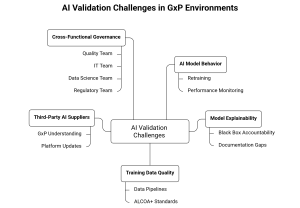
Validating an AI-enabled computerised system in a GxP environment is more complex than validating traditional software for five specific reasons:
- AI models can change behaviour over time. A conventionally validated software system performs the same operations after validation as it did during it. An AI model retrained on new data may produce different outputs than it did at the point of initial validation. Validation therefore cannot be a single point-in-time event, it requires ongoing performance monitoring, defined thresholds for triggering revalidation, and change control processes specifically designed for model updates and retraining.
- Model explainability is a genuine documentation challenge. Many AI systems, particularly those using deep learning architectures, cannot readily explain why they generated a specific output. In GxP environments where auditability and traceability are regulatory requirements, this creates accountability gaps that must be addressed through deliberate design choices at the architecture and governance level, not retrospectively during a regulatory inspection.
- Training data quality directly determines model compliance. The reliability of an AI system's outputs is inseparable from the quality of the data it was trained on. In pharma, training data must be managed to the ALCOA+ principles like attributable, legible, contemporaneous, original, accurate, complete, consistent, enduring, and available that apply to all GxP records. Most AI data pipelines were not originally built to these standards, and retrofitting them is a significant undertaking.
- Third-party AI supplier qualification requires a new framework. Many AI tools deployed in pharmaceutical environments are built and continuously updated by third-party vendors with limited understanding of GxP requirements. Qualifying these suppliers with appropriate rigour and maintaining that oversight as their platforms are updated, retrained, or restructured, requires a qualification framework that most organisations are still in the process of developing.
- Cross-functional governance alignment is an organisational challenge, not a technical one. Establishing a shared language, shared risk classification criteria, and a shared governance process for AI across quality, IT, data science, regulatory affairs, and operations is more difficult in practice than it appears in planning. This is one of the primary reasons AI initiatives stall after the pilot phase, and it is an area where leadership sponsorship is directly determinative of outcome.
Is your underlying data infrastructure still relying on manual or disjointed processes?
AI models fail in GxP environments without pristine, digitized data.
→ Read: Quality Without Digitalization: A Risk Modern Pharma Leaders Can't Ignore
Six Questions Pharma And Biotech Executives Should Be Asking Their Teams
The GAMP AI Guide provides a practical basis for assessing where your organisation currently stands on AI governance. These are the questions that surface the most important gaps:
- Is there a documented inventory of all AI systems currently operating or in development in GxP-regulated areas of the business? Many organisations discover significantly more AI applications in flight than leadership is aware of when they conduct a structured inventory for the first time.
- Does the organisation have a defined, documented process for classifying the GxP impact and patient risk of a new AI system before it is deployed? Without this, risk qualification decisions are being made informally and inconsistently across functions.
- Are third-party AI tool and platform suppliers being formally qualified to the same standard applied to other GxP computerised system suppliers? This is one of the most common and consequential gaps in current AI governance practice.
- Do quality assurance and data science teams operate with a shared vocabulary and governance framework for AI? Misalignment between these functions, including different understandings of what validation means in an AI context is a leading reason AI programmes fail to progress from pilot to production.
- How are AI systems already deployed in production being monitored for model drift, data quality degradation, or performance deviation? If the honest answer is that structured monitoring is not in place, this is a priority gap with direct regulatory implications.
- Are the data pipelines feeding AI systems in GxP environments managed to ALCOA+ data integrity standards? For the majority of organisations, the accurate answer is currently "not fully," and this requires an explicit remediation plan.
A Practical Implementation Roadmap: How To Apply The GAMP AI Guide In Phases?
The GAMP AI Guide is comprehensive, and implementing it in full is not a realistic near-term objective for most organisations. The most effective leadership approach is to treat it as a maturity roadmap and sequence implementation in phases that build capability progressively.
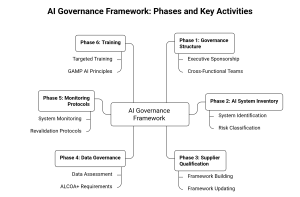
1) Establish a cross-functional AI governance structure with executive sponsorship. This body should include quality assurance, IT, data science, regulatory affairs, and legal representation, with defined decision rights, clear accountability, and a direct reporting line to senior leadership. Without this structure, everything else is harder to sustain.
2) Conduct an AI system inventory and apply risk classification. Document every AI application operating or in development in GxP-relevant areas. Classify each by intended use, GxP impact, and patient risk level. This exercise immediately identifies where validation priorities lie and which systems require urgent governance attention.
3) Build or update the AI supplier qualification framework. Review current vendor qualification processes against the guide's supplier oversight recommendations. Identify where additional due diligence is required and integrate updated qualification criteria into procurement and vendor management workflows.
4) Assess training data governance against ALCOA+ requirements.Conduct a data integrity review of the pipelines supplying training data to AI systems operating in GxP environments. In most organisations, this step reveals the largest structural gaps and informs the most significant remediation investment.
5) Define ongoing AI system monitoring and revalidation protocols. For each AI system in GxP deployment, establish documented performance thresholds, monitoring cadence, and the specific conditions that trigger escalation, retraining, or formal revalidation. This should be built into the operational design of every AI system from the point of initial deployment.
6) Deliver targeted cross-functional training on GAMP AI principles. The governance framework only functions when the people responsible for quality, IT, regulatory, and data science understand the guide's principles and can apply them collaboratively. Structured training across these functions, tailored to each audience's role in AI governance is one of the most direct investments an organisation can make in AI compliance readiness.
Are you struggling to hire the specialized technical experts needed to govern and validate these complex systems?
The life sciences industry is facing a massive shortage of cross-functional skills.
→ Read: Pharma Talent Gap | Forecasting Models That Fix It
The Strategic Case: Why Compliant AI Implementation Is A Competitive Advantage?
There is a framing of the GAMP AI Guide that treats it as a compliance burden, another set of requirements to be satisfied at minimum cost. That framing significantly underestimates what is at stake.
Pharmaceutical organisations that build a genuine, documented capability in compliant AI implementation will be positioned to:
- Accelerate the path from AI pilot to GxP production deployment because the governance infrastructure to validate, qualify, and release AI systems will already be in place
- Maintain a defensible regulatory position as FDA, EMA, and other agency expectations around AI oversight become formally binding
- Expand AI applications across the broadest range of regulated functions like manufacturing quality, clinical operations, regulatory affairs, pharmacovigilance, without being constrained by unresolved compliance questions
- Attract and retain data science and AI engineering talent who want to work in organisations where their contributions can progress into regulatory-grade deployment rather than remaining in perpetual pilot status
The pharmaceutical and biotech companies that realise the greatest long-term value from AI will not be those that moved fastest in unregulated contexts. They will be those that built the governance infrastructure early enough to deploy AI at scale inside GxP environments such as generating clinical, operational, and commercial value with full regulatory confidence behind them.
The ISPE GAMP® Guide: Artificial Intelligence is the industry's most authoritative, comprehensive roadmap for doing exactly that. For pharma and biotech leadership, the decision is not whether to engage with it — it is how soon.
FAQs
1. What Is The ISPE GAMP® AI Guide And Why Was It Created?
The ISPE GAMP® AI Guide is a 290-page framework designed to help pharma and biotech companies implement artificial intelligence in GxP-regulated environments without compromising safety, data integrity, or quality. It was created to fill a critical gap where traditional validation approaches could not address AI’s adaptive, opaque, and data-dependent behaviour. It ensures organisations have a clear, compliant, and industry-aligned roadmap for deploying AI responsibly.
2. How Does The GAMP® AI Guide Help Pharma And Biotech Organisations Use AI Compliantly?
The guide provides structured, lifecycle-based guidance that covers data governance, model training, validation, system deployment, performance monitoring, and change control. It aligns with global regulations such as the EU AI Act, FDA draft guidelines, and ISO/IEC 42001 to help organisations stay ahead of regulatory expectations. By following it, companies can scale AI with confidence instead of leaving pilots stuck in experimentation.
3. Why Should AI Governance Be A Leadership Priority Rather Than Just An IT Responsibility?
AI systems used in manufacturing, quality, clinical operations, or regulatory submissions can directly impact product integrity, patient safety, and compliance, making governance a business-critical responsibility. The guide emphasises that AI risk is not an IT issue but an organisational one requiring strategic oversight, resourcing, and accountability from senior leadership. Strong leadership involvement ensures AI investments actually reach compliant deployment instead of remaining fragmented or ungoverned.
Reporting on the science, business and regulation shaping the pharmaceutical industry.
More in Regulatory Intelligence
All articles →
The Pattern Behind FDA Warning Letters: What Startups & CDMOs Often Miss

ISO 14644 Cleanroom Classes for Pharma (with EM Implications)

Discussion