Digitalization Workforce Planning In Pharma : Redefining Workforce Planning
Digitalization Workforce Planning Pharma covers new skills, new roles, and reskilling strategies as Pharma 4.0 reshapes the factory floor.


Introduction
Walk into a modern pharmaceutical plant today, and it looks very different from the factory floors of even ten years ago. Machines talk to each other. Sensors track every batch in real time. Software systems flag quality issues before a human even notices them.
This shift is what people call "digital manufacturing" — the use of technologies like automation, data analytics, sensors, and manufacturing execution systems (MES) to run, monitor, and improve how medicines are made.
But there's a quieter story happening alongside all this technology: the people running these plants are changing too. The operator who once manually checked dials and filled out paper logs is now expected to read digital dashboards.
The maintenance technician who once fixed mechanical parts now needs to understand software and data systems as well. In short, digital manufacturing isn't just changing machines — it's completely reshaping how pharma companies plan, hire, train, and organize their workforce.
This article explains, in simple terms, what digital manufacturing means for pharma, and how it is transforming workforce planning — from the skills companies now look for, to the roles being created, to the way teams are structured on the shop floor.
What Digital Manufacturing Actually Means In Pharma?
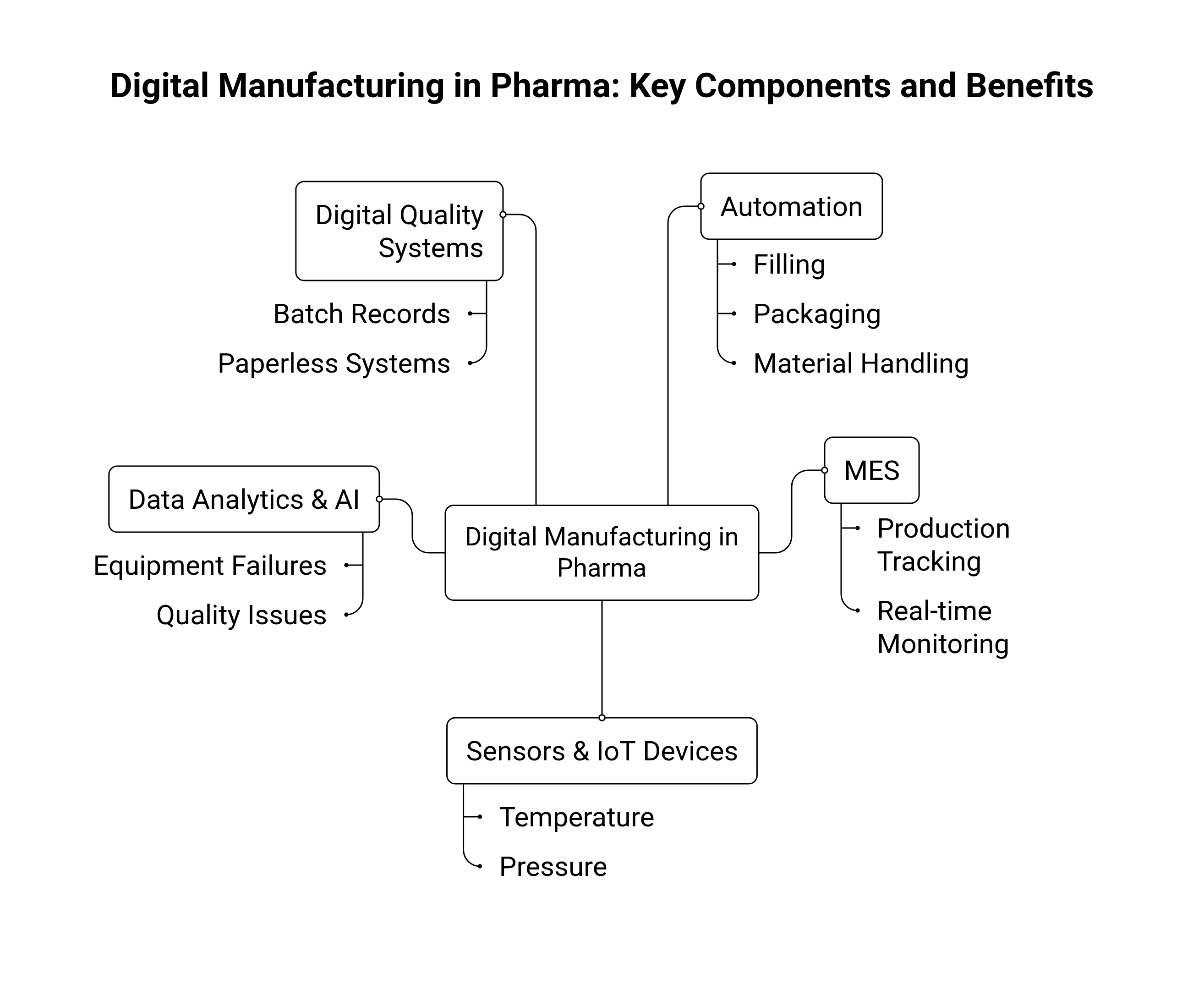
Before diving into workforce changes, it helps to understand what digital manufacturing covers. In the pharmaceutical world, it generally includes:
Automation: Machines and robots handling repetitive tasks like filling, packaging, and material handling.
Manufacturing Execution Systems (MES): Software that tracks production in real time, connecting the shop floor to quality and compliance systems.
Sensors & IoT Devices: Equipment fitted with sensors that constantly monitor temperature, pressure, and other conditions.
Data Analytics & AI: Tools that analyze production data to predict equipment failures, spot quality issues early, and optimize output.
Digital Quality Systems: Electronic systems replacing paper-based batch records and compliance documentation.
Together, these technologies are often referred to as "Pharma 4.0," a pharma-specific version of the broader Industry 4.0 movement. The goal is a connected factory where data flows freely, decisions are made faster, and human effort is focused where it matters most.
Why Does This Change Workforce Planning?
Workforce planning is essentially the process of figuring out how many people you need, with what skills, doing what jobs, and organising in what way. Digital manufacturing disrupts almost every part of this equation. Here's how.
1) New Skills Are Now Essential
Traditional manufacturing roles were built around mechanical and procedural knowledge — operating equipment, following standard operating procedures (SOPs), and manual quality checks. Digital manufacturing adds a whole new layer of required skills on top of that foundation:
Reading and interpreting real-time data dashboards
Basic troubleshooting of digital systems and connected equipment
Understanding how MES platforms track and control production
Working alongside automated and robotic systems safely and efficiently
Digital data entry and electronic documentation, replacing paper records
Even operators who never touch a line of code now need enough digital literacy to work confidently within these connected systems.
2) Demand Is Rising For Specialist Technical Roles
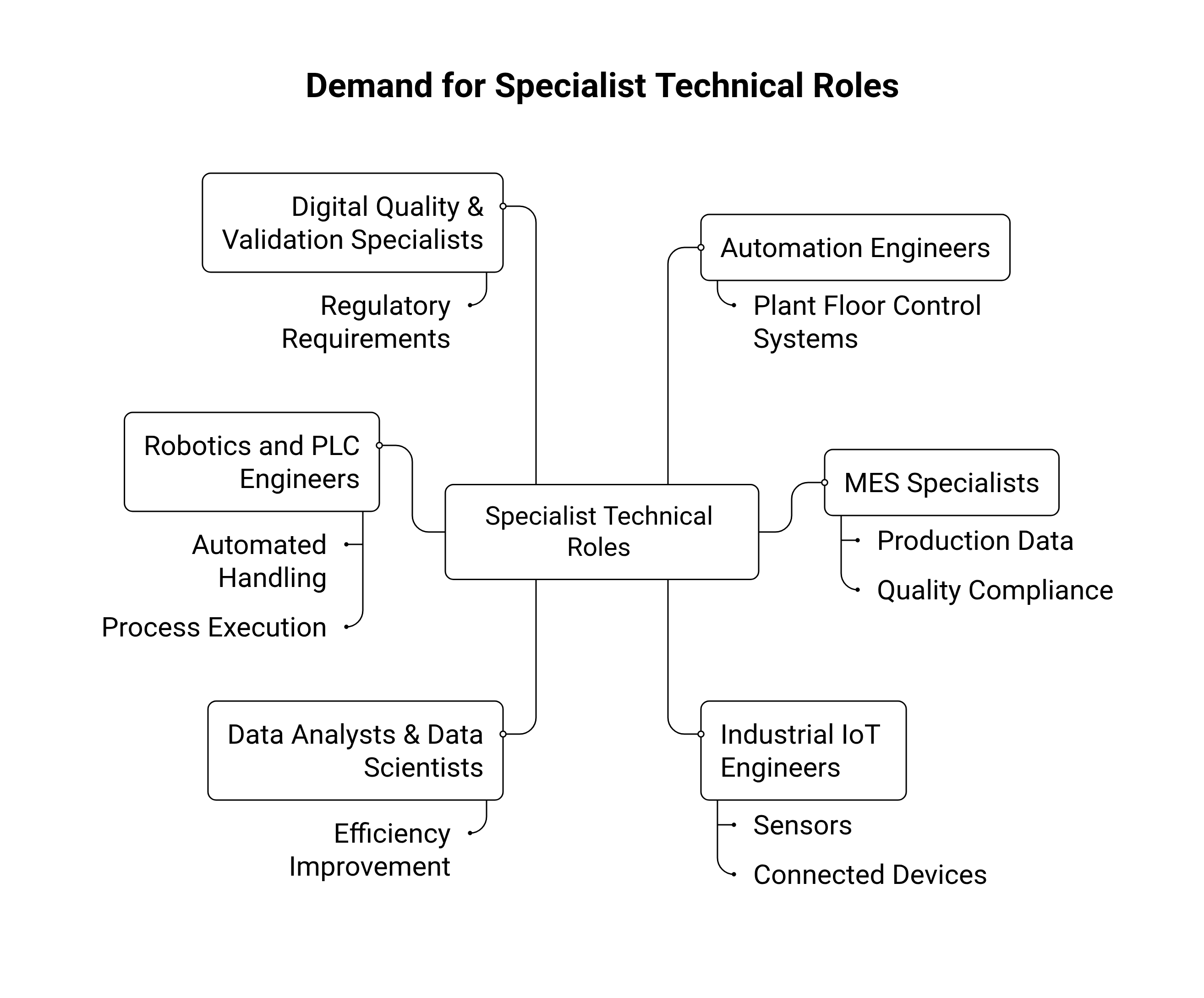
As plants become more automated and data-driven, pharma companies are creating and hiring for roles that barely existed on the factory floor a decade ago, including:
a) Automation Engineers — Who configure and maintain control systems on the plant floor.
b) MES Specialists — Who manage the systems connecting production data with quality and compliance.
c) Industrial IoT Engineers — who integrate sensors and connected devices into the manufacturing environment.
d) Data Analysts & Data Scientists — who interpret production data to improve efficiency and catch problems early.
e) Robotics and PLC (Programmable Logic Controller) Engineers — who support automated handling and process execution.
d) Digital Quality & Validation Specialists — who ensure new digital systems meet regulatory requirements.
This shift means workforce plans can no longer focus only on hiring "operators" or "technicians" in broad terms. Companies now need to plan for very specific, technically skilled roles that didn't previously exist in most manufacturing job structures.
3) Reskilling Existing Employees Has Become A Priority
Hiring new specialists is expensive and, in many regions, hard to do quickly because the talent pool for these niche digital-manufacturing skills is still limited. Because of this, most pharma companies are choosing to reskill and upskill their existing manufacturing workforce rather than replace it. This typically involves:
Structured digital-literacy training programs for existing operators and technicians
Cross-training staff on MES platforms and data dashboards
Partnering with technology vendors to provide hands-on system training
Building internal "digital champions" — experienced employees trained deeply in new systems who then help train their peers
Starting the upskilling process with leadership and senior management first, so that change is guided from the top down before reaching the wider workforce
This approach protects institutional knowledge — experienced employees already understand the product, the compliance environment, and the plant, while gradually building the digital capability needed to run smart manufacturing systems.
4) Shift & Team Structures Are Evolving
Digital manufacturing doesn't just change what people do — it also changes how teams are organized and scheduled. Some common shifts include:
Smaller, Cross-Functional Teams: Instead of separate silos for operations, maintenance, and quality, teams increasingly include a mix of skill sets working together, supported by shared real-time data.
Remote & Centralized Monitoring: Some monitoring tasks that once required someone physically present on the floor can now be done from a central control room, changing staffing patterns across shifts.
24/7 Data Visibility: Because digital systems track production continuously, decision-making and troubleshooting are less tied to a single shift, allowing more flexible coverage models.
Flatter Reporting Structures: With data available in real time to everyone, some layers of manual reporting and supervision are being reduced or restructured.
5) Some Manual, Repetitive Work Is Being Reduced
It's true that automation and digital systems are reducing the need for certain repetitive, manual tasks — such as manually recording readings, physically inspecting every unit, or performing routine data entry. However, this doesn't necessarily mean fewer overall jobs. In most cases, it means:
Employees shift from manual, repetitive tasks toward monitoring, exception-handling, and problem-solving.
Time once spent on paperwork is redirected toward process improvement and quality oversight.
New technical roles are created to build, maintain, and improve the very systems doing the automation.
In other words, the nature of the work changes more than the total amount of work disappears.
New technical roles are just one piece of pharma's bigger workforce shift. See what jobs will look like by the end of the decade.
Read: The Future Of Work In Pharma | What Jobs Will Look Like In 2030?
The Real-World Challenges Companies Are Facing
This transformation isn't without friction. Industry surveys and reports have pointed to a few consistent challenges pharma companies face when trying to align workforce planning with digital manufacturing:
Integrating new and old data systems is often cited as the single biggest implementation hurdle, since many plants still run on a patchwork of legacy equipment and newer digital tools.
Behavioral and cultural change is a major obstacle — employees accustomed to paper-based, procedure-driven work need time and support to adapt to data-driven decision-making.
Skills shortages remain a persistent barrier, particularly for niche roles like MES specialists and automation engineers, making both hiring and internal training critical.
Balancing compliance with innovation, pharma is a heavily regulated industry, so any new digital role or system must also be built around strict quality and regulatory standards, which can slow down adoption compared to other industries.
Workforce planning tools are helping companies manage this shift at scale. See the HR software solutions closing execution gaps in pharma manufacturing.
Read: 20 HR Software Solutions for Pharma Companies
In Conclusion
Digital manufacturing is doing far more than upgrading pharma factories with new machines and software — it's fundamentally rewriting the workforce playbook. Companies now need employees who are comfortable with data, automation, and connected systems, alongside the traditional manufacturing expertise that has always been essential.
This is pushing pharma organizations to rethink hiring strategies, invest heavily in reskilling their existing teams, redesign shift and team structures, and create entirely new categories of technical roles.
The pharma companies that succeed in this shift are the ones treating it as more than a technology upgrade — they're treating it as a genuine workforce transformation. Those that invest early in people, not just platforms, will be the ones best positioned to run the smart, connected, and resilient manufacturing plants of the future.
FAQs
1. What Is Digital Manufacturing In The Pharmaceutical Industry?
Digital manufacturing uses technologies such as automation, Manufacturing Execution Systems (MES), sensors, IoT, data analytics, and AI to monitor, manage, and improve pharmaceutical manufacturing processes.
2. How Does Digitalization Affect Workforce Planning In Pharma?
Digitalization changes the skills, roles, team structures, and staffing needs of pharmaceutical companies. Workforce planning now needs to consider both traditional manufacturing expertise and digital capabilities.
3. What New Skills Are Required In Digital Pharma Manufacturing?
Employees increasingly need skills such as digital literacy, data interpretation, MES operation, automated equipment handling, digital documentation, and basic troubleshooting of connected systems.
4. Does Automation Reduce Jobs In Pharmaceutical Manufacturing?
Automation can reduce some repetitive manual tasks, but it also creates new technical roles. Employees may shift toward monitoring, problem-solving, quality oversight, and managing automated systems.
5. Why Is Reskilling Important For The Pharma Workforce?
Reskilling helps existing employees adapt to new technologies while allowing companies to retain their manufacturing knowledge and experience. It can also help address shortages of specialized digital and technical talent.
Reporting on the science, business and regulation shaping the pharmaceutical industry.
More in HR in Pharma
All articles →
Crisis Management: HR's Role in Business Continuity in the Pharmaceutical Industry

Top HR Strategies for Successful Pharma Mergers: People, Culture, and Integration 2025

Discussion