Why Scientists Leave Pharma Companies? The Talent Problem No One Talks About Enough!
Why scientists leave pharma companies goes beyond salary. Explore the key causes of scientist attrition and strategies to improve retention.

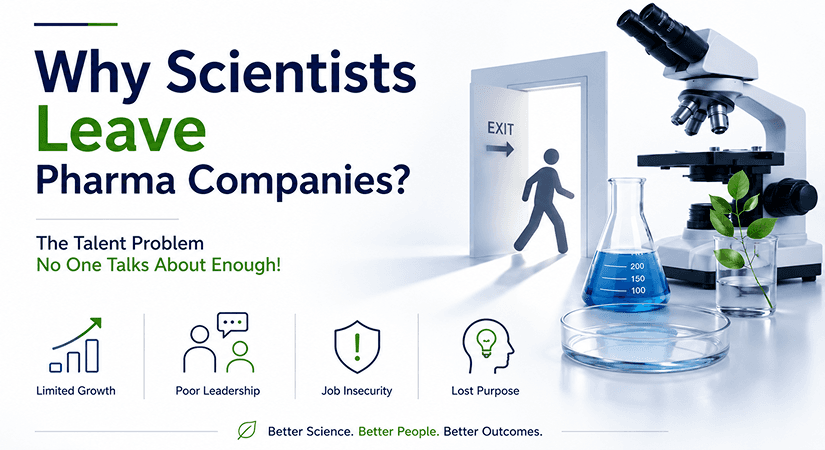
Every year, pharmaceutical companies spend billions finding, hiring, and training scientific talent. They recruit PhD chemists, biologists, clinical researchers, and regulatory scientists who are deeply capable, deeply motivated, and genuinely excited to work on medicines that can change lives. And then, often within two to three years, a significant number of them leave.
This is not a new problem by any means. But it has become a more urgent one. A 2025 comparative workforce survey by Pharmaceutical Technology found that voluntary turnover in the bio-pharma workforce rose from 13.71% in 2024 to 15.91% in 2025 — a year-on-year increase driven not just by layoffs, but by scientists choosing to go.
The same survey found that the proportion of employees who expect their company's prospects to meaningfully improve dropped from 43% to just under 30% in a single year. Pessimism is spreading fast, and pessimism is a precursor to departure.
The pharmaceutical industry is also in the middle of a significant structural upheaval. After more than 13,000 layoffs in the first half of 2025 alone, a 31% year-over-year increase, the instability is affecting not just those who lost their jobs but the scientists who stayed.
When talented colleagues disappear overnight, those left behind start quietly updating their CVs. The question every pharma leader should be asking is not just why scientists leave when pushed. It is why they leave when they choose to.
The Career Growth Problem
For most scientists joining a pharma company, the first few years are energising. There are interesting problems to solve, capable colleagues to learn from, and the genuine satisfaction of working on something that could one day help a patient. But somewhere between year two and year five, something often shifts. The work continues. The progression does not.
Career development is consistently cited as one of the top drivers of voluntary departures from pharma companies. The structured, hierarchical nature of large pharmaceutical organisations means promotion timelines are long, lateral moves are rare, and the path from bench scientist to senior contributor feels opaque and slow. Scientists, who by training are ambitious, curious, and accustomed to measuring progress clearly, find this deeply frustrating.
The problem is compounded in companies that have grown through acquisition. When two organisations merge, career pathways often collapse. Two development tracks become one. Scientists who joined a company for its specific R&D culture now find themselves in an organisation that looks and operates differently and offers them less room to grow.
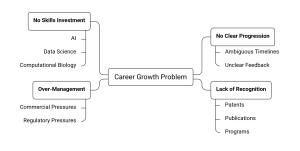
Several specific career frustrations tend to drive scientists toward the exit:
- No Clear Progression Path — Scientists are given no honest timeline or criteria for advancement, and are left interpreting ambiguous feedback
- Lack Of Scientific Recognition — Contributions to publications, patents, and programmes go unacknowledged or attributed primarily to leadership
- Over-Management Of Scientific Decisions — Commercial and regulatory pressure increasingly constrains what scientists can pursue, leaving them with little actual scientific autonomy
- No Investment In skills Development — Particularly in areas like AI, computational biology, and data science, where skills gaps are widening and scientists feel they are being left behind the field
The Culture And Leadership Gap
Scientists do not leave companies. Most of the time, they leave managers. In pharma, where scientific culture is complex and the relationship between scientific integrity and commercial pressure is always in tension, the quality of immediate management matters enormously.
Scientists in pharmaceutical settings frequently describe three specific management failures that push them out:
a) Managers Who Cannot Speak The Science: Scientists managed by people without technical depth feel their work is not being evaluated accurately. When performance reviews miss the nuance of what was achieved, or when credit flows upward without attribution, trust erodes quickly.
2) A Culture Of Fear Around Failure: Drug development fails at high rates. That is not dysfunction — it is biology. But many pharma organisations treat failed experiments as career liabilities rather than valuable learning. Scientists who feel punished for honest negative results eventually leave to find environments where intellectual risk is respected.
3) Disconnection From Mission — Most pharma scientists entered the field to help patients. When daily work becomes consumed by compliance documentation, administrative burden, and process management with no visible connection to patient impact, motivation collapses.
Job Security, Structural Instability, & The Fear Factor
There is a specific dynamic that has become particularly acute in 2024 and 2025: scientists are leaving not just because of day-to-day treatment, but because of what they see coming.
The wave of pharmaceutical layoffs — Novo Nordisk cutting 9,000 positions, Merck targeting 8% of its global workforce, Bayer in a multi-year reduction, Moderna trimming 10%, has created structural uncertainty that is impossible to ignore even for scientists whose immediate jobs are safe.
The most talented scientists have options. When they see their organisation heading into a patent cliff, strategic restructuring, or an M&A integration that historically consolidates R&D teams, they leave before they have to.
They go to smaller biotechs, CROs, or technology companies applying AI to drug discovery, places that feel more stable, more scientifically focused, and more honest about their direction.
Compensation matters too. Salary satisfaction in the bio-pharma workforce fell in 2025, a modest decline that sits on top of rising living costs and increasingly competitive offers from tech employers who have realised that biologically trained scientists are valuable in AI platforms and health tech ventures.
Scientists aren't just leaving companies, they're responding to a global talent race.
Explore why competition for biopharma talent is accelerating and what it means for hiring and retention.
→ Read: The Global Competition For Biopharma Talent: Why The Race Is Accelerating And What It Means For The Industry
What Pharma Companies Can Actually Do?
The good news is that the reasons scientists leave are well-understood, consistently reported, and largely addressable by organisations willing to invest in the solutions.
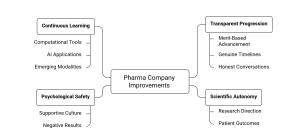
Retention improves when companies commit to four things in real practice, not just in policy documents:
1) Transparent, merit-based career progression with real timelines and regular honest conversations, not vague promises of advancement attached to unmeasurable criteria.
2) Scientific autonomy and mission connection, giving scientists genuine influence over research direction and maintaining a visible, meaningful link between daily work and the patient outcomes that motivated them to join in the first place.
3) Psychological safety around scientific failure, building cultures where a rigorous negative result is valued and used, not quietly buried to protect someone's quarterly review.
4) Investment in continuous learning, actively upskilling scientists in computational tools, AI applications, and emerging modalities, rather than watching them leave to acquire those skills at a competitor or a tech company.
Retaining scientists starts with solving broader workforce challenges. Discover how pharma HR leaders are addressing talent shortages, burnout, and employee retention across the industry.
→ Read: 10 Challenges HR In A Pharma Company Faces And How Leaders Are Solving Them
In Conclusion: The Cost Of Doing Nothing
Replacing a research scientist costs, on average, one to two times their annual salary and takes around six months. The institutional knowledge they carry about the biology, the chemistry, the internal history of a programme, walks out with them and cannot be recovered from an onboarding document. When enough scientists leave, pipeline programmes slow, morale falls, and others in the team notice the pattern and follow.
The answer is not complicated at all. Scientists stay where they grow, where they are genuinely heard, where their work is connected to something that truly matters, and where the organisation is honest with them about its direction. Pharma companies already know this. The ones that act on it are the ones that keep their best people.
FAQs
1. Why Do Scientists Leave Pharma Companies Even When They Have Good Salaries?
While competitive salaries are important, they are rarely the only factor influencing retention. Many scientists leave because of limited career growth, lack of recognition, poor leadership, reduced scientific autonomy, and uncertainty about the organization's future. They also seek workplaces that support continuous learning and provide meaningful opportunities to contribute to innovation. A positive work environment often has a greater impact on long-term retention than compensation alone.
2. What Are The Biggest Factors Driving Scientist Turnover In The Pharmaceutical Industry?
Common reasons include unclear career progression, ineffective management, lack of scientific recognition, workplace instability, fear of layoffs, and limited opportunities to develop new skills. Many scientists also become disengaged when their work feels disconnected from its impact on patients or when innovation is restricted by excessive bureaucracy. These challenges can reduce job satisfaction and encourage talented professionals to explore opportunities elsewhere. Addressing these issues is essential for retaining experienced scientific talent.
3. How Can Pharma Companies Improve Scientist Retention?
Pharmaceutical companies can improve retention by offering transparent career development, investing in continuous learning, encouraging scientific autonomy, and creating a culture where innovation and responsible risk-taking are valued. Strong leadership, open communication, recognition, and psychological safety also play a crucial role in keeping scientists engaged. Organizations that prioritize employee growth and well-being are more likely to retain skilled professionals. This ultimately strengthens innovation, research continuity, and long-term business success.
Reporting on the science, business and regulation shaping the pharmaceutical industry.
More in HR in Pharma
All articles →
Crisis Management: HR's Role in Business Continuity in the Pharmaceutical Industry

Top HR Strategies for Successful Pharma Mergers: People, Culture, and Integration 2025

Discussion