by Nandini Swaminathan, PhD
6 minutes
Bridging the Translational Research Gap: A Successful Partnership Involving a Physician and a Scientist
How physician-scientist partnerships bridge the translational gap in microbiology and drive real-world solutions for India's AMR crisis.

Table of Contents
- Introduction
- Modern Microbiology and the Translational Gap
- The Anatomy of a Genuine Partnership
- What makes a Partnership Work?
- Ethical Use of AI and Clear Research Writing
- Conclusion
- FAQ
Introduction
In 2025 Mumbai hospital trials, promising biosensor developments for detecting S. aureus implant biofilms achieved over 90 % lab accuracy, yet faltered bedside amid blood interferents and workflow mismatches, exemplifying how 70 % of microbiology innovations fail in translation, fuelling India's 1.3 million annual antimicrobial resistance (AMR) deaths.
Translational research, the journey from laboratory discovery to bedside treatment, remains a formidable challenge in the pharmaceutical industry, exacerbated by surging AMR and implant infections. While basic research unravels biological mechanisms, clinical success demands patient safety, real-world feasibility, and regulatory compliance. In India, overwhelmed hospitals further complicate long trials and practical deployment.
This article explores how physician-basic scientist partnerships, backed by structured project management, bridge this translational gap, turning lab insights into market-ready diagnostics amid 2026's precision medicine shift.
The Translational Gap in Modern Microbiology
The translational gap, widely known as the "Valley of Death" in drug development, marks the perilous phase in which basic research funding ends, yet clinical-stage investment remains elusive. This funding chasm proves especially brutal in microbiology, where diagnostics and antimicrobials struggle to cross from technology readiness level (TRL) 3 (proof-of-concept) to TRL 6 (clinical prototype).
Consider a biosensor detecting Staphylococcus aureus with 95 % lab sensitivity that falters amid clinical interferences like blood proteins, synovial fluid matrices, and biofilm complexity.
In India, orthopaedic implant infections plague 5-10% of procedures, with S. aureus biofilms driving chronic failures that demand costly revisions. Data reveals ~60 % of these translational failures stem not from flawed science, but from ignoring clinical realities including messy samples, workflow constraints, and patient variability that sterile lab conditions never replicate.
Regulatory challenges amplify this Valley of Death: central drugs standard control organizations (CDSCO) Phase I-II trials for diagnostics span 18-36 months, with >40 % rejection rates due to inadequate preclinical data bridging. Ethical reviews by institutional review boards (IRBs) often add 6-12 months, scrutinizing patient consent for implant studies and AMR surveillance.
India's New Drugs & Clinical Trials Rules, 2019 tightened diagnostic approvals, requiring multi-centric validation and post-market surveillance plans that most early-stage projects lack. Global alignment with U.S. Food and Drug Administration/ European Medicines Agency (USFDA/EMA) further complicates timelines, as Indian council of Medical Research (ICMR)-funded microbiology projects must meet international bioequivalence standards.
Closing this gap demands structured collaboration from ideation such as, clinician-defined problem identification, scientist-led mechanistic validation, and bedside impact assessment. This will help to deliver market-ready diagnostics amid India's overburdened healthcare reality.
The Anatomy of a Genuine Partnership
When scientists and physicians collaborate, they create a bilingual environment where laboratory precision meets clinical reality essential for a senior audience expecting depth and credibility in microbial insights.
The Scientist’s Role: Delivering Mechanistic “Insight”
Scientists own the “how” molecular mechanisms, high resolution data and reproducibility.They deliver the genomics for pathogen tracking, visualisation of peptide polysaccharide binding in the biofilms, and rigorous validation ( qPCR, confocal microscopy etc.). In future, AI-assisted biofilm models validated against patient cohorts will elevate this precision further.
The Physicians Role : Ensuring clinical "Implications"
Clinicians offer the “why it matters” safety profiles including feasible dosing amid Asia’s AMR surge, and workflow integration. Furthermore, they assess how therapies fit ICU protocols, potentially slashing implant revision rates by 30 % through targeted interventions that respect hospital realities.
Proven Collaboration Models
- Mayo Clinic Clinician-scientist teams : Mayo’s clinician-investigator training program embeds infectious disease (ID) specialists within microbiology labs from project inception. A notable example would be their 2024 collaboration where they developed a rapid S.aureus genomic diagnostic that cut sepsis mortality rate by 25 %.
- This was achieved by combining scientist-led co-gemone sequencing with clinician-defined blood culture endpoints. This co-localised model accelerates from bench discovery to bedside validation 40 % faster than traditional soiled research.
- Broad Institute translational Programs : The Infectious disease initiative pairs computational biologists with clinician-epidemologists to tackle resistance. Their 2025 Klebsiella resistance project used AI to predict carbapenemase genes from hospital surveillance data. Later, they validated clinical utility through physician-led de-escalation protocols advancing from computational models (TRL 3) to ICU deployed algorithms (TRL 6) in 18 months.
Clear Role Synergies :
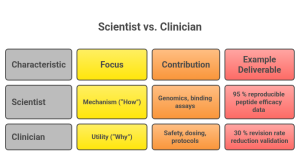
This structured partnership transforms raw data into market-ready solutions, with defined handsoff ensuring both technical and bedside relevance.
What makes a partnership Work?
Several factors influence whether these collaborations succeed:
Shared goals
Both sides need to agree on a common scientific challenge and stay committed to translating discoveries into real benefits for the public.
Respect for expertise
Recognise that scientists and clinicians approach problems differently. Valuing these perspectives promotes open, productive discussions rather than siloed thinking.
Frequent & open communication
Regular meetings and honest communications help refine ideas, interpret data more meaningfully, and adapt strategies to real-world needs.
Institutional backing
Multidisciplinary thrives with shared spaces, access to biobanks and dedicated funding for translational work.
Long-term vision
These collaborations shouldn’t just be about individual projects, they help shape a culture that values impactful, patient-focused research over time.
Ethical Use of AI
With AI tools proliferating different domains including life sciences, ethical integration is paramount balancing innovation with transparency and human oversight for credible output.
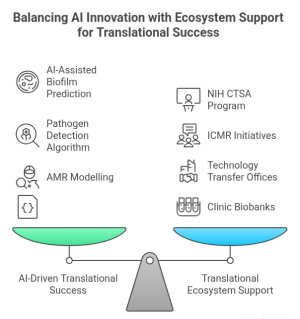
AI outputs driving translational success :
Several technologies have come to light empowering clinician-scientist partnerships.
- AI-assisted Biofilm Prediction : Models like AlphaFold 3 predict S.aureus matrix proteins ≅ 85 % accuracy, guiding peptide designs that clinicians validate for implants coatings.
- Pathogen Detection Algorithm : Convolutional neural network (CNN) based biosensors analyze raman spectra for rapid Klebsiella ID in blood cultures, cutting down their time results from 48 to 2 hours.
- AMR Modelling : Genomic ML platforms forecast resistance patterns from ICMR surveillance data, enabling clinicians-scientist teams to prioritize stewardship interventions.
Although AI tools enhance scientific technology, ethical guardrails are essential. This demands for strict transparency. AI handles hypothesis and data synthesis, but humans own clinical validation and final outputs.
Supporting Translational Ecosystem :
- National Institute of Health and Clinical Translational Science Awards (NIH CTSA) Program : 60+ centers fund clinician-scientist collaboration, bridging the valley of death with $ 2B + awards.
- Indian Council of Medical research (ICMR) initiatives : India’s AMR surveillance Network supplies clinic biobanks for model training; Translational Health Science Technologies accelerate diagnostics.
- Technology Transfer Offices (TTO) : BIRAC TTOs commercialize IP, handling 200+ microbiology patents annually.
- Clinic Biobanks : ICMR-NIV repositories provide about 10,000+ Indian isolates for real-world validation.
India’s AMR crisis
With 1.3M annual deaths, hospital acquired infections (HAIs) like implants SSIs (5-10% , orthopedic rate) demand AI-accelerated translation. structured oversight ensures these tools deliver patient impact than ethical compromise.
Conclusion
Physician-scientist partnership represents far more than collaboration. They are strategic engines driving microbiological innovations across the translational gap. From AI powered biofilm prediction to clinician-validated diagnostics, this article highlighted how structured teamwork transforms lab discoveries to market ready solutions that confront India’s AMR crisis head-on.
FAQs
Q1. What’s the main reason translational research sometimes fails?
Often, it's because early clinical insights are missing, leading to innovations that don’t quite fit real-world scenarios, such as biofilms that slip past hospital diagnostics.
Q2. When should a doctor get involved in basic research?
Ideally, right from the start, during idea formation, so that patient needs are embedded early on, boosting chances of success by up to half.
Q3. How does project management help these collaborations?
It keeps everyone on track, aligning technical progress with business goals through tools like Jira or Veeva, ensuring steady progress and clear milestones.
Q4. What can companies do to foster better teamwork between scientists and clinicians?
Set clear standards such as SOPs for joint reviews, shared data platforms, and targeted training on issues including antimicrobial resistance to build a stronger, more integrated approach.