Types of Capsule Filling Machines: A Complete Guide for Pharma Manufacturers
From manual to fully automatic, here's how to choose the right capsule filling machine for your production scale, formulation type, and GMP needs.

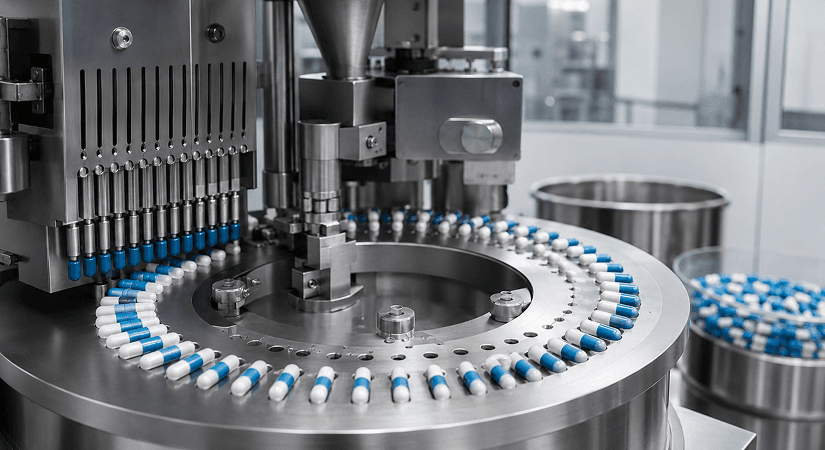
Capsules are among the most trusted dosage forms in the pharmaceutical and nutraceutical industries. Behind every capsule on the pharmacy shelf is a machine that measures, fills, and seals it with precision. Choosing the right capsule filling machine affects product quality, batch consistency, and regulatory compliance.
This guide breaks down the main types of capsule machines, how they work, and how to pick the right one for your production needs.
What Is a Capsule Filling Machine?
A capsule filling machine is purpose-built to produce consistently dosed capsules at scale by automating the entire fill and seal process. Depending on the formulation, these machines can be configured to handle powder, liquid, or granulated ingredients with equal precision.
What Does a Capsule Filling Machine Do?
A capsule filling machine, also called an encapsulator, separates empty capsule shells into two parts (body and cap), fills the body with a measured dose of powder, granules, pellets, or liquid, and then rejoins the cap and body into a finished capsule. The goal is consistent fill weight, minimal powder loss, and a sealed capsule that meets dosage accuracy requirements set by pharmacopeial standards such as the USP and IP.
What Are the Main Types of Capsule Filling Machines?
Capsule filling machines are generally grouped by their level of automation: manual, semi-automatic, and fully automatic. A fourth category, liquid and oil-based capsule fillers, serves a different formulation need altogether.
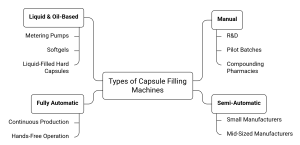
1. Manual Capsule Filling Machines
Manual machines are the simplest and most affordable option. An operator places empty capsules into a loading plate by hand, spreads powder across the tray, and manually locks the caps and bodies together using a hand-operated press.
Key traits of manual machines:
- Best suited for research labs, compounding pharmacies, and very small production runs
- Typically handles a few hundred capsules per batch
- Low capital cost and simple to maintain
- Require significant manual labour and are prone to operator-dependent variation in fill weight
- Not suitable for GMP-scale commercial manufacturing
Manual machines remain popular for pilot batches, formulation trials, and small nutraceutical businesses that don't yet need high throughput.
2. Semi-Automatic Capsule Filling Machines
Semi-automatic machines bridge the gap between manual effort and full automation. The machine handles capsule separation, powder dosing, and rejoining through a motorised, programmable cycle, while an operator still loads capsules onto the loading ring, monitors the process, and unloads finished capsules.
These machines commonly use a loading ring or plate mechanism to move capsules through the filling stations. They are built from pharmaceutical-grade stainless steel to meet cleanability and hygiene standards expected in GMP environments.
Semi-automatic machines suit small to mid-sized manufacturers, contract manufacturers running multiple small-batch products, and businesses that need better accuracy than manual filling but can't yet justify a fully automatic line. Output can range from a few thousand to around 15,000–25,000 capsules per hour, depending on the model and capsule size, making these machines a practical middle step for growing operations.
3. Fully Automatic Capsule Filling Machines
Fully automatic machines are designed for high-volume, continuous production with minimal human involvement. They handle every step automatically: capsule feeding, orientation, separation, dosing, tamping or metering, rejoining, and ejection of finished capsules, often with in-line weight-checking systems to reject underweight or overweight capsules.
Automatic machines use one of two motion types:
- Intermittent motion: The turret stops briefly at each station to complete an action before moving to the next. This design is common in many mid- to high-speed machines and enables precise control at each step.
- Continuous motion: The turret keeps moving without stopping, and all filling actions happen while the capsules are in motion. This design supports very high speeds and is used in some of the fastest commercial encapsulators on the market.
Dosing on automatic machines is usually achieved through one of these mechanisms:
- Dosator (tamping pin) system: Powder is compressed into a plug using tamping pins and pushed into the capsule body. This works well for a wide range of powder densities.
- Auger/dosing disc system: A rotating screw or perforated disc meters powder by volume into the capsule, often used for free-flowing powders and granules.
- Vacuum-based dosing: Powder is drawn into dosing chambers under vacuum, useful for very fine or cohesive powders.
Fully automatic machines are the standard choice for large pharmaceutical plants and established nutraceutical producers because they combine speed with tight dosage control and lower labour dependency.
4. Liquid and Oil-Based Capsule Filling Machines
Not every capsule contains powder. Softgel and liquid-filled hard capsule machines dose oils, suspensions, or semi-solid formulations using metering pumps or piston-dosing systems, and they often include a banding or sealing step to prevent leakage. They are essential for products such as fish oil supplements, vitamin E capsules, and certain liquid-filled drug formulations.
Comparison Table:
The machine type follows the capsule type, and hard and soft gelatin capsules are built very differently.
Here's the full formulation comparison before you spec your filling line.
→ Read: What is Difference Between Hard and Soft Gelatin Capsules
How to Choose the Right Capsule Machine
Selecting the right machine depends on more than budget. Weigh production volume, formulation type, and available floor space before deciding.
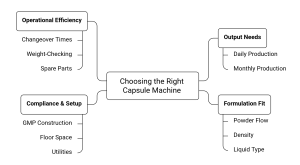
Checklist for choosing a capsule filling machine:
- Confirm your required daily or monthly production volume
- Identify your formulation type (powder, granules, pellets, or liquid)
- Check the dosing mechanism compatibility with your powder's flow and density
- Verify the machine meets GMP construction standards (stainless steel contact parts, easy cleaning)
- Assess available floor space and utility requirements
- Review in-line weight-checking or rejection capabilities
- Consider the changeover time if you run multiple products
- Factor in long-term maintenance and spare parts availability
Choosing the right filler is step one. Verifying every capsule meets weight spec is step two.
Here's why checkweighers are non-negotiable for oncology and potent drug capsule lines.
→ Read: Capsule Checkweighers for Oncology & Potent Drugs
Conclusion
There is no single "best" capsule filling machine. A compounding pharmacy filling a few hundred capsules a week has different needs than a manufacturer running three shifts.
Manual machines suit small trials, semi-automatic machines support growing businesses, fully automatic machines handle mass production, and liquid-fill machines address a different formulation category. Matching the machine to your production scale and formulation type protects both product quality and manufacturing efficiency.
FAQs
1. What is the main difference between semi-automatic and fully automatic capsule machines?
Semi-automatic machines still need an operator to load and unload capsules, while fully automatic machines handle the entire process with minimal human involvement.
2. Which capsule filling machine is best for a small nutraceutical startup?
A semi-automatic machine is usually the best fit, offering better accuracy and speed than manual filling without the high cost of a fully automatic line.
3. What is the difference between intermittent and continuous motion machines?
Intermittent motion machines pause briefly at each filling station, while continuous motion machines keep moving throughout the entire filling cycle, allowing higher speeds.
4. Can capsule filling machines handle both powders and liquids?
Standard capsule fillers are built for powders, granules, or pellets. Liquid and oil-based formulations require dedicated liquid-fill or softgel machines.
5. What dosing method is most accurate for fine powders?
Vacuum-based dosing and dosator systems generally handle fine or cohesive powders more accurately than auger-based systems.
Reporting on the science, business and regulation shaping the pharmaceutical industry.
More from the Knowledge Hub
All articles →
Pharmaceutical Regulatory Affairs: Challenges, Innovations, and Global Harmonization

Cold Chain Logistics in Pharma: Building Resilient Supply Chains

Discussion