Big Pharma’s Appetite For AI: Analyzing Recent M&A Deals In Small Molecule Chemistry
AI in drug discovery is reshaping small molecule chemistry through M&A Recursion, Exscientia, Schrödinger and Insilico lead the wave.

Artificial intelligence is rapidly becoming one of the most influential technologies in the pharmaceutical industry. While AI has already transformed sectors such as finance, retail, and manufacturing, its impact on healthcare and drug development is now attracting significant attention.
Among the many applications of AI in life sciences, small molecule drug discovery has emerged as a major area of interest for pharmaceutical companies, investors, and biotechnology startups alike.
For decades, small molecule drugs have formed the foundation of modern medicine. They are used to treat a wide range of diseases, including cancer, cardiovascular conditions, infectious diseases, neurological disorders, and metabolic illnesses.
However, discovering and developing these medicines remains a complex, expensive, and time-consuming process. It can take more than ten years and billions of dollars to bring a single drug from the laboratory to the market, and many drug candidates fail before reaching patients.
Faced with rising development costs and increasing pressure to improve research productivity, pharmaceutical companies are actively exploring new technologies that can accelerate innovation. Artificial intelligence has emerged as one of the most promising solutions.
As a result, major pharmaceutical organizations are pursuing acquisitions, mergers, licensing agreements, and strategic partnerships with AI-focused biotech companies that specialize in small molecule chemistry.
These deals are not simply about acquiring new software tools. They represent a broader shift in how pharmaceutical companies approach research and development. By combining AI with chemistry, biology, and computational science, the industry hopes to discover better medicines faster and more efficiently than ever before.
Understanding Small Molecule Drug Discovery
Small molecules are low-molecular-weight chemical compounds capable of entering cells and interacting with biological targets such as proteins, enzymes, and receptors.
Because of their ability to influence biological processes, they have become one of the most widely used forms of medicine. Common examples include treatments for high blood pressure, diabetes, infections, and various forms of cancer.
The traditional process of discovering small molecule drugs is highly complex and typically involves several stages:
- Identifying a biological target linked to a disease.
- Screening large libraries of chemical compounds.
- Optimizing promising molecules for effectiveness and safety.
- Conducting preclinical testing.
- Advancing successful candidates into clinical trials.
Although this process has led to many medical breakthroughs, it is also associated with significant challenges. Researchers often evaluate thousands or even millions of compounds before identifying a viable candidate.
Many promising molecules fail during later stages of development due to safety concerns, lack of effectiveness, or unexpected side effects. As a result, the pharmaceutical industry has long sought methods to improve efficiency and reduce the risk of failure.
This is where artificial intelligence is beginning to play a transformative role. By helping researchers analyze data more effectively and make smarter decisions earlier in the discovery process, AI has the potential to fundamentally change how small molecule drugs are developed.
How AI Is Transforming Small Molecule Chemistry?
Artificial intelligence offers pharmaceutical researchers powerful tools for managing the enormous amounts of data generated during drug discovery. Modern drug development produces information from laboratory experiments, genetic studies, clinical research, chemical databases, and scientific literature. Analyzing these datasets manually can be both difficult and time-consuming.
AI systems can process this information at a scale and speed that would be impossible for traditional research methods. Machine learning algorithms can identify hidden patterns, predict molecular behavior, and generate insights that help scientists make better decisions throughout the discovery process.
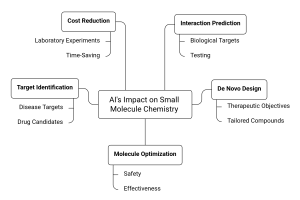
Some of the most important applications of AI in small molecule chemistry include:
- Predicting how molecules will interact with biological targets.
- Designing entirely new chemical compounds.
- Optimizing existing molecules to improve safety and effectiveness.
- Identifying novel disease targets.
- Prioritizing the most promising drug candidates.
- Reducing the number of costly laboratory experiments.
One of the most important applications of AI is predicting how molecules will interact with biological targets. Instead of relying entirely on laboratory experiments, researchers can use AI models to estimate whether a compound is likely to be effective before investing significant resources in testing.
AI is also being used to design entirely new molecules. Rather than screening existing chemical libraries, advanced algorithms can generate novel compounds tailored to specific therapeutic objectives. This capability expands the range of potential drug candidates and may lead to treatments that would not have been discovered through conventional methods.
Another important benefit is optimization. Drug candidates often require multiple rounds of modification before they are suitable for clinical development. AI can help researchers identify the most promising changes to a molecule's structure, reducing the number of experiments needed and accelerating progress.
As these technologies continue to improve, many experts believe AI could significantly reduce development timelines while increasing the probability of success.
Why Is Big Pharma Investing Heavily In AI?
The pharmaceutical industry faces a difficult challenge. While scientific knowledge continues to expand, the cost of developing new medicines has increased dramatically. At the same time, competition among pharmaceutical companies has intensified, and investors expect continuous innovation.
AI offers a potential solution to many of these challenges. By improving efficiency during the earliest stages of drug discovery, AI can help companies reduce research costs and bring new therapies to market more quickly. Even small improvements in productivity can generate substantial financial benefits when applied across large research organizations.
Several factors are driving big pharma's growing interest in AI:
- Rising research and development costs.
- Increasing pressure to accelerate drug discovery timelines.
- The need to strengthen future drug pipelines.
- Greater competition in key therapeutic areas.
- Opportunities to create new intellectual property.
- Access to unique datasets and advanced technologies.
Another reason for growing investment is the need to strengthen drug pipelines. Pharmaceutical companies depend on a steady flow of new products to replace older medicines that lose patent protection. AI-powered discovery platforms may help identify novel therapeutic opportunities and create new sources of intellectual property.
Competitive pressure is also driving adoption. As more companies invest in AI, organizations that fail to embrace these technologies risk falling behind their rivals. Pharmaceutical executives increasingly view AI as a strategic necessity rather than an optional research tool.
Furthermore, AI companies often possess valuable proprietary datasets and specialized expertise. Acquiring these capabilities can provide pharmaceutical firms with long-term advantages that are difficult for competitors to replicate.
These factors have contributed to a growing wave of mergers, acquisitions, and strategic partnerships throughout the industry.
Recent M&A Deals And Strategic Partnerships
The growing interest in AI has led pharmaceutical companies to pursue a variety of deal structures, ranging from research collaborations to full-scale acquisitions. While outright acquisitions have been relatively limited compared to other sectors, strategic partnerships have become increasingly common.
Some of the most notable examples include:
1) Recursion Pharmaceuticals & Exscientia
One of the most significant developments was the merger between Recursion Pharmaceuticals and Exscientia. Both companies had established themselves as leaders in AI-driven drug discovery, combining expertise in machine learning, automation, computational biology, and medicinal chemistry. By joining forces, the organizations aimed to create a larger and more comprehensive platform capable of accelerating therapeutic development across multiple disease areas.
2) Isomorphic Labs Partnerships
Another company attracting significant attention is Isomorphic Labs. Leveraging advanced AI technologies, the company has entered partnerships with major pharmaceutical organizations seeking to improve drug discovery through computational approaches. These collaborations highlight the industry's growing confidence in AI-powered molecular design.
3) Schrödinger Collaborations
Schrödinger represents another important example. Known for combining physics-based simulations with machine learning techniques, the company has established partnerships with numerous pharmaceutical firms. Its technology helps researchers understand molecular interactions and prioritize promising compounds before expensive laboratory testing begins.
4) Insilico Medicine Agreements
Insilico Medicine has also emerged as a key player in the AI drug discovery landscape. The company gained widespread recognition after successfully advancing AI-designed drug candidates into clinical trials. This achievement provided evidence that AI-generated discoveries can progress beyond theoretical research and enter real-world pharmaceutical development.
Collectively, these deals demonstrate how pharmaceutical companies are increasingly viewing AI-driven organizations as valuable partners in the search for new medicines.
Schrödinger and Insilico keep showing up in the same deal conversations.
Their actual approaches couldn't be more different.
→ Read: Schrodinger vs. Insilico Medicine: A Comparison Report
What Pharmaceutical Companies Look For In AI Startups?
Not every AI startup becomes an attractive acquisition target. Pharmaceutical companies typically evaluate several factors before committing significant resources to a partnership or acquisition.
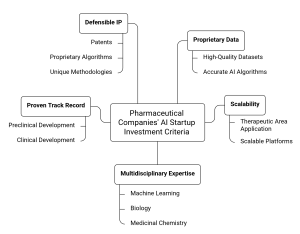
The most important criteria include:
- High-quality proprietary datasets.
- Scalable technology platforms.
- Strong scientific and technical expertise.
- Demonstrated success in drug discovery programs.
- Valuable intellectual property and patents.
- The ability to support multiple therapeutic areas.
One of the most important considerations is data quality. AI models depend heavily on the information used to train them. Companies with large, high-quality, proprietary datasets often have a competitive advantage because their algorithms can generate more accurate predictions.
Technology platforms are equally important. Pharmaceutical firms prefer solutions that can be applied across multiple therapeutic areas rather than tools designed for a single disease. A scalable platform offers greater long-term value and creates opportunities for future research programs.
Scientific expertise also plays a crucial role. Successful drug discovery requires knowledge that extends beyond artificial intelligence. Teams that combine expertise in medicinal chemistry, biology, pharmacology, and machine learning are particularly attractive because they understand both the scientific and technological aspects of drug development.
Another major factor is demonstrated success. Pharmaceutical companies want evidence that an AI platform can generate meaningful results. Startups that have advanced drug candidates into preclinical or clinical development often receive greater attention from potential partners.
Intellectual property is another important consideration. Patents, proprietary algorithms, and unique methodologies can provide valuable competitive advantages and strengthen a company's long-term market position.
Challenges Facing AI-Driven Drug Discovery
Despite the excitement surrounding AI, significant challenges remain. While the technology has shown impressive capabilities, many questions about its long-term impact on drug development remain unanswered.
Some of the biggest challenges include:
- Limited clinical validation of AI-discovered drugs.
- Dependence on high-quality datasets.
- Regulatory uncertainty.
- Integration challenges following mergers and acquisitions.
- High expectations from investors and stakeholders.
One challenge is the limited amount of clinical validation available today. Although AI has successfully contributed to several drug discovery programs, relatively few AI-generated therapies have completed the full development process and reached the market. As a result, researchers and investors are still evaluating whether AI consistently improves clinical success rates.
Data quality presents another obstacle. AI models can only perform as well as the information they receive. Incomplete, inconsistent, or biased datasets may lead to inaccurate predictions and poor decision-making.
Regulatory uncertainty also remains a concern. As AI becomes more deeply integrated into pharmaceutical research, regulatory agencies may introduce new requirements related to transparency, validation, and accountability. Companies will need to demonstrate that their AI-driven approaches meet rigorous scientific and regulatory standards.
Integration challenges can also arise following mergers and acquisitions. AI startups often operate with different cultures, structures, and workflows compared to large pharmaceutical organizations. Successfully combining these environments requires careful planning and strong leadership.
Billions are flowing into AI drug discovery deals.
Whether that's actually cutting R&D costs is a separate, harder question.
→ Read: Quantifying the ROI: Do AI Chemistry Platforms Actually Reduce Pharma R&D Costs?
The Future Of AI In Small Molecule Chemistry
The pharmaceutical industry's appetite for AI shows no signs of slowing down. Advances in machine learning, computational power, and data availability are expected to further enhance the capabilities of AI-driven drug discovery platforms in the coming years.
Several trends are likely to shape the future of this field:
- More AI-driven mergers and acquisitions.
- Increased collaboration between pharma companies and biotech startups.
- Greater use of generative AI for molecular design.
- Faster identification of drug candidates.
- Improved integration of biological and chemical datasets.
- A growing number of AI-designed therapies entering clinical trials.
Future mergers and acquisitions will likely focus on companies that can demonstrate measurable improvements in speed, efficiency, and clinical outcomes. As more AI-generated drug candidates enter human trials, the industry will gain a clearer understanding of the technology's true potential.
Many experts believe the future of drug discovery will involve close collaboration between human scientists and artificial intelligence systems. Rather than replacing researchers, AI will serve as a powerful tool that helps scientists make better decisions, identify opportunities more quickly, and focus resources on the most promising areas of investigation.
As pharmaceutical companies continue investing in AI-driven innovation, the technology is expected to play an increasingly important role throughout the entire drug development lifecycle.
In Conclusion
Artificial intelligence is rapidly becoming a central component of modern pharmaceutical research, particularly in the field of small molecule chemistry. Faced with rising costs, lengthy development timelines, and growing competitive pressures, pharmaceutical companies are turning to AI as a way to improve efficiency and accelerate innovation.
Recent mergers, acquisitions, and strategic partnerships involving AI-focused biotech firms demonstrate the industry's strong commitment to these technologies. Companies such as Recursion, Exscientia, Isomorphic Labs, Schrödinger, and Insilico Medicine have shown how AI can contribute to discovering and developing new therapies.
While challenges related to clinical validation, data quality, and regulatory oversight still exist, the momentum behind AI-driven drug discovery continues to grow. As technologies mature and more AI-designed medicines advance through clinical development, their impact on the pharmaceutical industry is likely to become increasingly significant.
For big pharma, AI is no longer simply an emerging technology, it is becoming a critical part of the future of drug discovery and healthcare innovation.
FAQs
1. Why Are Pharmaceutical Companies Investing Heavily In AI For Small Molecule Drug Discovery?
Pharmaceutical companies are investing in AI because it has the potential to reduce drug discovery timelines, lower research costs, and improve the efficiency of identifying promising drug candidates. AI can analyze large datasets, predict molecular behavior, and support decision-making throughout the development process. This helps organizations strengthen their research pipelines and accelerate innovation in highly competitive therapeutic areas. As a result, AI is increasingly viewed as a strategic tool for future pharmaceutical growth.
2. How Is AI Transforming Small Molecule Chemistry?
AI is helping researchers predict drug-target interactions, design novel molecules, optimize chemical structures, and identify new therapeutic opportunities more efficiently than traditional methods alone. These technologies can process vast amounts of biological and chemical data to uncover patterns that may not be easily identified through manual analysis. By reducing the number of required laboratory experiments, AI can help accelerate early-stage research and improve resource allocation. This has made AI an increasingly important component of modern drug discovery programs.
3. What Do Pharmaceutical Companies Look For In AI-Focused Biotech Startups?
Pharmaceutical companies typically seek startups with strong scientific expertise, proprietary datasets, scalable technology platforms, and proven drug discovery capabilities. They also evaluate the quality of intellectual property, the strength of the leadership team, and evidence that the technology can generate meaningful research outcomes. Startups that combine expertise in artificial intelligence, chemistry, and biology are often considered particularly attractive partners. Demonstrated progress in advancing drug candidates can further increase interest from potential investors and acquirers.
Reporting on the science, business and regulation shaping the pharmaceutical industry.
More in Leadership
All articles →
Essential Leadership Skills for Success in the Pharmaceutical Industry
Pharmaceutical Regulatory Affairs: Roles, Skills, and Roadmap

Discussion