FDA Computer Software Assurance (CSA): A Definitive Guide for Pharma Leaders
FDA Computer Software Assurance explained, CSA vs CSV, six step framework, SaaS validation and implementation roadmap for pharma leaders.


The Day the Old Playbook Expired, September 24, 2025. For quality and IT leaders in pharmaceutical and medical device companies, it was the day three decades of validation doctrine officially changed.
The FDA's Center for Devices and Radiological Health (CDRH) and the Center for Biologics Evaluation and Research (CBER) jointly released the final guidance: "Computer Software Assurance for Production and Quality System Software." An updated version followed on February 3, 2026, further aligning the guidance with the newly effective Quality Management System Regulation (QMSR).
This was not an incremental tweak. It was a fundamental rewrite of how software validation is conducted, documented, and defended in regulated life sciences environments. And for pharma leaders who have lived through the paper-heavy, audit-driven world of Computer System Validation (CSV), the implications are profound.
"FDA is encouraging adoption of advanced manufacturing technologies by providing a more iterative, agile approach for software validation." — FDA Federal Register Notice, September 24, 2025
This guide is your strategic roadmap. We explain the why, the what, and the how of the FDA CSA final guidance — with the frameworks, data, checklists, and real-world context that pharma leaders need to act decisively.
Part I: The Problem That Made CSA Necessary
Twenty Years of Paper-Driven Validation
To understand why CSA matters, you must first understand what it replaces. Computer System Validation (CSV), governed by FDA's General Principles of Software Validation (2002) and 21 CFR Part 11 (1997), became the gold standard for regulated software assurance across pharma and medical device manufacturing.
In principle, CSV was sound: validate software before use, document the process, maintain records for inspection. In practice, it became something else entirely.
Industry veterans describe CSV documentation as generating "great mountains of paper" — plans, requirements matrices, traceability documents, IQ/OQ/PQ protocols, scripted test cases, and reports that filled binders but rarely reflected actual system risk. A 2022 industry analysis found that CSV activities for a mid-complexity SaaS platform could consume 6 to 18 months and generate documentation packages exceeding 500 pages — regardless of whether the software touched a critical patient safety function.
An ISPE/GAMP South Asia industry survey (March 2024) found that only 14% of participants felt they strongly understood CSA, while 31% had never heard of it and 55% were unclear on how it differed from CSV. This represented the baseline awareness gap that the FDA's final guidance needed to bridge.
The Digital Transformation Crisis
While validation teams were generating documentation, the technology landscape moved at an entirely different speed. Cloud services, SaaS platforms, automated manufacturing execution systems, and AI-powered QMS tools proliferated.
Global cloud spending by medical device and pharma manufacturers grew from $2.0 billion in 2021 to an estimated $4.4 billion by 2024, driven by SaaS adoption in quality, supply chain, and manufacturing operations. Traditional CSV was structurally incompatible with this reality.
SaaS vendors release updates continuously. Cloud platforms update infrastructure automatically. A CSV protocol written in January for a system that has been updated twelve times by December is, in regulatory terms, a document about a system that no longer exists.
The FDA recognized this gap. The Case for Quality initiative, launched in 2011, began the intellectual groundwork. By 2015, a joint FDA-industry team concluded that a new paradigm — Computer Software Assurance — could deliver the same quality confidence with dramatically lower validation burden.
The Data Integrity Wake-Up Call
FDA warning letters and 483 observations related to computer system validation failures climbed consistently through the 2010s and early 2020s. Between 2018 and 2023, the FDA issued over 140 warning letters citing inadequate software validation as a contributing factor in data integrity failures.
Critically, however, FDA inspectors also noted a paradox: many organizations with extensive CSV documentation still had data integrity failures. Excessive documentation did not equate to true quality assurance. This paradox made the case for a risk-focused approach impossible to refute.
CSV documentation failures drove 140+ FDA warning letters between 2018 and 2023.
The pattern behind them is more predictable than most realize.
→ Read: The Pattern Behind FDA Warning Letters: What Startups & CDMOs Often Miss
Part II: What Is the FDA CSA Final Guidance?
Scope and Applicability
The CSA final guidance provides recommendations for computers and automated data processing systems used as part of medical device production or the quality system. This includes:
- On-premises software (ERP, MES, LIMS, eQMS)
- Cloud-based platforms (IaaS, PaaS, SaaS)
- Automated data processing systems used in production
- Learning Management Systems (LMS) used for GMP training
- CAPA management tools, document management systems, complaint handling software
What it does NOT cover: Software that is itself a medical device (Software as a Medical Device, SaMD) — that remains under separate device software guidance.
The guidance formally supersedes Section 6 of FDA's 2002 General Principles of Software Validation, which governed validation of automated process equipment and quality system software. CSA is now the controlling reference.
The Defining Principle: Intended Use + Risk
The core philosophical shift of CSA can be summarized in four words: intended use drives risk. Rather than validating all features of all software used in a GMP environment, manufacturers are directed to:
- Define what each software feature or function is actually used for in the production or quality system context
- Assess the process risk of that intended use — would a failure foreseeably compromise patient safety or product quality?
- Apply assurance activities proportionate to that risk
This is structurally different from traditional CSV, which applied uniform validation rigor to all features of in-scope systems.
Table 1: CSV vs. CSA — A Structural Comparison
Part III: The CSA Six-Step Framework
The CSA six-step framework (enumerated in Section V.A of the guidance) is the operational heart of the new approach. Every pharma and medical device quality leader should know this framework with precision.
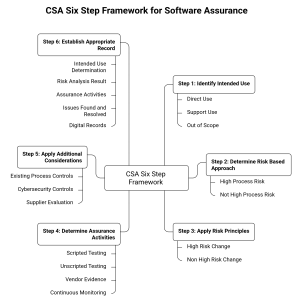
Step 1: Identify the Intended Use
The first question is not "Is this software in-scope?" but "What specific functions of this software are used in production or the quality system?"
FDA distinguishes between:
- Direct use: Software or features used directly in production (e.g., MES batch record generation, automated dispensing controls)
- Support use: Software used to support production or the QMS (e.g., LMS delivering GMP training, document management storing SOPs)
- Out-of-scope: General business applications with no GMP nexus (e.g., HR payroll software, general email)
The regulatory obligation under 21 CFR 820.70(i) applies when software is used directly or to support production/QMS activities. Intended use drives the scope of assurance required.
Step 2: Determine the Risk-Based Approach
With intended use defined, manufacturers classify each function as:
- High process risk: A failure could foreseeably create a quality problem that compromises patient safety or product quality. This requires more rigorous assurance activities.
- Not high process risk: A failure would not foreseeably compromise safety or product quality. This requires proportionally less rigorous assurance.
The FDA provides explicit examples in the final guidance. The same ERP module used for financial reporting (not high process risk) versus lot traceability in production (potentially high process risk) requires different assurance approaches — even within the same software system.
Step 3: Apply Risk Principles to Software Changes
Software change management under CSA requires the same risk logic applied to the change, not just the original implementation:
- High-risk change (could affect patient safety): Triggers more rigorous assurance, and for PMA/HDE medical devices, may require a 30-day notice to FDA
- Non-high-risk change (no foreseeably safety impact): Addressed through targeted regression testing; for PMA/HDE devices, may be reportable in the annual report
This framework eliminates the common CSV trap of treating every software update — including cosmetic UI changes and back-end infrastructure patches — as requiring full revalidation.
Step 4: Determine Appropriate Assurance Activities
CSA explicitly endorses a menu of assurance activities that can be selected and combined based on risk:
Scripted Testing: Formal test cases with pre-defined steps, expected results, and recorded outcomes. Appropriate when repeatability, traceability, or auditability are required. Analogous to traditional OQ/PQ protocols.
Unscripted Testing: Includes scenario-based testing, exploratory testing, and error-guessing. Appropriate for discovering unexpected behaviors, usability issues, and edge cases that scripted protocols miss. FDA explicitly endorses this approach for lower-risk functions.
Vendor/Developer Evidence: Certifications, SDLC documentation, SOC 2 reports, ISO 27001 certifications, cybersecurity assessments, and supplier validation packages can be incorporated into the manufacturer's assurance record. This is a landmark shift — organizations can now leverage vendor quality systems to reduce their own validation burden.
Continuous Monitoring: Ongoing surveillance of system logs, error rates, and audit trails to maintain a validated state post-deployment. Particularly relevant for SaaS platforms with automatic updates.
Automated Testing: Regression test automation, unit testing frameworks, and CI/CD pipeline evidence can satisfy CSA documentation requirements.
Step 5: Apply Additional Considerations
CSA encourages manufacturers to leverage the full breadth of their quality system to reduce incremental assurance burden:
- Existing process controls (e.g., dual approval workflows, manual verification steps) can reduce risk classification of software functions
- Cybersecurity controls (access management, audit trails, encryption) are recognized as quality-assurance contributors
- Supplier evaluation programs can provide a risk-proportionate framework for vendor oversight
- Purchasing controls can be used to set assurance expectations on software vendors contractually
Step 6: Establish the Appropriate Record
Documentation under CSA shifts from volume to purposeful evidence. The FDA specifies that records should contain:
- Intended use determination
- Risk analysis result (high or not high process risk)
- Description of assurance activities performed
- Issues identified and resolution
- Who performed the assurance activities
- Dates of activities
- Sign-offs where appropriate
FDA explicitly encourages the use of digital records — system logs, audit trails, automated test outputs — instead of relying on screenshots or duplicative paper documentation. This is a direct response to the paper-intensive culture of traditional CSV.
Part IV: Key Changes From the 2022 Draft Guidance
The final guidance incorporated three years of stakeholder comment and significant regulatory developments, most notably the FDA QMSR final rule (effective February 2, 2026).
1. Formal QMSR Alignment
The 2022 draft predated the QMSR. The final guidance explicitly ties CSA assurance practices to the QMSR framework, which incorporates ISO 13485:2016 by reference into 21 CFR Part 820. Manufacturers operating under ISO 13485 will find significant structural alignment between CSA and their existing risk management frameworks (ISO 14971).
A further update to the CSA guidance, issued February 3, 2026, refined this alignment. Manufacturers should anticipate further refinements as ISO 13485 fully replaces most of legacy Part 820.
2. Formal Supersession of GPSV Section 6
The draft described CSA as a supplement to the 2002 General Principles of Software Validation. The final guidance formally supersedes Section 6 of GPSV. This removes ambiguity about which framework governs production and quality system software validation. CSA is now the sole controlling reference.
3. Strengthened Vendor and Cybersecurity Expectations
The draft acknowledged vendor evidence. The final guidance sets explicit expectations:
- Review supplier SDLC (Software Development Lifecycle) practices
- Evaluate certifications (SOC 2, ISO 27001, ISO 9001)
- Assess cybersecurity posture: SBOMs (Software Bill of Materials), encryption standards, access controls
- Use vendor-provided testing, audit trails, and service agreements as formal components of the assurance package
This is significant. It legitimizes a practice that quality teams had often employed informally while carrying uncertainty about its regulatory standing.
4. More Granular Risk Examples
The final guidance includes detailed case studies for specific software types:
- Nonconformance management systems
- Learning Management Systems (LMS)
- Product Lifecycle Management (PLM) systems
- Manufacturing Execution Systems (MES)
- Electronic signature platforms
These examples eliminate much of the interpretation ambiguity that the draft generated and provide concrete anchors for internal risk classification decisions.
Part V: What This Means for Pharmaceutical Operations
The eQMS and Validation Stack
For pharma organizations running eQMS platforms, LMS systems, LIMS, and MES, CSA creates immediate operational implications.
Consider a cloud-based eQMS that manages document control, CAPA, and training records. Under traditional CSV, each vendor-released update triggered a formal revalidation cycle, often consuming 4 to 8 weeks of quality team effort. Under CSA:
- Low-risk UI updates (e.g., dashboard layout changes): Addressed through continuous monitoring and targeted spot-checks
- Medium-risk functional updates (e.g., changes to workflow routing logic): Exploratory testing with documented rationale
- High-risk updates (e.g., changes to audit trail functionality, electronic signature enforcement): Scripted regression testing with formal sign-off
This graduated approach can reduce validation cycle times by 30 to 60 percent for organizations that implement CSA effectively — based on early adopter benchmarks reported in ISPE Pharmaceutical Engineering (2024).
The SaaS Paradigm Shift
SaaS has become the dominant deployment model for quality systems in life sciences. The validation challenge for SaaS is structural: the vendor controls the update cycle. CSA addresses this directly.
Under CSA, SaaS manufacturers are encouraged to:
- Obtain and review vendor release notes for every update
- Risk-classify changes relative to intended use
- Apply targeted regression testing proportionate to risk classification
- Maintain rolling documentation of continuous monitoring activities
This framework transforms SaaS validation from a periodic, crisis-driven activity into a steady-state quality management process.
Table 2: CSA Solutions for Modern Software Deployment Models
The AI and Advanced Manufacturing Dimension
CSA's risk-based framework is structurally better suited for AI-enabled software than traditional CSV. Machine learning systems, by design, can change their behavior over time — making scripted OQ/PQ protocols a poor fit.
The FDA has signaled that CSA's continuous monitoring and risk-based assurance approach will form the foundation for AI/ML software assurance in production and quality systems. This is particularly relevant for pharmaceutical manufacturers deploying AI for process analytical technology (PAT), predictive maintenance, and anomaly detection in QC operations.
Part VI: Industry Data and Adoption Landscape
Table 3: FDA CSA — Industry Data Snapshot
"A medical-device supplier that risk-classified its software functions under CSA principles shaved weeks off its release cycle — demonstrating that less bureaucracy can coexist with more targeted quality assurance." — IntuitionLabs CSA Analysis, March 2026
Part VII: The CSA Implementation Roadmap for Pharma Leaders
Implementing CSA is not simply a matter of updating validation SOPs. It requires a structured program that addresses governance, skill-building, vendor relationships, and documentation architecture.
Phase 1: Inventory and Baseline Assessment (Months 1-2)
The first step is understanding your current software landscape against the CSA framework.
Phase 2: Intended Use and Risk Classification (Months 2-3)
This is the intellectual core of CSA implementation. Every in-scope system requires a feature-level intended use and risk analysis.
Phase 3: SOP and Procedure Revision (Months 3-4)
Existing validation SOPs must be revised to reflect the CSA framework. This is also an opportunity to streamline documentation architecture.
Phase 4: Vendor Assurance Program (Months 4-5)
CSA legitimizes — and expects — active engagement with software vendors on quality and cybersecurity. This requires a structured supplier quality program for software vendors.
Phase 5: Training and Culture Change (Months 4-6)
CSA requires a shift in quality culture, not just procedure. Validation teams accustomed to scripted, paper-intensive protocols must develop new competencies: risk-based thinking, exploratory testing, and vendor engagement.
Phase 6: Pilot, Audit, and Continuous Improvement (Months 6-12)
CSA implementation should be piloted on a representative system before enterprise-wide rollout.
CSA changes how software is validated.
Risk based discipline must run across your entire operation, not just your systems.
→ Read: Qualification & Validation Under Schedule M 2023
Part VIII: Common Misconceptions and Pitfalls
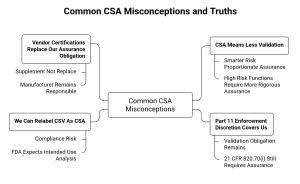
Misconception 1: "CSA Means Less Validation"
This is the most dangerous misreading of the guidance. The FDA is explicit: CSA is not less validation — it is smarter, risk-proportionate assurance. High-risk functions require more rigorous assurance than traditional scripted testing may have provided. The reduction in burden applies to low-risk functions that were previously over-validated.
"CSA is not 'less validation' — it's smarter, risk-based validation." — Pharmity CSA Analysis, September 2025
Misconception 2: "21 CFR Part 11 Enforcement Discretion Covers Us"
The FDA explicitly warns against this. Part 11's enforcement discretion about validation does not relieve manufacturers of the validation requirement under 21 CFR 820.70(i) for software used as part of production or the QMS. Organizations that have relied on Part 11 enforcement discretion as a de facto validation waiver are exposed.
Misconception 3: "We Can Simply Relabel Our CSV as CSA"
Renaming a traditional IQ/OQ/PQ package as a "CSA record" without restructuring the underlying approach is a compliance risk. FDA investigators are sophisticated. A CSA record that lacks intended use analysis, risk classification rationale, and proportionate evidence selection will not withstand scrutiny.
Misconception 4: "Vendor Certifications Replace Our Assurance Obligation"
Vendor certifications supplement manufacturer assurance — they do not replace it. The manufacturer remains responsible for the validated state of software used in their production and quality systems. Vendor evidence is incorporated into the manufacturer's assurance package, not substituted for it.
Part IX: CSA and the QMSR — The Convergence Imperative
The February 2, 2026, effective date of the FDA QMSR (21 CFR Part 820, as amended) marks the most significant restructuring of the medical device quality regulatory framework in 25 years. The QMSR replaces most legacy Part 820 requirements with ISO 13485:2016 by reference.
For pharma and medical device organizations, the QMSR and CSA final guidance represent a convergent regulatory signal: align with international standards, embrace risk-based quality management, and reduce compliance overhead where it does not contribute to patient safety.
Table 4: Regulatory Timeline — The Road to CSA
Conclusion
The FDA CSA final guidance is not a compliance burden. For organizations that implement it well, it is a competitive advantage.
Quality teams that transition from CSV to CSA will reallocate thousands of hours of validation effort — currently spent on low-risk documentation — toward higher-value assurance activities on functions that genuinely matter for patient safety and product quality. SaaS adoption cycles will accelerate. Regulatory inspections will encounter more coherent, risk-justified documentation packages.
But the transition requires intentional leadership. The habits of the CSV era — generate more paper, test more functions, add more sign-offs — are deeply embedded in pharmaceutical quality culture. CSA asks quality leaders to exercise judgment, not just follow checklists.
"The shift from the uniform, paper-intensive CSV approach to the more agile, risk-based CSA model allows manufacturers to focus their validation resources where they matter most — ensuring patient safety more reliably." — QMSDoc CSA Analysis, January 2026
The organizations that will thrive under CSA are those that understand this is not a documentation exercise. It is a quality management philosophy. And in an era of accelerating digital transformation, AI-enabled manufacturing, and global regulatory harmonization, that philosophy has never been more necessary.
FAQs
Q1. Does the FDA CSA final guidance apply to pharmaceutical manufacturers, or only medical device companies?
The September 2025 final guidance was formally issued by CDRH and CBER for medical device production and quality system software. However, FDA signaled in the February 2026 update that CSA principles align with pharmaceutical quality frameworks, and industry consensus (ISPE, PDA) strongly supports applying CSA principles in pharmaceutical GMP environments under 21 CFR Part 211 cGMP.
For pharmaceutical manufacturers, CSA represents current FDA thinking on risk-based software assurance and constitutes a defensible best-practice standard even where not yet formally mandated.
Q2. Do we need to re-validate all our existing CSV-documented systems under CSA?
No. The FDA does not require retroactive re-validation of systems that are currently in a validated state under CSV. The CSA framework applies going forward — to new implementations, system changes, and ongoing assurance activities. However, organizations should review their current validation packages to identify gaps in intended use documentation and risk classification that could be vulnerable in an inspection.
Q3. How do we handle SaaS vendor updates under CSA?
For each vendor update, conduct an intended use and risk assessment of the changed functionality. For not-high-process-risk changes: document the assessment and conduct targeted spot-checks or exploratory testing. For high-process-risk changes: conduct scripted regression testing of the affected function. Document continuous monitoring activities (system logs, error rate surveillance) as part of your ongoing assurance record.
Q4. What documentation does CSA actually require?
The FDA specifies that CSA records must include: intended use determination; risk analysis result; description of assurance activities; issues identified and resolution; who performed activities; dates; and sign-offs where appropriate. Digital records — system logs, audit trails, automated test outputs — are explicitly encouraged. The format is flexible; the content requirements are not.
Q5. How does CSA interact with the GAMP 5 (2nd Edition) framework?
GAMP 5, 2nd Edition (ISPE, 2022) and FDA CSA are highly aligned. Both embrace risk-based approaches, intended use-driven validation scope, and vendor evidence utilization. Organizations already implementing GAMP 5, 2nd Edition are well-positioned for CSA compliance. Key differences: CSA provides specific FDA regulatory context, supersedes GPSV Section 6 formally, and introduces the explicit six-step framework. GAMP 5 provides more granular implementation guidance for specific software categories and lifecycle activities.
References and Citations
- FDA CDRH/CBER. Computer Software Assurance for Production and Quality System Software. Final Guidance. September 24, 2025. Updated February 3, 2026.
- Federal Register. Computer Software Assurance for Production and Quality System Software; Guidance Availability. 90 FR [September 24, 2025].
- FDA. General Principles of Software Validation; Final Guidance for Industry and FDA Staff. January 11, 2002.
- FDA. Quality Management System Regulation (QMSR) Final Rule. 21 CFR Part 820, as amended. Effective February 2, 2026.
- ISPE GAMP. GAMP 5: A Risk-Based Approach to Compliant GxP Computerized Systems, 2nd Edition. ISPE, 2022.
- ISPE/GAMP South Asia Chapter. CSA Industry Awareness Webinar Survey Results. March 2024.
- ISPE Pharmaceutical Engineering. Finding Assurance in Computer Software Assurance. September/October 2024.
- ISPE Pharmaceutical Engineering. Computer Software Assurance and Critical Thinking. March/April 2024.
- IntuitionLabs (Laurent, A.). CSV to CSA: Understanding FDA's New Validation Guidance. Updated March 20, 2026.
- Polaris Biomedical (Michael, B.). FDA Finalizes Guidance on Computer Software Assurance: What Changed From the Draft. September 26, 2025.
- QMSDoc. FDA Issues Final Computer Software Assurance Guidance. January 2026.
- Pharmity. FDA Final Guidance on Computer Software Assurance Released. September 25, 2025.
- Rook Quality Systems. FDA Computer Software Assurance 2025 Guidance: Six-Step Framework. October 2025.
- Blue Mountain Quality Resources. FDA's CSA Guidance Is Final: What It Means for Your Validation Strategy. October 21, 2025.
- NSF Life Sciences. FDA Final Guidance Computer Software Assurance (CSA). February 9, 2026.
- Technology Networks. Computer Software Assurance: Perfect Solution or Confidence Trick? 2023.
- FDA. 21 CFR Part 11: Electronic Records; Electronic Signatures. U.S. Food and Drug Administration.
- FDA. 21 CFR Part 820.70(i): Production and Process Controls — Automated Processes. U.S. Food and Drug Administration.
- ICH. Q10: Pharmaceutical Quality System. International Council for Harmonisation, 2008.
- ISO. ISO 13485:2016 — Medical Devices: Quality Management Systems. Geneva: ISO, 2016.
This guide is intended for informational and educational purposes for quality and regulatory professionals in regulated life sciences industries. It does not constitute legal or regulatory advice. Organizations should consult qualified regulatory counsel and refer directly to applicable FDA guidance documents and regulatory frameworks when making compliance decisions.
Reporting on the science, business and regulation shaping the pharmaceutical industry.
More in Leadership
All articles →
Essential Leadership Skills for Success in the Pharmaceutical Industry
Pharmaceutical Regulatory Affairs: Roles, Skills, and Roadmap

Discussion