Qualification And Validation Under Schedule M 2023: Everything You Need To Know
Learn qualification and validation under Schedule M 2023. Covers DQ, IQ, OQ, PQ stages, validation types, and GMP compliance.


Pharmaceutical manufacturing is built on a foundation of science, precision, and control. Every tablet, capsule, vial, or solution administered to a patient must meet high standards of safety, quality, and consistency.
Achieving this level of reliability requires more than routine testing or occasional checks, it demands clear, structured, and well-documented evidence proving that equipment works correctly, processes perform as intended, and systems remain in a continuous state of control. This is where qualification and validation become indispensable.
Schedule M 2023, particularly Section 5, outlines a comprehensive framework that ensures manufacturers adopt a holistic and lifecycle-based approach to qualification and validation. These activities are not optional technical tasks but essential components of Good Manufacturing Practices (GMP).
They help organisations demonstrate control over critical operations, prevent failures, and maintain compliance throughout the lifecycle of equipment, processes, and systems. This article explains the full scope of qualification and validation under Schedule M 2023 in a simple and structured manner, offering clarity for both experienced professionals and new learners.
A Simplified Overview Of Qualification And Validation
Qualification and validation are closely connected, yet each serves a specific purpose. Qualification focuses on verifying the suitability and performance of physical infrastructure such as facilities, utilities, and equipment. It confirms that these elements are designed correctly, installed properly, and functioning according to their intended design. In short, qualification assures that the “hardware” of the manufacturing environment is reliable and fit for purpose.
Validation, in contrast, evaluates processes, analytical methods, cleaning procedures, computerised systems, and any operational element that directly affects product quality. It demonstrates that these processes consistently yield results meeting predetermined specifications. If qualification confirms that the equipment is capable, validation confirms that the process is trustworthy.
A critical principle in Schedule M is that qualification and validation are not one-time achievements. Section 5.5 emphasises that these activities must be part of an ongoing programme. Processes evolve, equipment wears down, raw materials change, and regulatory expectations advance. Therefore, qualification and validation must be periodically reviewed, updated, and strengthened to ensure continuous control.
The Four Stages Of Qualification
Qualification under Schedule M follows a structured four-stage sequence designed to establish documented assurance that equipment and utilities are fit for their intended use. Each stage adds a layer of confidence, ensuring systems are properly designed, correctly installed, function as intended, and perform reliably during routine operations.
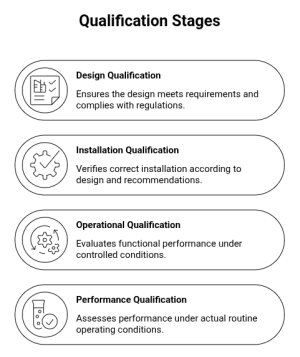
1) Design Qualification (DQ): Design Qualification is conducted before installation and ensures that the proposed design of equipment or systems meets user requirements and complies with regulatory expectations. It confirms that design choices such as materials of construction, specifications, capacity, and functionality are suitable for the intended process and aligned with GMP principles.
2) Installation Qualification (IQ): Installation Qualification verifies that the equipment or utility is installed according to the approved design and manufacturer’s recommendations. It includes the verification of calibration status, components, wiring, piping, accessories, manuals, and all relevant documentation. IQ ensures that no parts are missing, altered, or incorrectly installed, establishing a reliable foundation for subsequent qualification stages.
3) Operational Qualification (OQ): Operational Qualification evaluates the functional performance of the equipment under controlled conditions. It involves testing critical parameters such as temperature, pressure, flow rate, mixing speed, alarms, and software responses to ensure they fall within predefined limits. OQ provides documented evidence that the equipment operates correctly and consistently within its intended operating ranges.
4) Performance Qualification (PQ): Performance Qualification assesses the equipment or system under actual routine operating conditions using real materials and standard process parameters. It confirms that the system performs reliably, consistently, and reproducibly during everyday use. PQ demonstrates that the equipment is truly fit for GMP operations and can deliver expected results during real production scenarios.
Together, these four stages offer a complete, evidence-based demonstration that equipment is fit for GMP operations.
The Role Of The Validation Master Plan (VMP)
The Validation Master Plan is the backbone of all qualification and validation activity within a facility. It acts as a strategic document that defines the validation philosophy, identifies systems requiring validation, and outlines responsibilities, priorities, timelines, and documentation structures. Without a VMP, validation efforts risk becoming inconsistent or poorly coordinated.
A well-prepared VMP includes equipment lists, process descriptions, risk assessments, change control links, revalidation triggers, acceptance criteria, and a schedule for periodic reviews. It ensures alignment among stakeholders and provides auditors with a clear overview of the organisation’s validation approach. The VMP is a living document and must be regularly updated to reflect operational or regulatory changes.
Process Validation: A Lifecycle Approach
In line with global standards, Schedule M 2023 mandates a lifecycle approach to process validation. Instead of treating validation as a one-time activity, manufacturers must continuously review and strengthen the process through three interconnected stages.
- Stage 1, Process Design, involves developing a thorough scientific understanding of the process. Critical quality attributes, critical process parameters, and control strategies are defined based on experiments, trials, and historical knowledge. The objective is to design a robust process capable of delivering consistent results.
- Stage 2, Process Qualification, verifies the performance of the process under commercial manufacturing conditions. Typically, multiple consecutive validation batches are manufactured and analysed to confirm that the process performs consistently and within acceptance criteria. Equipment, systems, and personnel must already be qualified and trained before this stage begins.
- Stage 3, Continued Process Verification, spans the entire commercial lifecycle. It involves regularly reviewing process data, trending critical parameters, monitoring deviations, assessing variability, and implementing improvements as needed. This ongoing verification ensures that processes remain stable and capable of producing quality products year after year.
Types Of Validation Required
Schedule M outlines several critical types of validation that must be carried out to ensure consistent product quality, patient safety, and full compliance with GMP requirements. Each type of validation addresses a specific aspect of pharmaceutical production, creating a comprehensive framework of control.
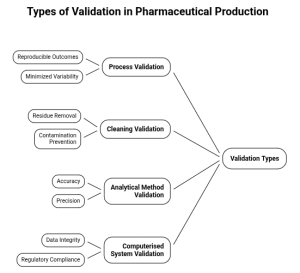
a) Process Validation: Process validation is one of the most essential validation activities and ensures that the manufacturing process consistently produces products that meet predetermined quality attributes. It confirms that the process is well understood, controlled, and capable of delivering reproducible outcomes batch after batch. This type of validation provides assurance that variability is minimised and product quality is dependable.
b) Cleaning Validation: Cleaning validation verifies that equipment cleaning procedures effectively remove residues, prevent contamination, and eliminate the risk of cross-contamination. It involves demonstrating that cleaning limits are scientifically justified—often using health-based exposure limits—and that cleaning methods consistently achieve acceptable residue levels. This ensures patient safety and prevents product mix-ups or impurities.
c) Analytical Method Validation: Analytical method validation ensures that laboratory testing methods used for raw materials, intermediates, and finished products are accurate, precise, reliable, and reproducible. Key parameters evaluated include specificity, precision, accuracy, linearity, range, detection limits, quantitation limits, and robustness. This validation guarantees that analytical results are trustworthy and suitable for quality decision-making.
d) Computerised System Validation (CSV): Computerised system validation ensures that software applications, automated systems, and digital tools operate correctly and maintain data integrity. It verifies that systems perform as intended, are secure, and comply with regulatory requirements for electronic data handling. With the increasing adoption of automation and digitalisation in the pharmaceutical industry, CSV has become a vital component of modern validation programmes.
These validation types form a complete and robust structure for controlling manufacturing processes, laboratory operations, cleaning procedures, and automated systems ensuring that every aspect of pharmaceutical production remains compliant, consistent, and reliable.
Requalification, Revalidation, And The Role Of Change Control
Change is inevitable in any manufacturing environment. Equipment upgrades, supplier changes, redesigns, material substitutions, and process improvements are routine. Schedule M requires that any change with potential impact on product quality be subjected to qualification or validation, depending on its nature.
Requalification ensures that equipment continues to meet its original specifications after significant modifications or after extended periods of use. Revalidation ensures that processes continue to perform correctly after changes such as formulation adjustments or equipment upgrades.
A strong change control system is essential because it determines when requalification or revalidation is required. Change control ensures that all changes are evaluated, documented, approved, and implemented carefully.
Periodic reviews must also be performed to ensure that qualification and validation remain effective, even when no major changes occur. This continuous oversight helps maintain long-term compliance.
Validation Protocols And Reports
All qualification and validation activities must be carried out according to approved protocols. A protocol defines what will be done, how it will be done, acceptance criteria, and responsibilities. It outlines test steps, data collection methods, risk assessments, and sampling plans.
Once the activity is completed, a validation report summarises results, deviations, observations, and conclusions. The report confirms whether the system or process met all acceptance criteria and whether it is suitable for release. Protocols must be approved before use, and reports must be approved afterward by authorized personnel. This documentation provides traceability and supports inspections and audits.
Practical Example: OOS During Process Validation
To illustrate the value of validation, consider a scenario in which a manufacturer executes three process validation batches for a new product. Batch 2 fails dissolution testing, achieving only 68% where the requirement is at least 75%. This out-of-specification result triggers a formal investigation.
The investigation may reveal issues such as blending variations, granule size inconsistencies, equipment malfunction, or analytical errors. Corrective actions may involve adjusting blending parameters, recalibrating equipment, retraining operators, or updating analytical methods.
Depending on the outcome, additional batches may be required. This example shows how validation not only confirms process consistency but also detects issues early and drives improvements.
Roles And Responsibilities In Qualification And Validation
Qualification and validation are multi-disciplinary activities requiring collaboration across departments. Quality Assurance typically oversees the overall programme, approves protocols and reports, and ensures compliance with Schedule M. Production teams execute processes, provide operational insights, and support validation activities.
Engineering teams qualify equipment and utilities, while Quality Control teams validate analytical methods and support data review. Clear definition of responsibilities prevents gaps and ensures accountability. Schedule M stresses that validation responsibilities must be formally documented, ensuring transparency and alignment among all stakeholders.
Common Pitfalls And How To Avoid Them?
Many organisations struggle with treating validation as a box-ticking exercise rather than a scientific discipline. Common pitfalls include performing validation only at the beginning of a product’s lifecycle, failing to document changes thoroughly, neglecting periodic reviews, and relying on insufficiently trained personnel.
These issues can be prevented through proper planning, investment in training, attention to documentation, and adoption of a lifecycle mindset. Integrating validation with risk management and change control further strengthens compliance and consistency.
In Conclusion
Qualification and validation are critical pillars of pharmaceutical quality systems and are central to the expectations of Schedule M 2023. They ensure that equipment is reliable, processes are consistent, and systems remain in a state of control throughout their lifecycle.
By following a structured qualification sequence, maintaining a robust Validation Master Plan, adopting a lifecycle approach to process validation, and ensuring continuous verification, organisations can uphold high standards of quality and patient safety.
Effective qualification and validation are not merely regulatory obligations, they represent an organisation’s commitment to excellence, scientific integrity, and patient trust. By embracing strong validation practices, manufacturers build resilient systems and demonstrate readiness for regulatory scrutiny while ensuring consistent delivery of high-quality medicines to patients.
FAQs
1. What Is The Difference Between Qualification And Validation Under Schedule M 2023?
Qualification and validation are related but serve different purposes. Qualification focuses on ensuring that equipment, facilities, and utilities are properly designed, installed, and functioning correctly. Validation, on the other hand, ensures that processes, methods, and systems consistently produce results that meet predefined quality standards. In simple terms, qualification confirms that the equipment is capable, while validation confirms that the process is reliable.
2. What Are The Four Stages Of Equipment Qualification?
The four stages of qualification are Design Qualification (DQ), Installation Qualification (IQ), Operational Qualification (OQ), and Performance Qualification (PQ). DQ verifies that the design meets requirements, IQ ensures correct installation, OQ checks that the equipment operates within defined limits, and PQ confirms consistent performance under real production conditions. Together, these stages provide complete assurance that equipment is suitable for use.
3. Why Is Validation Considered A Continuous Process?
Validation is considered continuous because processes, equipment, and materials can change over time. Schedule M 2023 requires ongoing monitoring through continued process verification, periodic reviews, and revalidation when necessary. This ensures that processes remain stable, controlled, and capable of consistently producing high-quality products throughout their lifecycle.
Reporting on the science, business and regulation shaping the pharmaceutical industry.
More in Pharma Manufacturing
All articles →
Compliance In Pharma Manufacturing 2025: Key Regulations And Best Practices You Need to Know

Improving Pharmaceutical Manufacturing Flexibility: Agile Manufacturing and Rapid Scale-Up

Discussion