The LIMS Decision: Why Your Laboratory Software Choice Is Now a Regulatory and Strategic Imperative
As FDA enforcement tightens, your LIMS choice is no longer an IT call — it's a quality decision with boardroom consequences.


A Quality Control manager at a mid-size generic pharmaceutical manufacturer in Southeast Asia discovered a problem on a Tuesday morning that no one in her position wants to face. An FDA inspector, midway through an unannounced audit, was asking for the complete audit trail on a batch released eight months earlier. The records existed — across three spreadsheets, two shared network drives, and a paper logbook stored in a filing cabinet down the corridor.
It took four hours to reconstruct what should have been a two-minute retrieval. The inspector made a note. A Form 483 observation followed. What began as an operational inconvenience became a compliance finding that cost the facility months of remediation effort and significant management attention.
This story is not unusual. It is, in fact, representative of a challenge that thousands of pharmaceutical laboratories across the world are navigating right now — the gap between how data is being managed and how regulators expect it to be managed. At the centre of closing that gap sits a single category of software: the Laboratory Information Management System, or LIMS.
What a LIMS Actually Does — and Why the Definition Matters
A Laboratory Information Management System is software designed to manage the data, samples, workflows, and compliance documentation generated within a laboratory environment. In practical terms, it tracks samples from receipt through testing and release, manages instrument integrations, enforces access controls, generates reports, and — critically — maintains the audit trails that regulators expect to see.
But the definition has expanded considerably over the past decade. Modern LIMS platforms have evolved into operational systems that sit at the intersection of quality management, data governance, manufacturing execution, and regulatory compliance. In a pharmaceutical context, a LIMS is no longer peripheral infrastructure. It is, as one industry practitioner described it, "the system of record that everything else must answer to."
The gap between a laboratory using spreadsheets and shared folders, and one running a validated, integrated LIMS, is not merely technological. It is a gap in risk exposure, operational efficiency, and regulatory readiness.
The Regulatory Case: Why 2025 Changed the Stakes
In September 2025, the FDA finalised its Computer Software Assurance guidance — described by industry observers as the most consequential shift in software validation methodology in over two decades. The CSA framework does not reduce the obligation to validate laboratory systems. It modernises how that validation effort should be allocated, moving from document-heavy blanket testing toward a risk-based approach focused on functions that directly affect product quality, patient safety, and data integrity.
For pharmaceutical laboratories, the practical implication is clear: systems that handle regulated electronic records must demonstrate compliance with FDA 21 CFR Part 11. This regulation governs how electronic records and electronic signatures are created, maintained, and submitted. Audit trails must be complete. Access controls must be enforced. Records must be tamper-evident and retrievable on demand.
In January 2025, the FDA issued a warning letter following a BIMO inspection where data integrity deficiencies — traced to inadequate audit trail controls in a laboratory system — led to a complete response letter and a subsequent shareholder lawsuit. The underlying failure was not science. It was data governance.
The regulatory signal is unambiguous. FDA inspection strategy in 2025 shifted toward heightened scrutiny of data integrity, with prior findings triggering increased surveillance. For laboratories still relying on disconnected systems or manual documentation, the regulatory risk has materially increased — not decreased.
A well-implemented LIMS addresses this systematically. Electronic records are centralised and controlled. Audit trails are automated. Electronic signatures are enforced with time-stamping and user attribution. The compliance capability is built into the operational workflow, not bolted on as an afterthought before an inspection.
"When laboratories implement a compliant LIMS environment, they transform regulatory obligations into automated system capabilities — a secure digital foundation where data integrity, accountability, and regulatory readiness are built into everyday laboratory operations."
Your LIMS must be validated. But what happens when an inspector arrives before that validation is complete?
→ Read: FDA Form 483 — What It Means and How to Respond
The Market Landscape: Who Builds These Systems
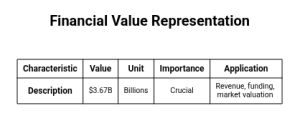
The global LIMS market is moderately consolidated, with fewer than 120 active vendors worldwide, according to a February 2026 report from ResearchAndMarkets. The top four enterprise vendors — LabWare, Thermo Fisher Scientific, LabVantage, and Abbott Informatics (STARLIMS) — collectively command an estimated 80% of the market. Each represents a different philosophy of implementation, and understanding those differences is essential before a procurement decision is made.
20260418150337.svg)
Beyond the enterprise tier, a generation of configurable, cloud-native platforms has emerged — including Benchling, QBench, and Scispot — that serve biotech, mid-size pharma, and CRO environments where flexibility, ease of deployment, and modern user experience are higher priorities than maximum configurability for complex multi-site operations.
The emergence of AI-assisted LIMS capabilities is also reshaping the landscape. Integration of machine learning for anomaly detection in QC data, predictive instrument maintenance alerts, and intelligent workflow automation are no longer aspirational features — they are actively being deployed by leading platforms as of 2025 and 2026.
The Five Decision Criteria That Determine the Right Choice
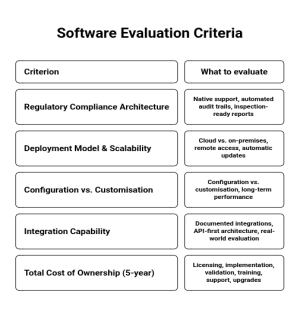
The wrong LIMS selection is more costly than no LIMS at all. A failed implementation — whether from misaligned functionality, underestimated validation effort, or poor user adoption — creates a compliance gap, absorbs significant capital, and often leaves the laboratory worse off than its starting position. The following five criteria provide a structured framework for evaluating any platform under consideration.
The Cost of Inaction — and of a Poor Decision
There is a tendency in pharmaceutical operations to frame LIMS selection as a discretionary improvement — something to evaluate when the current situation becomes untenable. This framing is increasingly difficult to defend.
The FDA's data integrity enforcement record is consistent. Warning letters citing inadequate audit trails, missing electronic signature controls, and insufficient system validation are issued every year, across all segments of the pharmaceutical industry, regardless of company size or geography. The January 2025 case — where data integrity deficiencies triggered not only a regulatory response but a shareholder lawsuit — illustrates the degree to which laboratory data governance has become a corporate risk, not simply an operational one.
The cost of a Form 483 observation, a warning letter, or a consent decree dwarfs any LIMS investment. More importantly, remediation under regulatory scrutiny is significantly more expensive, more disruptive, and more reputationally damaging than proactive implementation.
Now that you understand why LIMS selection is a quality decision, the next question is how to migrate your entire quality system without losing compliance along the way.
→ Read: eQMS Migration in Pharma — A Step-by-Step Guide for Quality Leaders
What Leading Organisations Are Doing Differently
Pharmaceutical organisations that have navigated LIMS selection successfully share a common approach. They treat the process as a quality initiative, not a technology procurement. They involve QA, regulatory affairs, laboratory operations, and IT in the evaluation from the beginning. They define their compliance requirements first and their workflow needs second, rather than the reverse.
They also approach the validation question early. In the post-CSA environment, validation planning is an integral part of platform selection — understanding how the vendor supports Computer Software Assurance, what validation documentation is available, and what internal resource commitment is required to achieve a validated state.
Finally, they invest in user adoption. The most compliant and most capable LIMS in the market delivers no value if laboratory personnel revert to spreadsheets because the system is difficult to use. Ease of use — not just functionality — is a selection criterion that deserves equal weight.
Key Takeaways for Pharma Leaders
- The LIMS selection decision is a quality and compliance decision first, and a technology decision second.
- FDA's Computer Software Assurance guidance (September 2025) modernises validation methodology but does not reduce the obligation to validate. Plan validation effort as part of platform selection.
- The top four enterprise vendors control approximately 80% of the market — but the right choice depends on your organisation's size, complexity, regulatory environment, and growth trajectory.
- Favour configuration over customisation wherever possible. Vendor-dependent customisation compounds cost and risk over time.
- Model total cost of ownership over five years, including implementation, validation, training, and maintenance — not just software licensing.
- The cost of inaction or a poor selection decision significantly exceeds the cost of a well-managed LIMS investment.
The Decision Ahead
The pharmaceutical industry is in the middle of a digital transformation that is not optional and is not reversible. Laboratory operations that were designed for a world of paper records and manual verification are being asked to perform in a world of real-time data, automated compliance, and global regulatory scrutiny.
A LIMS, chosen carefully and implemented well, is among the most consequential operational investments a pharmaceutical organisation can make. It does not simply solve a data management problem. It builds the infrastructure on which regulatory confidence, operational efficiency, and scientific quality rest.
The QC manager whose four-hour audit reconstruction could have been a two-minute retrieval did not suffer a technology failure. She suffered the consequence of a decision that had been deferred too long. That is a decision pharmaceutical organisations have increasing reason not to repeat.
Reporting on the science, business and regulation shaping the pharmaceutical industry.
More in Leadership
All articles →
Essential Leadership Skills for Success in the Pharmaceutical Industry
Pharmaceutical Regulatory Affairs: Roles, Skills, and Roadmap

Discussion