by Simantini Singh Deo
8 minutes
From Compliance to Contamination Control: How Annex 1 Is Reshaping Pharmaceutical Microbiology?
EU GMP Annex 1 made zero CFU the new Grade A standard. Here's how it's reshaping contamination control, EM programmes, and pharma microbiology.
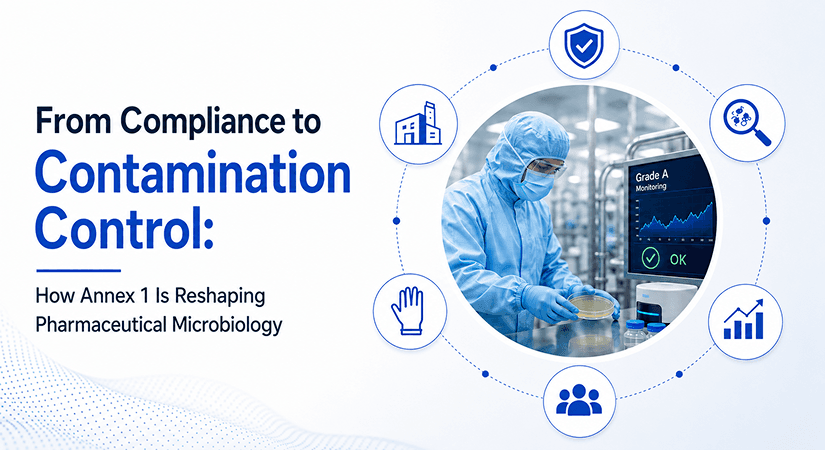
On 25 August 2023, the revised EU GMP Annex 1 — Manufacture of Sterile Medicinal Products — came into full force, following its publication in August 2022. Most of its requirements took effect on that date, with Section 8.123 following an extended implementation deadline of 25 August 2024.
For pharmaceutical microbiologists, quality professionals, and sterile manufacturing leaders, this was not simply another regulatory update to be absorbed into an existing compliance programme.
It represented a genuine paradigm shift, moving from prescriptive testing limits and terminal sterility checks toward a fully integrated, holistic, risk-based approach to contamination control that has fundamentally and permanently changed the role of microbiology in sterile manufacturing.
The scale of what changed is reflected in two specific details. First, the term "risk assessment" appears 20 times in the revised Annex 1, more than any single technical term other than contamination itself.
That repetition is not an accident. It signals that the entire framework is now built on scientific risk management rather than on fixed procedural compliance. Second, the microbiological limits for Grade A environments were tightened: where previous guidance stated an average of less than one colony-forming unit (CFU), the 2023 version states zero.
This is not a minor refinement. It is a statement that the expectation for the most critical manufacturing environments is now one of absolute exclusion, not statistical allowance.
For pharmaceutical microbiologists, three immediate and practical consequences follow from this shift:
- The Contamination Control Strategy (CCS) is now a mandatory, documented, living strategy, not a concept or best practice, but a regulatory requirement that must address all contamination sources across the full supply chain
- Environmental monitoring is no longer an isolated microbiology activity, it is a core component of the CCS, integrated with facility design, cleaning, gowning, utilities, and operational controls
- Microbiology teams are expected to be active, scientific contributors to contamination prevention decisions, not passive testing functions that report results after manufacturing is complete
The Contamination Control Strategy: What Annex 1 Actually Requires?
The Contamination Control Strategy is probably the most significant single element introduced by the revised Annex 1. The concept was not entirely new, best-practice manufacturers had been developing contamination control programmes for years before the revision.
What is genuinely new is that the CCS is now legally mandatory for all sterile medicinal product manufacturers supplying the European market, with no exemptions for company size or product category.
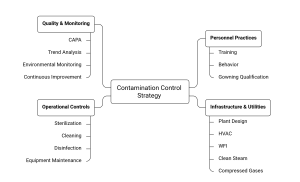
The CCS is not a single document. It is a living, integrated strategy that describes how a site actively prevents, detects, and responds to contamination at every stage of manufacturing. The revised Annex 1 enumerates at least 16 specific elements that the CCS must address:
- Plant design and facility layout
- Premises — cleanroom classification, pressure cascades, surfaces
- Personnel — training, behaviour, gowning qualification
- Utilities — HVAC, WFI, clean steam, compressed gases
- Raw materials and starting materials
- Containers, closures, and primary packaging
- Supplier qualification and outsourced activities
- Process risk management and validation
- Sterilisation processes
- Maintenance, calibration, and equipment qualification
- Cleaning and disinfection
- Environmental monitoring
- Trending, investigation, and root cause analysis
- CAPA — Corrective and Preventive Action
- Training and competency assessment
- Continuous improvement
The PDA Technical Report 90 (TR-90), published in February 2023 specifically to support Annex 1 CCS implementation, describes a three-level governance framework: individual control elements, integrated process controls, and a quality system overlay.
Critically, TR-90, and Annex 1 itself, makes clear that the CCS is not a static compliance document. It must evolve in response to monitoring data, investigation findings, process changes, and emerging contamination risks. If environmental monitoring data suggests an adverse trend, the CCS must be capable of triggering a documented, timely response.
Environmental Monitoring Reimagined
Under the revised Annex 1, the question regulatory inspectors are now asking of pharmaceutical manufacturers is no longer simply "Do you have an environmental monitoring programme?"
The question has shifted to something far more demanding and specific: can you demonstrate that your EM programme is risk-based, scientifically justified, data-driven, and proactively managed in response to real-time monitoring outputs?
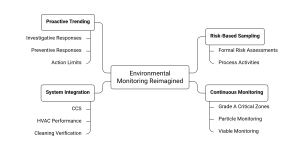
This represents a fundamental change in how environmental monitoring is expected to function within a pharmaceutical quality system. The old model, fixed sampling locations, fixed frequencies, culture-based methods, results reviewed at the end of the week, is increasingly insufficient to meet the expectations that Annex 1 inspection teams now actively apply. The new model has four defining characteristics:
a) Risk-Based Sampling Design — Monitoring location, frequency, and method must be justified by a formal risk assessment linked to process activities, personnel movements, intervention patterns, and historical contamination data. Areas where frequent aseptic interventions occur require more intensive monitoring — not because a fixed frequency table says so, but because the risk assessment demonstrates it.
b) Continuous Monitoring For Grade A — The revised Annex 1 requires a continuous, or near-continuous, monitoring approach for Grade A critical zones. Automated particle counting and viable monitoring systems that provide real-time data are increasingly the expected solution, replacing the batch sampling approaches that were previously standard practice.
c) Integration With The CCS — Under Annex 1, EM data does not exist in isolation. It must be explicitly connected to the contamination control strategy, to cleaning verification, to gowning performance data, to HVAC performance records, and to trend analysis programmes. Repeated environmental excursions following maintenance activities, for example, must trigger a system-level investigation, not be recorded as isolated events.
d) Trend Analysis & Proactive Response — The revised guidance strongly emphasises earlier detection of contamination risks. When EM data identifies an adverse trend, even before action limits are breached, the CCS must trigger a documented investigative and preventive response. This is prevention-first microbiology, not detection-after-the-fact compliance.
Annex 1 changed what EM must prove, not just that you're sampling, but that you're sampling in the right places for the right reasons.
Here's the full breakdown of what continuous, risk-based EM now demands.
→ Read: Annex 1 Changes: EM & CCS in Cleanrooms
The Role Of Rapid Microbiological Methods Under Annex 1
The revised Annex 1's emphasis on real-time contamination data, continuous monitoring, and early trend detection has created a powerful and direct regulatory incentive for the adoption of Rapid Microbiological Methods (RMMs) in environmental monitoring programmes. What was previously a technology decision driven by efficiency is now increasingly a compliance-driven decision.
Automated, growth-based rapid detection platforms such as the Growth Direct® System from Rapid Micro Biosystems are directly aligned with Annex 1's continuous monitoring expectations. These systems integrate automated incubation, non-destructive early microbial detection, and digital data management within a single platform.
In GMP manufacturing environments that have implemented automated rapid detection, QC teams have consistently reported earlier identification of emerging contamination trends, allowing adverse trends to be addressed before they progress to product-impacting contamination events.
The alignment between RMMs and Annex 1 operates at several specific levels:
- Real-Time Data For Grade A Continuous Monitoring — automated viable monitoring systems provide results in the timeframe that Annex 1's continuous monitoring expectations demand, rather than days after a sample is taken.
- Digital Audit Trails & Data Integrity — automated systems generate complete, time-stamped electronic records that satisfy Annex 1's data integrity and traceability requirements without manual transcription risk.
- Validated Alternative Methods — the USP Chapter <1223> and Ph. Eur. 5.1.6 frameworks provide the validation pathway for RMMs as accepted alternatives to compendial culture methods, giving manufacturers a regulatory route to implementation.
Annex 1 made real-time contamination data a compliance expectation not a nice-to-have.
Here's how Rapid Microbiological Methods are meeting that expectation in practice.
→ Read: Rapid Microbiology Methods | Speed Meets Compliance
How Inspection Practice Has Changed Since August 2023?
Since Annex 1 came into full force in August 2023, regulatory inspection practice has intensified significantly in its scrutiny of whether manufacturers have genuinely implemented the CCS framework or simply produced a document that describes one without the operational and scientific infrastructure to support it.
Inspection teams from the EMA, MHRA, and national competent authorities are now specifically examining:
1) Whether The CCS Is Truly Integrated: Inspectors are asking to see the connections between EM data, cleaning records, gowning performance results, HVAC qualification data, and the CCS narrative. A CCS that references these elements without demonstrating their integration is not considered adequate.
2) Whether EM Programmes Are Risk-Based & Justified: Sampling plans that cannot be defended by documented risk assessments linked to process activities are being cited as deficiencies. The question inspectors ask is not "how many samples do you take?" but "why do you take samples in these locations at these frequencies, and what risk analysis supports that decision?"
3) Whether Microbiology Is Scientifically Leading, Not Just Reporting: Annex 1 explicitly positions microbiology as a scientific contributor to contamination prevention. Inspection observations have cited manufacturers where microbiology teams operate as passive reporting functions, conducting testing, issuing certificates of compliance, and escalating out-of-specification results, without the scientific authority or data infrastructure to identify and act on trends proactively.
4) Whether Continuous Improvement Is Real: The CCS must demonstrate that the organisation learns from monitoring data, investigation findings, and industry experience. Static programmes that have not evolved in response to their own data are being treated as non-compliant with Annex 1's continuous improvement expectations.
Conclusion: A Larger Role, A Higher Bar, And A Greater Opportunity
Annex 1 is reshaping pharmaceutical microbiology in ways that are simultaneously more demanding and more professionally significant than any previous regulatory update in this specific field.
The demanding part is clear and unambiguous: microbiologists are now expected to own, contribute to, and continuously improve a contamination control strategy that spans the entire manufacturing operation, not simply operate a testing programme that runs alongside it without influencing decisions.
The professional opportunity is equally clear and significant. When pharmaceutical microbiology is practised at the level Annex 1 now demands, risk-based, data-driven, integrated, and proactively managed, it becomes one of the most strategically important disciplines in sterile manufacturing.
The microbiologist who can design a risk-justified EM programme, interpret trend data in the context of process and environmental variables, deploy validated rapid methods, and contribute scientifically to CCS decisions is not simply a compliance function. They are quality leaders.
Meeting Annex 1's expectations fully is genuinely challenging. The facilities, validated systems, digital infrastructure, and organisational culture required do not emerge from a single implementation project.
They are built through sustained scientific investment, courageous quality leadership, and an unambiguous organisational commitment to treating contamination control as the patient safety discipline it fundamentally is, not as a regulatory burden to be managed at minimum cost.
FAQs
1. What Is The Biggest Change Introduced By The Revised EU GMP Annex 1?
The revised EU GMP Annex 1 shifts the focus from meeting fixed compliance requirements to implementing a comprehensive, risk-based contamination control strategy. Instead of relying primarily on end-product testing, manufacturers are expected to prevent contamination throughout the entire manufacturing process. This approach emphasizes continuous monitoring, scientific risk assessment, and proactive decision-making. As a result, contamination prevention has become a central part of pharmaceutical quality management rather than a standalone compliance activity.
2. What Is A Contamination Control Strategy (CCS)?
A Contamination Control Strategy (CCS) is a documented, integrated plan that explains how a pharmaceutical facility prevents, detects, and responds to contamination risks across sterile manufacturing operations. It covers critical areas such as facility design, personnel practices, environmental monitoring, cleaning, sterilization, utilities, and quality systems. Unlike a static compliance document, the CCS must be continuously updated based on monitoring data, investigations, and process improvements. This ensures that contamination control evolves alongside manufacturing operations and emerging risks.
3. How Has Environmental Monitoring Changed Under Annex 1?
Annex 1 requires environmental monitoring to be risk-based, data-driven, and closely integrated with the facility's overall contamination control strategy. Manufacturers are expected to justify sampling locations and frequencies through scientific risk assessments while continuously monitoring critical Grade A areas whenever appropriate. Environmental monitoring data must also be actively trended to identify potential contamination risks before they become serious issues. This proactive approach helps improve product quality and strengthen regulatory compliance.