Why Data Integrity Is the Backbone of Every Microbiology Laboratory
ALCOA+ principles, common data integrity risks, OOS handling and audit trail best practices for pharma microbiology labs.


Data integrity is not just a regulatory checkbox. It is the foundation on which every test result, every batch release decision, and every patient safety outcome rests. In microbiology laboratories, whether they operate in pharmaceutical manufacturing, clinical diagnostics, or research settings, data integrity failures can lead to product recalls, regulatory sanctions, or, worse, patient harm.
Over the past decade, regulatory agencies like the FDA, MHRA, and WHO have increased their scrutiny of laboratory data practices. Warning letters and import alerts frequently cite poor data integrity controls as the root cause of critical violations. Understanding what data integrity means, what threatens it, and how to protect it is no longer optional for laboratory professionals.
What Data Integrity Actually Means in a Lab Context
Data integrity refers to the completeness, consistency, and accuracy of data throughout its entire lifecycle, from the moment it is generated to its long-term storage and retrieval. The most widely accepted framework for data integrity is captured in the acronym ALCOA+, originally introduced by the FDA and now used across global regulatory guidelines.
In microbiology laboratories, applying these principles is particularly challenging. Results such as colony counts, sterility test outcomes, and microbial identification data are often generated in real time, under time pressure, and by multiple analysts across different shifts.
Common Data Integrity Risks in Microbiology Laboratories
Microbiology is unique among laboratory disciplines because many of its processes are time-sensitive and dependent on subjective observation. This creates several specific vulnerabilities.
20260618121205.svg "Microbiology Data Integrity Risks")
1. Manual transcription errors
When analysts transcribe colony counts or zone measurements from a bench record to a paper form or electronic system, the risk of error, accidental or deliberate, increases. Any manual entry step is a potential gap in the data chain.
2. Backdating or pre-dating records
Recording results after the fact, or preparing documentation in advance, directly violates the contemporaneous principle. This is one of the most common integrity violations cited in FDA warning letters.
3. Unofficial "worksheets" or raw data on scrap paper
Many laboratories use informal working documents that are later discarded. These unofficial records, sometimes called "rough" records, are considered original data and must be retained. Discarding them constitutes a data integrity failure.
4. Shared user accounts in laboratory information systems
When multiple analysts use a single login, the attributability principle breaks down entirely. There is no way to link specific entries to a specific person or time.
5. Result manipulation in electronic systems
Deletion of failed runs, changing instrument settings without audit trail entries, or running samples multiple times and only recording favourable results are all serious violations. Computerised systems must have audit trail functionality enabled and reviewed regularly.
6. Environmental monitoring data gaps
Microbiology laboratories are responsible for monitoring controlled environments. Incomplete trending data, skipped sampling points, or failure to investigate excursions are among the most frequently cited gaps during inspections.
Incomplete environmental monitoring data is one of the most cited integrity gaps.
What happens after an excursion is where the real test begins.
→ Read: Investigations After Environmental Monitoring Excursions In Sterile Areas
Regulatory Framework Governing Data Integrity
Several key guidelines and regulations set the expectations for data integrity in microbiology laboratories:
- FDA 21 CFR Part 11 — Governs electronic records and electronic signatures for US-regulated environments
- EU GMP Annex 11 — Defines requirements for computerised systems in EU-licensed facilities
- WHO Technical Report Series (TRS 996, Annex 5) — Provides global guidance on data integrity in GMP-regulated laboratories
- MHRA GMP Data Integrity Guidance (2018) — One of the most detailed regulatory guidance documents on this topic
- USP <1058> — Covers analytical instrument qualification, including data systems
These frameworks consistently emphasise that data integrity must be designed into systems and processes from the outset, not remediated after the fact.
Building a Culture of Data Integrity
Regulatory frameworks and SOPs alone cannot guarantee data integrity. The behaviour of people within a laboratory is just as important as the systems they use.
A laboratory where staff feel pressured to meet timelines at any cost, or where management responds poorly to out-of-specification results, creates an environment in which data manipulation becomes tempting. Conversely, when leadership actively reinforces the importance of accurate reporting, including unwelcome results, the culture supports integrity by default.
Key cultural practices that support data integrity include:
- Open-door policies where analysts can report concerns without fear of blame
- Regular training not just on procedures, but on the why behind data integrity requirements
- Management review of audit trails as a routine quality activity, not just during investigations
- Recognition that an OOS result reported accurately is far better than a compliant-looking record that was manipulated
Technical Controls in Laboratory Systems
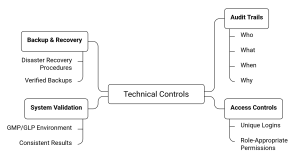
Beyond culture, technical safeguards play a critical role. Laboratories using computerised systems, whether laboratory information management systems (LIMS), chromatography data systems (CDS), or standalone instruments, must ensure the following controls are in place.
Audit trails must be enabled on all systems that generate, process, or store raw data. Audit trails should capture who made a change, what was changed, when it was changed, and why. These logs must be reviewed as part of routine operations, not only during investigations.
Access controls must be enforced so that each user has a unique login with permissions appropriate to their role. Analysts should not be able to delete or overwrite raw data.
System validation is required before any computerised system is used in a GMP or GLP environment. Validation must demonstrate that the system consistently produces accurate results and maintains data integrity under normal operating conditions.
Backup and disaster recovery procedures must ensure that data is not lost due to system failure, and that backups are verified regularly.
Data Integrity Checklist for Microbiology Laboratories
Use this checklist as a starting point for self-assessment or routine audit preparation:
- All analysts have individual, unique login credentials for electronic systems
- Audit trails are enabled and reviewed at defined intervals
- No unofficial worksheets or scrap paper records are discarded without archiving
- Timestamps on records match the sequence of laboratory activities
- OOS results are fully documented, investigated, and retained, not deleted
- Environmental monitoring data is complete, trended, and excursions are investigated
- Instrument calibration and qualification records are current and accessible
- Raw data is stored in a secure location with controlled access
- Staff have received recent training on data integrity principles
- Management routinely reviews data integrity metrics and audit trail reports
Handling Out-of-Specification Results Without Compromising Integrity
Out-of-specification (OOS) results are a genuine challenge in microbiology. A failed sterility test, an environmental excursion, or a bioburden result above the alert limit all trigger significant investigation and documentation requirements.
The temptation, particularly under production pressure, is to dismiss OOS results as laboratory errors or to perform unofficial re-tests before formally documenting the original result. Both practices are serious violations.
Under FDA guidance and ICH Q10 principles, every OOS result must be documented as it occurs. Phase 1 of an OOS investigation, the laboratory phase, should systematically assess whether an assignable laboratory error exists. Only when a confirmed, documented cause is established can a result be invalidated. This process must be fully traceable and supported by contemporaneous records.
Retesting is permitted under strictly defined circumstances and must follow a written protocol. The original failing result must always remain part of the official data set.
Data Integrity During Technology Transitions
Many microbiology laboratories are currently transitioning from paper-based systems to electronic records or from legacy instruments to modern integrated platforms. These transitions pose a heightened risk to data integrity if not managed carefully.
During any migration, the following must be addressed:
- All historical data must be migrated completely and verified post-migration
- Paper records predating the electronic system must remain accessible for their required retention period
- Hybrid systems, where some data remains on paper, and some is electronic, must have clear, documented procedures that prevent gaps or duplication.
- Staff must be trained on new systems before go-live, not after
Final Thoughts
Data integrity in microbiology laboratories is not simply about avoiding regulatory findings. It is about ensuring that the results a laboratory produces are trustworthy, that a sterility test result of "pass" truly indicates the product is sterile, and that an environmental monitoring programme detects contamination when it exists.
The investment required to build robust data integrity systems and a strong laboratory culture is significant. The cost of not making that investment, in patient safety, regulatory standing, and organisational reputation, is far greater.
Data integrity protects what a lab produces.
Good Lab Practices protect how it gets there.
→ Read: Why Good Lab Practices Matter In The Pharmaceutical Industry
Frequently Asked Questions
1. What is ALCOA+ and why does it matter in microbiology labs?
ALCOA+ is a set of nine data integrity principles: Attributable, Legible, Contemporaneous, Original, Accurate, Complete, Consistent, Enduring, and Available. It provides the standard framework used by global regulators to assess the trustworthiness of laboratory data.
2. Are paper records still acceptable in GMP microbiology laboratories?
Yes, paper records are still acceptable provided they meet ALCOA+ principles. They must be legible, original, retained for the required period, and protected from loss or unauthorised alteration.
3. What should a laboratory do when an OOS microbiology result occurs?
The result must be documented immediately, and a formal phase 1 laboratory investigation must be initiated. Results cannot be discarded or informally retested before documentation. Every step of the investigation must be recorded contemporaneously.
4. How often should audit trails be reviewed in a microbiology laboratory?
Regulatory guidance does not specify a fixed frequency. Still, audit trails should be reviewed as part of routine quality oversight — at a minimum during periodic self-inspections and as part of OOS or deviation investigations.
5. What are the most common data integrity violations cited in FDA warning letters for microbiology labs?
The most frequently cited issues include the deletion of failing results, the use of shared login credentials, backdating of records, the discarding of unofficial worksheets, and failing to complete environmental monitoring documentation.
Reporting on the science, business and regulation shaping the pharmaceutical industry.
More in Microbiology & CCS
All articles →
Active Air Sampling vs Settle Plates vs Contact Plates

Setting EM Alert & Action Levels (Grades A–D): A Practical Guide for Pharma Professionals
Discussion