How Airflow Controls Microbial Movement In Pharma And Healthcare Environments
The science of airflow and microbial movement in pharma cleanrooms and healthcare environments, from particle physics to EU GMP Annex 1.

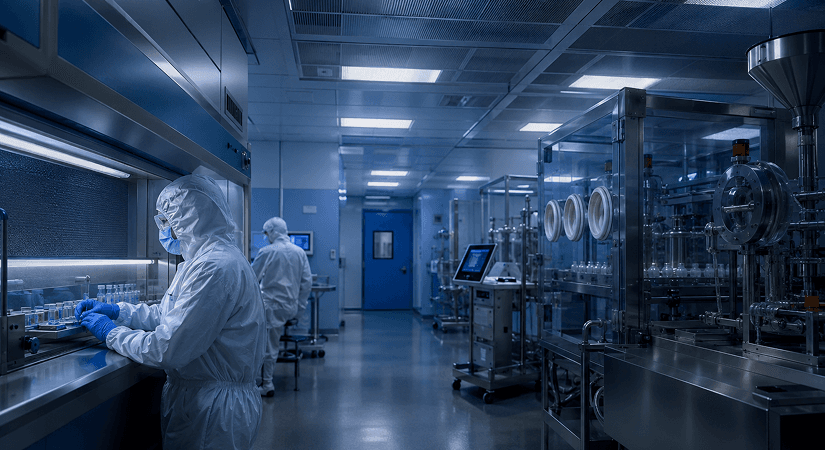
Air is invisible, but what it carries is not. In pharmaceutical manufacturing facilities, hospital operating theatres, and cleanrooms, air is one of the most carefully managed variables on the floor. Every breath of uncontrolled air is a potential vector for microbial contamination, and contamination in these settings carries real consequences for product quality and patient safety.
Understanding the science of airflow and microbial transport is not just an academic exercise. It is a practical foundation for designing facilities, writing SOPs, interpreting environmental monitoring data, and making contamination-control decisions that withstand regulatory scrutiny.
This guide breaks down how air moves, how microorganisms travel on and through it, and what that means for controlled environments in pharma and healthcare.
How Microorganisms Become Airborne
Microorganisms, bacteria, fungi, and their spores do not typically float through the air on their own. They are almost always attached to particles. These particles are shed from surfaces, equipment, and most significantly, from people.
Human beings are the largest source of airborne microbial contamination in any controlled environment. A person at rest sheds roughly 100,000 skin particles per minute. During movement, that number rises sharply. Each of those particles may carry one or more viable microorganisms.
Other sources of particle-bound microbes include:
- Raw materials and packaging components brought into the facility
- Water droplets from talking, coughing, or sneezing (which carry respiratory microorganisms)
- Equipment surfaces that are not adequately cleaned or disinfected
- Air brought in from outside that is not properly filtered
Once attached to a particle and suspended in air, a microorganism's fate depends almost entirely on the physical behaviour of that air, its speed, direction, turbulence, and relationship to surfaces in the room.
The Physics of Airflow: Laminar vs Turbulent
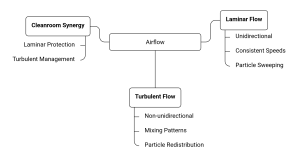
Airflow in controlled environments falls into two broad patterns, and the difference between them matters enormously for contamination control.
Laminar (unidirectional) airflow moves in parallel layers at a consistent velocity, typically between 0.36 and 0.54 m/s in critical zones. Particles in laminar flow are swept along in the direction of air travel with minimal mixing. This means that if a contamination event occurs, a particle shed by a person or a surface is carried away from the critical zone along a predictable path rather than being redistributed throughout the room.
Turbulent (non-unidirectional) airflow involves air moving in an irregular, mixing pattern. In turbulent conditions, particles that enter the air do not travel in a straight line. They circulate, recirculate, and can deposit on surfaces far removed from their point of origin. While turbulent airflow can still maintain acceptable contamination levels through air changes per hour (ACH) and HEPA filtration, it inherently carries more risk of particle redistribution than laminar airflow.
Most pharmaceutical cleanrooms use a combination of both: laminar airflow at the critical point of product exposure (the filling needle, the open container, the work surface) within a background of HEPA-filtered, turbulently mixed room air.
How Particles and Microbes Travel Through Air
Several physical forces govern the movement of particles in the air. Understanding these helps explain why certain zones remain cleaner than others, and why certain facility design choices create or eliminate contamination risk.
Particle size is critical. Particles larger than 5 µm settle quickly, within seconds to minutes, depending on airflow velocity. Particles between 1 and 5 µm remain suspended for longer and travel further. Particles smaller than 1 µm, including many bacterial spores and fragments, behave almost like gases and can remain airborne almost indefinitely in still or slowly moving air.
For microbial contamination, the most practically important particle range is 5 to 20 µm, the size range of most skin flakes and droplet nuclei that carry viable organisms.
Airflow Patterns and Contamination Zones
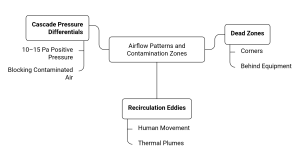
Room geometry, supply and return air locations, and the presence of equipment and personnel all interact to create airflow patterns that are rarely as simple as the design drawings suggest.
Dead zones, areas with very low air velocity, are particularly problematic. When air is not moving, particles are not being swept toward the HEPA filters or exhaust points. They settle or accumulate. Dead zones can develop behind large pieces of equipment, in corners, or in areas where supply and return air balance, leaving a pocket of still air.
Recirculation eddies occur when airflow meets an obstruction and curls back on itself. Personnel walking through a cleanroom, doors opening and closing, or the thermal plume from a person's body can all generate eddies that disrupt laminar flow and redistribute particles.
Cascade pressure differentials between rooms of different classifications are a fundamental design tool. Positive pressure in cleaner zones pushes air outward into less clean areas when a door is opened, rather than pulling potentially contaminated air inward. Regulatory guidance (EU GMP Annex 1, FDA aseptic processing guidance) typically requires a minimum differential of 10–15 Pa between adjacent classified zones.
Environmental Monitoring: What the Data Actually Tells You
Environmental monitoring (EM) data is only meaningful when interpreted in the context of airflow behaviour. A positive result at a given sample location does not simply mean the room is contaminated; it indicates that viable particles reached that point at that time.
Key EM methods and their relationship to airflow:
- Active air sampling (e.g., RCS, SAS, Biotest) draws a measured volume of air through the sampler. Results reflect the viable particle concentration at that location during the sampling period.
- Settle plates, capture particles that fall onto them under gravity. Results reflect the settling rate, which is influenced by particle size and local air velocity.
- Surface samples (swabs and contact plates) capture what has already been deposited. These integrate contamination over time and are useful for identifying where particles consistently land.
A high settle plate count in a particular location, especially if active air results are normal, often indicates a low-velocity zone where particles are accumulating by settling rather than being swept away by airflow. This is actionable information: it points to a room design or operational issue, not simply a hygiene failure.
Knowing how airflow moves particles is only half the equation.
The other half is knowing where to sample, and why.
→ Designing an EM Program | Locations, Frequency & Maps
Gowning and Personnel as Airflow Variables
Even the most perfectly designed room airflow system can be undermined by how people move through it. Personnel in a cleanroom are not passive. They generate heat (creating upward thermal plumes), continuously shed particles, and create wakes and turbulence as they move.
Contamination control checklist for personnel in classified zones:
- Gowning is complete and correct before entry, no exposed skin at wrists, neck, or ankles
- Movement through the cleanroom is slow and deliberate; rapid movement significantly increases particle shedding and turbulence.
- Work is planned to minimise the number of entries and exits
- Personnel do not lean over open product or containers; this places the body's shed-particle plume directly over critical surfaces
- Talking is minimised near an open product; speech generates droplets in the 1–100 µm range
- Gowning qualification is current and supported by fill-finish simulation (media fill) data
- Personnel understand that their bodies block HEPA-supplied unidirectional airflow when they stand between the air supply and the critical zone
Regulatory Expectations Around Airflow Science
Regulatory agencies have become increasingly specific about airflow in controlled environments. The revised EU GMP Annex 1 (2022) introduced the concept of a Contamination Control Strategy (CCS), which requires manufacturers to demonstrate a systematic, science-based approach to contamination prevention, including airflow behaviour.
Key regulatory expectations include:
- Smoke studies (airflow visualisation) are now expected as part of facility qualification. These studies use pharmaceutical-grade smoke to make airflow visible, confirming that the actual air movement matches the design intent.
- Dynamic conditions must be tested, not just static or at-rest conditions. The smoke study should reflect the room during normal operations, including the presence of personnel and equipment in typical working positions.
- HVAC qualification should include velocity measurements, air change rate calculations, pressure differential mapping, and filter integrity (HEPA) testing.
- Deviations in EM data must be investigated with reference to airflow patterns, not just hygiene practices.
FDA guidance on sterile drug manufacturing similarly emphasises that airflow in aseptic areas must be "characterised and controlled" and that velocity measurements alone are insufficient without understanding the resulting airflow patterns.
The 2022 Annex 1 revision didn't just raise the bar on airflow, it rewired how contamination control is documented and demonstrated.
→ Annex 1 Changes | EM & CCS in Cleanrooms
Conclusion
Airflow is not just a background engineering variable. It is the primary physical mechanism that determines where microorganisms go once they become airborne, how long they remain suspended, and whether they reach a critical surface.
Understanding the physics of particle transport, settling, drag, diffusion, and electrostatic deposition gives contamination control professionals a rational basis for room design, environmental monitoring programme design, deviation investigation, and personnel management decisions.
The cleanroom is, at its core, an airflow management system. The science behind it is well established, and applying it rigorously is both a regulatory expectation and a practical necessity for maintaining product quality and patient safety.
FAQs
Q1. What is the main source of microbial contamination in pharmaceutical cleanrooms?
People are the primary source. Human skin continuously sheds particles, each of which may carry viable microorganisms. Gowning, training, and controlled movement are the main controls.
Q2. What is the difference between laminar and turbulent airflow in a cleanroom?
Laminar (unidirectional) airflow moves in parallel layers, sweeping particles away predictably. Turbulent airflow mixes and recirculates air, potentially redistributing particles rather than removing them.
Q3. Why does EU GMP Annex 1 require smoke studies for cleanrooms?
Smoke studies make airflow visible, confirming that actual air movement in the room matches the design intent, especially during dynamic (operational) conditions when personnel and equipment are present.
Q4. How does particle size affect how long microorganisms stay airborne?
Larger particles (above 5 µm) settle quickly under gravity. Smaller particles (under 1 µm) can remain suspended almost indefinitely. Most contamination-relevant particles fall in the 5–20 µm range.
Q5. What is a pressure differential, and why does it matter in classified cleanrooms?
A pressure differential is the difference in air pressure between adjacent rooms. Positive pressure in cleaner zones pushes air outward when a door opens, preventing contaminated air from entering the critical area. Regulatory guidance typically requires a minimum of 10–15 Pa between classified zones.
Reporting on the science, business and regulation shaping the pharmaceutical industry.
More in Microbiology & CCS
All articles →
Active Air Sampling vs Settle Plates vs Contact Plates

Setting EM Alert & Action Levels (Grades A–D): A Practical Guide for Pharma Professionals

Discussion