CSV to CSA: The Migration Playbook Indian Pharma Hasn't Written Yet
A 4-step playbook for migrating from CSV to CSA, risk-tiering, retain/retire decisions, and inspection defense for Indian pharma.

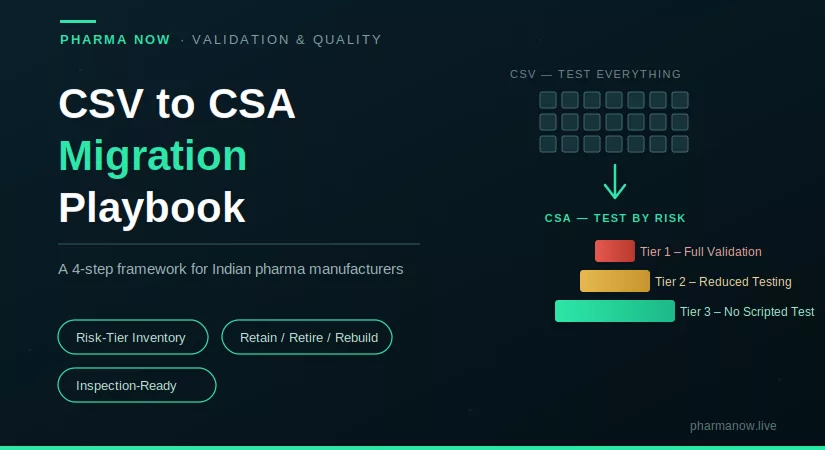
The Transition Every Indian Pharma Manufacturer Now Faces
Every Indian pharma manufacturer with a Computer System Validation (CSV) program built over the last decade is now facing the same uncomfortable question: what happens to that documentation when the FDA's Computer Software Assurance (CSA) guidance is fully in force?
The honest answer is that most of it does not need to be discarded. But almost all of it needs to be re-evaluated — systematically, deliberately, and with a clear understanding of what CSA actually demands versus what CSV required.
This is not a theoretical overview. It is a working playbook for the transition — one that Indian pharma manufacturers can use to move from a documentation-first validation culture to a risk-intelligence-first assurance culture, without losing the validated state that regulators expect.
The stakes are real. India supplies over 20% of the world's generic medicines and exports to more than 200 countries. The FDA's CSA framework, introduced through its 2022 guidance document, is not optional for manufacturers targeting the US market. And yet, across Gujarat, Hyderabad, Pune, and every other major Indian pharma hub, the majority of manufacturing plants are still running CSV programs designed for a regulatory world that is already changing underneath them.
CSV vs CSA: The Core Difference, Stated Plainly
Understanding the migration starts with understanding what actually changed — and what did not.
CSV asks: did we test everything and document it exhaustively? CSA asks: where is the actual risk to patient safety, product quality, and data integrity, and does our testing depth match that risk?
CSA is not less rigorous than CSV. It is differently allocated rigour. High-risk functions — those that directly influence batch release decisions, product quality, or patient safety — still receive the full treatment. What changes is that low-risk functions stop consuming disproportionate QA time, documentation effort, and validation resource that adds no meaningful protection to the patient or the product.
This distinction sounds simple on paper. In practice, it requires a fundamental shift in how QA and validation teams think about their work — from proving compliance through volume of documentation to demonstrating risk control through quality of judgement.
Under CSV, the question a validation engineer asked was: have I tested every function and documented every result? Under CSA, the question becomes: have I correctly identified the risk, matched my testing to that risk, and documented why that judgement is defensible?
That is a different skill set, a different mindset, and for many Indian pharma QA teams, a genuinely challenging cultural transition.
CSA is not less rigorous than CSV. It is differently allocated rigour.
If the terms CSV and CSA still feel interchangeable, that's the gap to close first.
→ Read: Computer System Validation (CSV) vs Computer Software Assurance (CSA)
Why Indian Pharma Cannot Afford to Wait
Gujarat alone manufactures roughly 33% of India's pharmaceutical output. Most of those plants are still paper-based or are running validation programs built on CSV assumptions from the 2000s and 2010s.
The FDA's 2022 CSA guidance is already influencing inspection expectations. 483 observations referencing over-validation of low-risk systems and under-documentation of risk rationale are beginning to appear. The question is no longer whether Indian pharma needs to make this transition — it is whether it makes the transition proactively, on its own terms, or reactively, under inspection pressure.
Companies that get ahead of this transition spend less time on low-value validation paperwork and more time on testing that genuinely protects patients. Companies that wait will make the same transition eventually — but from a far worse starting position.
Step 1: Inventory and Risk-Tier Your Existing Systems
Before retiring or rebuilding anything, build a single inventory of every validated system in your facility. This includes Manufacturing Execution Systems (MES), Laboratory Information Management Systems (LIMS), ERP modules, Building Management Systems (BMS), lab instrument software, and any other computerised system currently operating under a CSV validation lifecycle.
Once the inventory is complete, assign each system a risk tier based on its proximity to batch release decisions and patient safety — not based on how complex it is to operate, how expensive it was to implement, or how long ago it was validated.
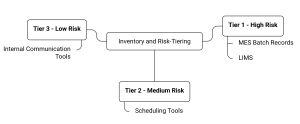
A simple three-tier framework works well in practice:
Tier 1 — High Risk: Systems that directly influence batch release, product quality, or data integrity. MES batch record functionality, LIMS result management, and ERP lot traceability modules typically fall here. These retain the full rigour of documented validation under CSA.
Tier 2 — Medium Risk: Systems that support but do not directly control regulated processes. Scheduling tools, reporting dashboards, and training management platforms often sit here. Testing depth is reduced but risk justification is documented.
Tier 3 — Low Risk: Systems with no direct patient safety or product quality impact. Internal communication tools, IT infrastructure monitoring systems, and non-GxP-facing modules fall here. Scripted IQ/OQ/PQ testing is not required and should not be performed — it adds cost without adding protection.
The risk tiering exercise is the most important step in the entire CSV to CSA migration. Everything downstream — what you retain, what you retire, what you rebuild — flows from getting this right.
Step 2: Decide What to Retain, Retire, and Rebuild
With a risk-tiered system inventory in hand, the migration decision for each validated system becomes structured rather than subjective.
Retain documentation that demonstrates genuine risk control for high-tier systems. If your existing CSV documentation for a Tier 1 MES includes robust risk assessments, meaningful test cases linked to patient safety functions, and clear change control records, most of that documentation retains its value under CSA. Do not retire it simply because it was written under a CSV framework — assess whether it does the job CSA requires.
Retire scripted test cases for low-risk, low-impact functionality that exist purely because the old CSV process demanded them. Hundreds of IQ/OQ/PQ test scripts for Tier 3 systems represent cost without benefit. Retiring them — with documented justification — is not a compliance shortcut; it is the correct CSA-aligned decision.
Rebuild Validation Master Plans and SOPs that still use CSV language, assumptions, and templates. These need to be rewritten around risk classification principles, not replaced wholesale. The goal is not a new document stack — it is a revised document framework that can defend risk-based decisions under inspection.
Step 3: Train QA and Validation Teams on the Mindset Shift
This step is consistently underestimated — and consistently where CSV to CSA migrations stall or fail.
QA teams who have spent a decade proving compliance through exhaustive documentation need structured, practical training on how to make and defend a risk-based call. A policy memo or a one-page guidance document is not sufficient. Teams need to work through real scenarios — actual systems in their own facility — and practice making and documenting the risk classification decision.
Without this training investment, two predictable failure modes emerge. First, teams default back to over-documenting everything "just to be safe," which defeats the purpose of CSA and perpetuates the resource drain of CSV without its regulatory familiarity. Second, teams under-document high-risk systems in an attempt to align with CSA's lighter touch on low-risk functions, creating genuine compliance gaps on the systems that matter most.
The mindset shift required is from documentation volume as proof of compliance to risk rationale as proof of compliance. That shift requires deliberate training, management reinforcement, and time.
Step 4: Prepare to Defend the Approach in an Inspection
The regulatory reality in 2026 is that inspection teams are not uniformly trained on CSA. Some investigators will arrive with CSV-era expectations and CSV-era questions. Your documentation needs to make the risk-based case clearly, confidently, and without ambiguity.
This means every risk classification decision must be traceable to a documented risk assessment — not simply asserted as "CSA allows this." When an investigator asks why a particular system has no scripted OQ testing, the answer must be: "because this is a Tier 3 system with no direct patient safety or product quality impact, as documented in our risk assessment dated [date], reviewed and approved by [QA Head]."
Prepare a CSA transition summary document — a single reference that maps every system, its risk tier, the migration decision made, and the rationale. This document is what an investigator needs to see to understand and accept your CSA-aligned approach. Do not wait for the inspection to explain your logic. Document it in advance.
Auditors are not uniformly trained on CSA. Some will still ask CSV-era questions.
Knowing exactly what FDA's final guidance says — and what changed from the 2022 draft — is what makes your answer defensible.
→ Read: FDA Computer Software Assurance | Pharma Leader's Guide
Common Mistakes Indian Pharma Makes During the CSV to CSA Transition
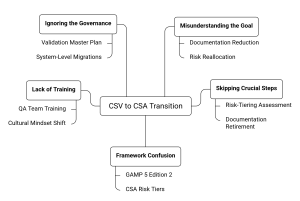
Several recurring errors are already visible across Indian pharma manufacturers attempting this migration:
Treating CSA as a documentation reduction exercise rather than a risk reallocation exercise. The goal is not fewer documents — it is the right documents for the right systems.
Skipping the risk tiering step and jumping directly to retiring documentation. Without a defensible risk tier for every system, retired documentation cannot be justified under inspection.
Confusing GAMP 5 Edition 2 software categories with CSA risk tiers. These frameworks are complementary but not identical. Both need to be understood and applied correctly.
Underinvesting in QA team training. The technical framework of CSA is simpler than CSV. The cultural change required to implement it consistently is significantly harder.
Failing to update the Validation Master Plan before beginning system-level migration. The VMP sets the governance framework for the entire validated state. It must reflect CSA principles before individual system decisions are made.
Where Indian Pharma Is Actually Working Through This
The CSV to CSA transition, alongside GAMP 5 Edition 2 adoption and the broader move to paperless batch records, is the central agenda at the Pharma Manufacturing IT Summit (PMITS) — taking place on 7 July 2026 at Le Méridien, Ahmedabad.
PMITS is an invitation-only, 130-seat, end-user-majority event built specifically for India's senior pharma manufacturing IT, CSV, and plant IT decision-makers. The agenda includes a dedicated session on the CSV to CSA Migration Playbook, a panel discussion on passing USFDA 483 observations in the CSA era, and a closed leadership roundtable on the 5-year manufacturing IT investment map.
Confirmed speakers include Vikram Shukla (President, Zydus), Pramod Gokhale (Sr. President & Global CIO, Mankind Pharma), Dr. Bijender Mishra (Global IT Head & CISO, Alkem Laboratories), and Shyam Khante (former Director, GSK) — practitioners running the systems they speak about, not vendors presenting product case studies.
Conclusion
The CSV to CSA transition is not optional for Indian pharma manufacturers targeting regulated markets. It is already underway — in FDA inspection expectations, in GAMP 5 Edition 2 guidance, and in the strategic decisions being made by the most forward-looking Indian pharma manufacturing IT leaders.
The four-step playbook outlined here — inventory and risk-tier, retain/retire/rebuild, train the team, and prepare the inspection defence — provides a structured path through a transition that can feel overwhelming when approached without a framework.
Indian pharma's strength has always been its ability to meet global regulatory standards at scale. The CSV to CSA migration is the next standard to meet. The companies that write this playbook now, rather than waiting for the inspection that forces them to, will be better positioned, better resourced, and better protected when that moment arrives.
FAQs
1. What is the difference between CSV and CSA in pharmaceutical manufacturing?
CSV (Computer System Validation) requires exhaustive testing and documentation of all computer system functions. CSA (Computer Software Assurance) takes a risk-based approach, focusing testing and documentation effort on functions that directly impact patient safety, product quality, and data integrity. CSA is not less rigorous — it allocates rigour more intelligently based on actual risk.
2. Is CSA mandatory for Indian pharma manufacturers?
CSA is required for Indian manufacturers exporting to the United States under FDA jurisdiction. The FDA's 2022 CSA guidance has progressively influenced inspection expectations. Manufacturers targeting the US market cannot treat CSA as optional.
3. Do we need to discard all our existing CSV documentation when migrating to CSA?
No. Most existing CSV documentation does not need to be discarded. High-risk system documentation that demonstrates genuine risk control retains its value. What needs to be retired is scripted testing for low-risk functions that adds no patient safety or product quality protection. What needs to be rebuilt is the governance framework — Validation Master Plans and SOPs — to reflect CSA principles.
4. How long does a CSV to CSA migration typically take for an Indian pharma site?
Timeline varies significantly based on the size and complexity of the validated system landscape. A mid-sized Indian pharma site with 50 to 100 validated systems should expect 12 to 24 months for a thorough migration — including system inventory, risk tiering, documentation revision, team training, and inspection readiness preparation.
5. What is GAMP 5 Edition 2 and how does it relate to CSA?
GAMP 5 Edition 2, published by ISPE, is the industry guidance framework for pharmaceutical computer system validation and assurance. It aligns closely with FDA's CSA principles, emphasizing risk-based approaches, software categories, and critical thinking over prescriptive testing requirements. Both frameworks should be understood and applied together during the migration.
Reporting on the science, business and regulation shaping the pharmaceutical industry.
More in Pharma Manufacturing
All articles →
Compliance In Pharma Manufacturing 2025: Key Regulations And Best Practices You Need to Know

Improving Pharmaceutical Manufacturing Flexibility: Agile Manufacturing and Rapid Scale-Up

Discussion